The new book “Enriching America: A World History of 20th Century Immigrant Families,” written by Diablo Valley College history professor Dr. John Corbally, tells the stories of 60 immigrant families of DVC students covering a 60-year period in American and world history.
Ranging in time from the Great Depression and World War II through the Korean and Vietnam wars, the Civil Rights Movement, and all the way up to America’s recent fights over immigration, the book — compiled from 250 student interviews with their own family members — presents a legacy of regional, intergenerational struggle in a new way.
“One safe generalization is that those who have to move to a new country nearly always have a harder time getting by [than] the people already there,” Corbally said in a recent interview with The Inquirer. “This is at the heart of the issue of migration.”
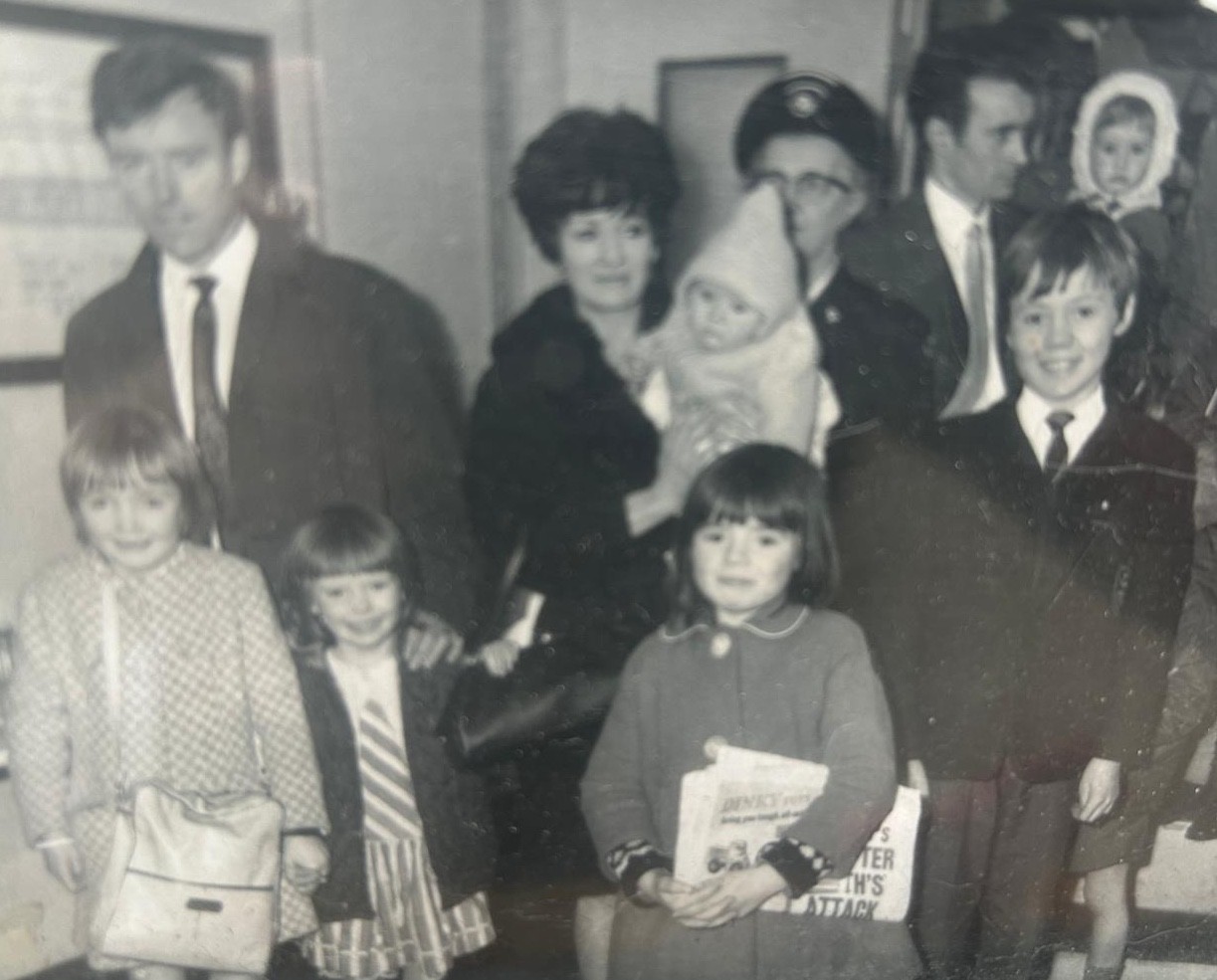
Corbally’s own life story involved a search for nationalization on three continents, which started when he was a baby in Sydney, Australia, where his Irish parents moved the family from England to find work. He later returned to Sydney as an undocumented teenager, but was never able to gain Australian citizenship.
From there, Corbally moved to the United States alone at age 18 with one dream: to gain the documents that would guarantee him legal status in the country. He lived in hiding here for eight years, he said, feeling “always on the run.”
“I worked on construction sites, paid cash in hand and had to avoid hospitals and government offices out of fear,” he recalled. “There was a time when I had an accident at work, I got a nail through the top of my head, and could not go to the hospital because of fear of deportation.”
Corbally finally obtained U.S. citizenship at 26, which allowed him to move forward building a life in America. “I took a class at City College of San Francisco without papers,” he said, and “that is how I met my first wife, when we did a shared assignment.”
He earned his Ph.D in history from UC Davis, and taught history at Stanford and UC Berkeley before being hired at DVC in 2014.
His first book, “The Twentieth-Century World, 1914 to the Present,” came out in 2018, with a second edition in early 2025. His next book, “The Early Modern World, 1450-1750,” appeared with Bloomsbury in 2022.
For his new book, “Enriching America,” produced during his sabbatical and published in August with Cognella, Corbally addressed the subject of migration to the U.S. in its many forms.
“I wanted to shape a 20th-century history through the lives of DVC immigrant families,” Corbally said. He encountered “students from all over the world, providing real diversity. Like history and life, migration is not black and white.”
In the introduction, he writes, “This is a book about 60 diverse families who either moved to the United States in the last century or were born in the US in poverty. The family stories derive from the period after World War One through to the 1970s.”
For Corbally, the process was about teaching students how to do proper historical research. Any historian knows that “the historical archives don’t give you what you want,” Corbally said.
“I always tell my students, when I did my Ph.D on migration to Britain, I was looking at Irish immigrants, Indian, Pakistani, and Afro-Caribbean, to find a supportable and honest thesis. Five thousand documents from 50 archives do not tell a simple story.”
In the stories, students share how their immigrant families brought flavor, creativity and hard work to building their piece of America. For example, in the first chapter, Reid Stein talked about his grandmother, who “was born in the 1920s in Oklahoma as the daughter of a Native American woman.”
Stein’s grandmother became a single mom due to divorce, and owned a farm where she worked hard to support herself and her family. “They didn’t have much money, so early life was fairly hard, especially through the Great Depression,” Stein wrote in the book.
“She remembers not being allowed to go into many stores, restaurants, or social places because her skin color was a little darker than that of most other people in her area.”
Another student, Holland Seropian, shared a family story about his grandfather, George Seropian, who was born in 1928 in Fresno, Calif.
“His family had previously escaped to America following the Armenian genocide during the reign of what was the Ottoman Empire,” Corbally wrote about Seropian, who was ultimately “able to create a better life not only for himself but would lay the foundations for a better life for his family after him as well.”
According to Corbally, the variety of lived experiences comes across on the pages.
“The first chapter, the 1920s, is the least diverse, but there are diverse stories, too — a Palestinian family, a Punjabi, Iranian, and Armenian, though the rest are all poor whites,” he said. “Every other chapter is about diverse people from all around the world.”
Racism, prejudice and politics repeatedly come into play in the family narratives.
“What I learned is that immigrants are often conservative and generally love America,” added Corbally.
“While conservatives perhaps overly admire America, and progressives perhaps overly condemn it, immigrants are just grateful to be in such a free country — one where such arguments can be so freely had.”