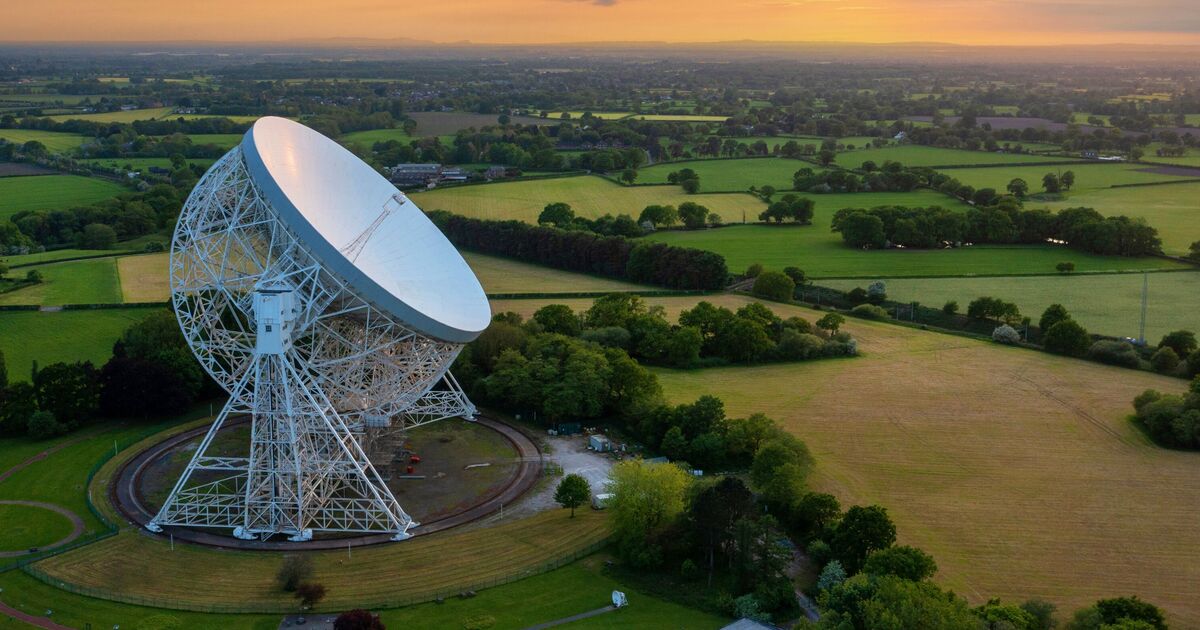
The secret Cold War role played by a giant radio telescope in the middle of the sleepy Cheshire countryside has finally been revealed, as it helped foil the USSR. Set among the rolling hills of Cheshire in the village of Lower Withington, near Goostrey and Holmes Chapel, Jodrell Bank was first used by academics when the University of Manchester‘s botany department bought three fields there.
In 1945 Sir Bernard Lovell used left over WWII radar to probe cosmic rays before the Lovell Telescope was built in 1957 – then the largest steerable dish radio telescope in the world. The telescope’s soaring costs left Sir Bernard facing the sack until the first unmanned satellite Sputnik was launched by the USSR in 1957 and he realised he could track its launch.
From then on historians have revealed Sir Bernard and two other staff, sworn to secrecy, helped GCHQ staff on site, nicknamed the “secret squirrels” monitored Soviet missiles as nuclear tensions between the USSR and Nato powers escalated in the 1960s.
David Abrutat, the official historian for Government Communications Headquarters (GCHQ) – which provides top-secret intelligence to ministers and the armed forces – explained to BBC radio’s Archive On 4 programme.
Mr Abrutat said British and American intelligence bosses were desperate to discover more about the Soviet missile programmes – as nuclear missile rockets were being used to launch satellites like Sputnik into orbit.
He said: “A lot of these early space probes that were launched, the early satellites that were launched by the Soviet Union, relied on intercontinental ballistic missiles.
“You could get an understanding of telemetry (the process of recording and transmitting instruments’ readings) – the power, the capability of the missile systems being used – by monitoring a space launch.
“There was intelligence dividends from us being involved in this space programme and the work of Jodrell Bank.”
He said it gave the UK “a capability” which is did not previously have.
Sir Bernard recalled years later: “I was in the laboratory where the receiving apparatus was and suddenly, before midnight, I saw the most dramatic echo.
“A huge echo – the echo of the intercontinental missile travelling over the lake to a distributed speed of 17,000 miles an hour.”
He added: “And we developed this photograph, and I projected it to a packed media, cameramen, the newspapermen, in the small lecture room.
“This wonderful echo, the only instrument in the Western world which could detect the launching of the Sputnik. And the press recognised immediately that this was the intercontinental missile.”
It led to a hidden role for the University of Manchester’s radio telescope.
British and US intelligence chiefs soon realised its potential for monitoring the Soviets’ inter-continental ballistic missile tests.
These rockets were designed to carry nuclear warheads many times more powerful than the atomic bombs which devastated Hiroshima and Nagasaki at the end of World War Two.
Staff would soon notice GCHQ’s “secret squirrels” from Cheltenham visiting two labs above the foyer of the control building. Sir Bernard and his two members of staff were sworn to secrecy.
The Jodrell Bank monitoring also discovered failed Soviet attempts to land a robotic space probe on the moon to scoop up a sample of lunar soil and bring it back to Earth.
Jodrell Bank’s team heard the telltale signals as the probe crashed into the surface of the moon.
Bizarrely, when the signal stopped the head of the Soviet Academy of Sciences rang Sir Bernard to ask him if he had been listening to the spacecraft’s signals.
The Soviets asked for a copy of the recording and told him they already had a “man in the air” on the way to Manchester Airport.
In scenes that perhaps could have come straight out of a James Bond movie, an engineer carried a copy of one of the tapes in an envelope and drove up to the airport.
Once there, he handed the envelope to a Soviet official who flew straight back to Moscow.