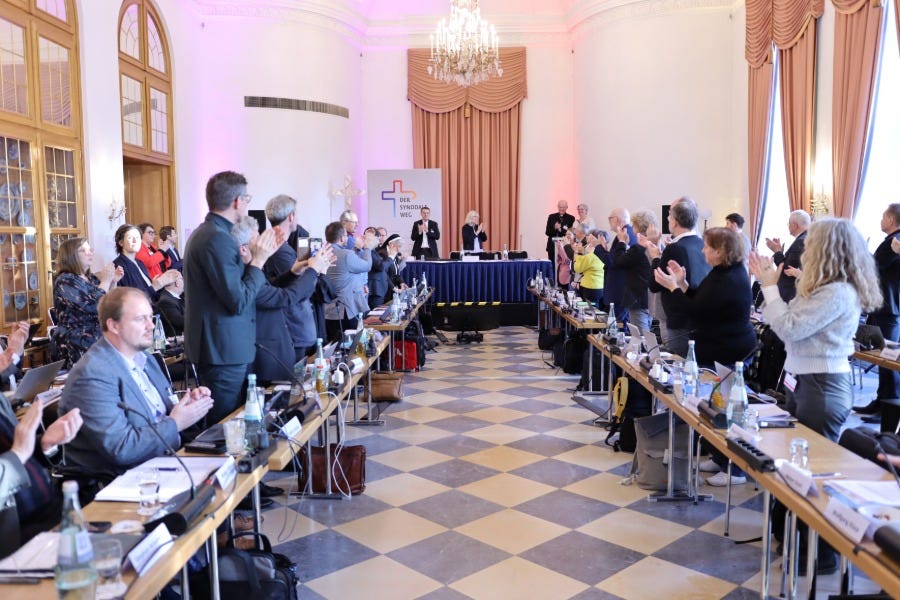
Members of Germany’s interim synodal committee finalized the statutes of a new national synodal body Saturday, in the first major step toward creating the permanent structure envisaged by the country’s synodal way.
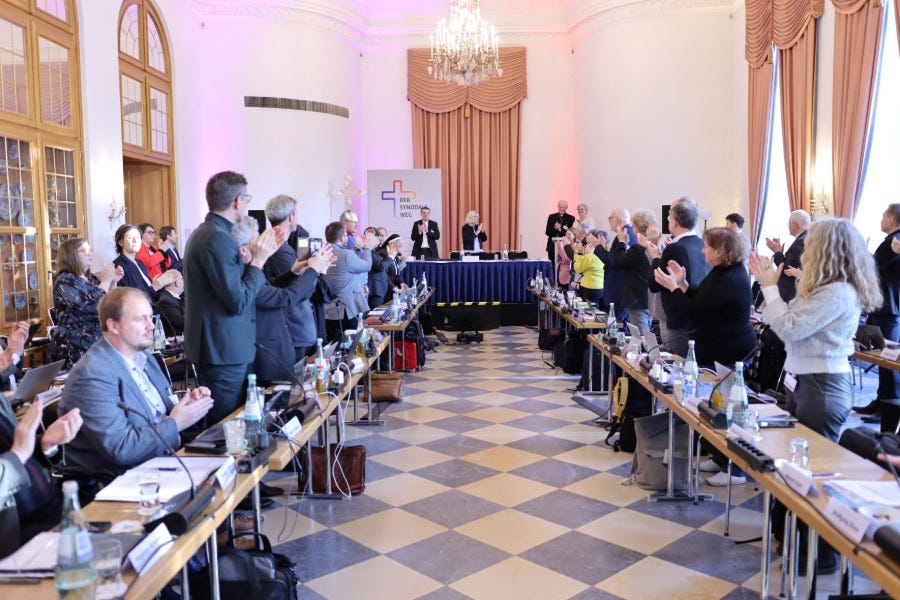
Synodal committee members voted unanimously Nov. 22 to approve the statutes, which seek to establish a body known as the “synodal conference,” in which bishops and lay people “deliberate and make decisions together to fulfill the Church’s mission.”
The statutes, agreed at a two-day meeting in Fulda and consisting of 12 articles, seek to allay Vatican concerns that the new body would undermine the authority of the country’s bishops’ conference and diocesan bishops.
The finalized text said the synodal conference “respects the constitutional order of the Church and preserves the rights of diocesan bishops and the German bishops’ conference, as well as diocesan procedures and bodies.”
The new body would consist of all 27 diocesan bishops and 27 representatives of the lay Central Committee of German Catholics, known by its German initials, ZdK. A further 27 members are due to be elected at a final synodal way assembly in Stuttgart on Jan. 29-31, 2026. All members would have equal voting rights, according to the statutes.
But it is uncertain whether all diocesan bishops would join the new body as four bishops previously boycotted the interim synodal committee, arguing it was at odds with the global synodal path established by Pope Francis.
Now they have been finalized by the synodal committee, the statutes must be endorsed at plenary assemblies of the German bishops’ conference and the ZdK. They would then be submitted to the Vatican for recognitio ad experimentum, or provisional approval for trial implementation.
The synodal conference’s inaugural meeting is scheduled for Nov. 6-7, 2026, in Stuttgart, eight months later than originally planned.
The proposal to create a new national synodal body emerged during the synodal way, a 2019-2023 initiative that brought together German bishops and select lay people to discuss far-reaching changes to Catholic teaching and practice.
A synodal way resolution passed in September 2022 called for the establishment of a permanent “advisory and decision-making body” composed of bishops and lay people. It said the new organ would “take fundamental decisions of supradiocesan significance on pastoral planning, future perspectives of the Church, and financial and budgetary matters of the Church that are not decided at diocesan level.”
But in January 2023, the Vatican told German bishops that neither they nor synodal way participants had the authority to establish the body.
The Vatican argued that it would represent “a new governance structure of the Church in Germany which … would place itself above the authority of the German bishops’ conference and would in fact appear to replace it,” undermining episcopal authority as outlined in the documents of Vatican Council II.
When the synodal way ended in March 2023, the new interim institution known as the synodal committee was established with the task of setting up the permanent new body “by March 2026 at the latest,” despite the Vatican veto.
German bishops flew to Rome in March 2024 for discussions with senior Vatican officials, building on talks over the synodal way that began during their 2022 ad limina visit.
At a follow-up meeting in June 2024, the German bishops and the Vatican issued a joint statement, saying that a commission created by the synodal committee would “deal with questions of synodality and the structure of a synod body.”
The statement said the commission would work “in close contact with a corresponding commission composed of representatives from the relevant dicasteries” to draw up draft statutes. It added that the new national body should be “neither above nor at the same level as the bishops’ conference.”
According to German Catholic media, the statutes presented to synodal committee members at the meeting in Fulda contained wording proposed by Archbishop Filippo Iannone, the former prefect of the Vatican’s Dicastery for Legislative Texts who now serves as the prefect of the Dicastery of Bishops.
The archbishop’s submissions — which reportedly consisted of clarifications of canon law and references to Vatican documents, including the synod on synodality’s final document — were highlighted in a different color to the main text.
German media said that one point of contention at the Fulda meeting came when participants discussed an amendment submitted in August by the German bishops’ conference’s permanent council. The permanent council objected to the draft statutes’ definition of the synodal conference as a body that “deliberates and decides” on important Church matters that transcend diocesan boundaries.
Following discussions, this was amended to “deliberates and decides in accordance with ‘synodal decision-making processes’ on important issues of Church life of supra-diocesan significance.” The phrase “synodal decision-making processes” is drawn from the synod on synodality’s final document.
Another point of dispute was the statute’s description of the new permanent body’s relationship to the Association of the Dioceses of Germany, a legal entity of the bishops’ conference. The association, known by its German initials VDD, is the central financial and administrative coordinating body of the country’s 27 dioceses.
A synodal committee member proposed that the statutes say that the synodal conference’s finance committee would assume the responsibilities of the VDD’s association council in budgetary matters.
The association council, a body with both advisory and decision-making powers, consists of 18 voting members, including seven diocesan bishops, six vicars general, three diocesan finance directors, and two people nominated by the ZdK.
Bishop Franz Jung of Würzburg and Archbishop Udo Markus Bentz of Paderborn reportedly spoke out against the proposal, while welcoming the general principle of increased lay input in financial decisions.
A declaration approved by synodal committee members said the body “would like to see the basic principle of synodality implemented here too through a reform of the structures and procedures of the VDD.”
“The synodal committee therefore recommends that the synodal conference promptly submit criteria for a changed structure to the German bishops’ conference,” it said.
Commenting on the statutes’ adoption, German bishops’ conference chairman Bishop Georg Bätzing said: “This is a great moment, and also a historic one. Getting to this point has required a lot of work in advance, including discussions with Rome.”
“I feel a great weight has been lifted from my shoulders, and the unanimous approval of the statutes also shows how much we have come together through our work in the synodal committee.”
Bätzing appealed to bishops who shunned the interim synodal committee to join the synodal conference.
“It is my wish that, in the end, everyone will want to and be able to participate,” he said. “To be honest, we have learned from the experiences of the synodal way, where there were also hurt feelings and the critical question of whether minorities were taken seriously.”
“The current experiences in the committee have led to a different kind of cooperation and made it possible to clarify issues together.”
ZdK president Irme Stetter-Karp insisted the synodal conference would not be a “paper tiger.”
She said: “Bishops and lay people unanimously adopted the statutes for the synodal conference. With the formula that has always been important to us as lay people: that we deliberate and decide together.”
But other German Catholics argued the synodal conference’s statutes could provoke future conflicts within the Church in Germany.
In a Nov. 23 op-ed for the Catholic daily newspaper Die Tagespost, Regina Einig suggested that lay people involved in diocesan church tax and finance councils would resent interventions from the national synodal conference.
“Why should diocesan church tax councils relinquish powers to people who are less familiar with the local situation than they are?” she asked.
In a Nov. 24 analysis for the website of the German edition of the journal Communio, Benjamin Leven wrote: “Despite their formal character, the statutes are clearly designed as an intermediate step. The text sets out guidelines, but deliberately leaves room for further increases in the power of lay representatives.”
“Numerous points are to be regulated in rules of procedure, which the German stakeholders will probably not present in Rome. Roman authorities should keep this in mind when reviewing the German rules, which contain terms that are difficult to translate into Italian — such as the beautiful expression ‘entscheidungserheblich’ [relevant to the decision].”
Pope Leo XIV has held a series of private audiences with German bishops in recent months, including with Bishop Stefan Oster of Passau Sept. 8, Bishop Bertram Meier of Augsburg Nov. 12, Bishop Heiner Wilmer of Hildesheim Nov. 13, and Bishop Stephan Ackermann of Trier Nov. 24.
On Nov. 22, the day the synodal committee adopted the statutes, Leo XIV met with Katharina Westerhorstmann, a lay German theologian. Westerhorstmann resigned from the synodal way’s forum on sexual morality in 2022, arguing that the forum’s deliberations followed a “predetermined direction.”