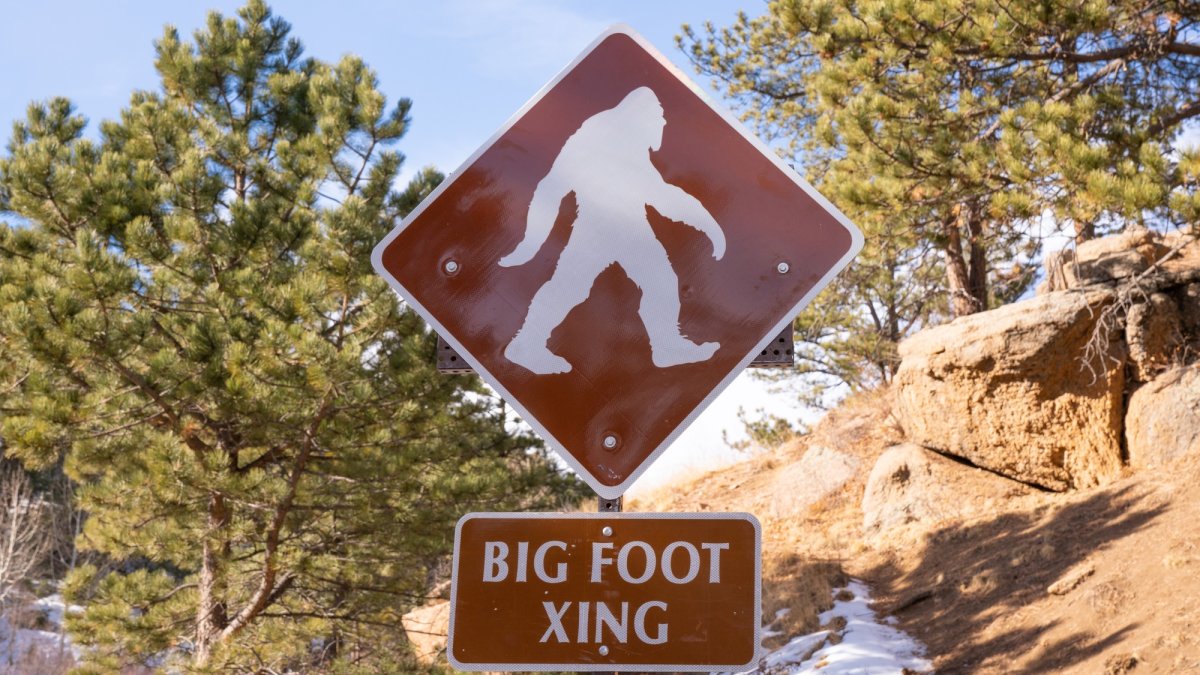
Bigfoot remains firmly in the realm of cryptozoology, along with the likes of the Loch Ness monster. However, its pursuers often are not the stereotypical crackpots depicted across pop culture. According to two social scientists, they frequently rely on widely accepted, reliable methods and tools to search for the elusive Sasquatch.
“They spend weekends, weeks, and even months in the field. This work is skillful behavior, as they need to detect, collect and analyze the merest traces, remnants and residues of the presence of an unknown-to-science animal,” Cardiff University researcher Jamie Lewis said in a recent profile.
Along with Sheffield University social scientist Andrew Bartlett, Lewis has spent more than three years conducting interviews with over 150 individuals for their recent book, Bigfooters and Scientific Inquiry: on the borderlands of legitimate science. Subjects included the aforementioned hunters (often referred to as Bigfooters), television personalities, skeptics, and even the late primatologist, Jane Goodall. Lewis and Bartlett now contend that while a small subsect of cryptozoologists subscribe to far-fetched extraterrestrial, interdimensional or supernatural Bigfoot theories, the vast majority simply theorize a still-undiscovered great ape may still roam regions such as the Pacific Northwest.
“Skeptics might believe that Bigfooters are rejecting science by chasing an animal whose existence has never been proved. But what my interviews showed were the ways in which Bigfooters draw on their idea of scientific practices to piece together fragments of what they believe is tangible evidence,” said Lewis.
Bartlett jokingly explained that the duo adopted an approach they call “methodological credulity.” Essentially, they believe that simply dismissing outside researchers does not do the academic scientific community any favors.Heaping scorn or derision on these well-intentioned individuals actually becomes actively harmful.
“In taking the time and care to understand their knowledge world and their rationality, we can see just how much their activities are not ‘anti-science’ but an attempt to be scientific as they see it,” said Bartlett, who added that today’s pervasive misinformation and science skepticism speaks to the issue.
“Some of the problems that we face in this moment– in which all kinds of knowledge claims are contested in public, by the public–is that the asocial, individualized stories that we tell about science downplay the role of communities of expertise, of the value of consensus and continuity,” he said.
Most of today’s Bigfooters aren’t pointing to every large, misshapen footprint in the woods as proof of the cryptid’s existence. Instead, they frequently employ objectively commonly used technologies, including thermal imaging, drones, and even parabolic dishes to collect audio data. Lewis and Bartlett explained that it’s not about believing these Bigfooters’ claims. Instead, it’s about recognizing when real scientific standards are still being applied outside traditional, knowledge-generating institutions. Viewed through this social scientific lens, Bigfoot’s existence is undisputable-–in a manner of speaking.
“Bigfoot exists,” said Lewis. “Not necessarily as a biological creature, but certainly as an object around which thousands of Americans organize their lives, collecting and analyzing evidence, and making knowledge.”

2025 Holiday Gift Guide