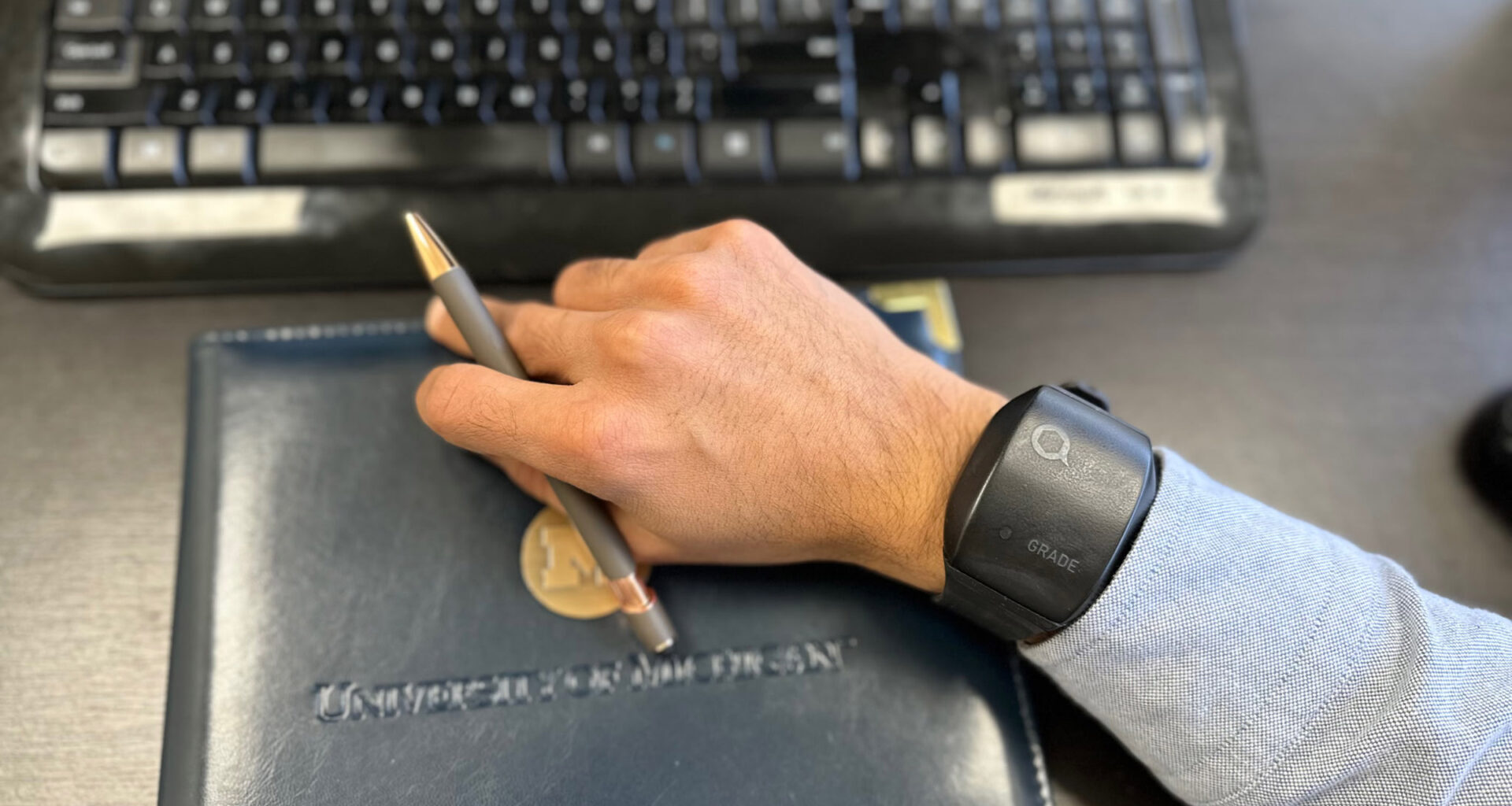
Arborsense, an Ann Arbor-based health technology startup, has developed wrist-worn wearable devices that detect chemicals in human sweat in order to assist in 24/7 alcohol monitoring for individuals in court-mandated and treatment settings. The device, Arborsense GRADE®, uses the wearer’s perspiration to measure alcohol levels every five minutes. The results are then analyzed multiple times a day and sent to supervising agencies.
Arborsense was founded by University of Michigan alum Girish Kulkarni. In an interview with The Michigan Daily, Kulkarni said the startup emerged from his electrical engineering doctorate research at the University. His work focused on the functional analysis of graphene, an integral compound to the function of the nanomaterial sensors used in the watch-like device.
“It’s just a single atom thick carbon sheet, so just because of its structure, it has these properties where it becomes very sensitive to the change in environment, which means that it can pick up chemicals,” Kulkarni said. “It’s a novel nanomaterial.”
Kulkarni said he began to explore potential uses for the technology after discovering that the sensor could detect a range of chemical compounds.
“Substance use is one of the biggest public health crises,” Kulkarni said. “We thought, ‘We have these sensors — why not make devices that can help detect these compounds and help people monitor their own use?’”
Arborsense’s technology focuses on the detection of transdermal compounds, which are chemicals detected through sweat on the body.
“Even if you can’t see it, your body is releasing small amounts of sweat,” Kulkarni said. “If the sensors are sensitive enough, they can pick up chemicals through that sweat, and we can relate it to what’s happening inside your body.”
Kulkarni said the external chemical sensors Arborsense uses allow for less invasive and more accessible testing.
“If you have to test for any substance now, you either do blood, urine or saliva,” he said. “Those are invasive, they’re expensive and they only give a single point in time. With our technology, you can monitor continuously and noninvasively.”
In an interview with The Daily, Emily Smith, a social worker on Michigan Medicine’s inpatient addiction consult team, said continuous monitoring can provide clarity for patients trying to change their substance use.
“It can be helpful to have that visual,” Smith said. “ (It’s) a tool to manage looking at ‘How am I doing? Are my numbers changing? Has my effort to cut back or cut completely off been successful?’”
LSA freshman Victor Monnier told The Daily he thinks Arborsense’s technology can serve as an incentive for maintaining a healthy lifestyle.
“I think it can help increase accountability, especially if others have access,” Monnier said. “More importantly, it can be motivating, as it will prove to people that they really are making progress.”
Jennifer Rankin, a peer recovery coach with lived experience in recovery, said some may gain motivation from seeing real-time patterns throughout their recovery process.
“Someone might find it very helpful to track how much alcohol or substances they’re consuming over time,” Rankin said. “A lot of us unfortunately go through the justice system when we’re in active addiction for various reasons, and it could be a safety net.”
U-M alum Vaishnavi Potluri, who leads the development of the company’s sweat-based drug detection device, told The Daily that staying aware of customers’ needs was important during the design process.
“We talked to more than 100 people,” Potluri said. “You can do as much research and development as you want, but if the users are not going to use it, there’s no use of the product.”
Potluri said listening to user input provided valuable insights during certain stages in the device’s development.
“We thought saliva testing was accurate,” Potluri said. “But users told us it’s not. People who use more drugs often don’t produce much saliva, so it can take hours just to collect a sample. That really opened our eyes.”
Potluri said a next step to improve the sensor’s accuracy is refining results with data analytics and artificial intelligence to minimize false positives, which could incorrectly alert agencies of the wearer’s drug use.
“When it comes to detecting drugs, a false positive can affect someone’s life,” she said. “If AI can help us remove even that 0.01% error, it’s worth it. It’s not just about being accurate — it’s about being safe.”
Kulkarni said the company’s measure of success is helping those struggling with substance abuse monitor their use in a more accessible way.
“Our success is if we can make a positive impact on the lives of people suffering from substance use disorders,” Kulkarni said. “If our devices make treatment more accountable, affordable and effective — that’s how we define success.”
Kulkarni said starting the company in Ann Arbor was a deliberate choice that allows him to maintain close proximity to his roots.
“I think the startup ecosystem here is growing,” Kulkarni said. “You don’t have to go to Silicon Valley to build something meaningful. You can do it right here.”
Daily Staff Contributor Antoinette Lowy can be reached at alowy@umich.edu.
Related articles