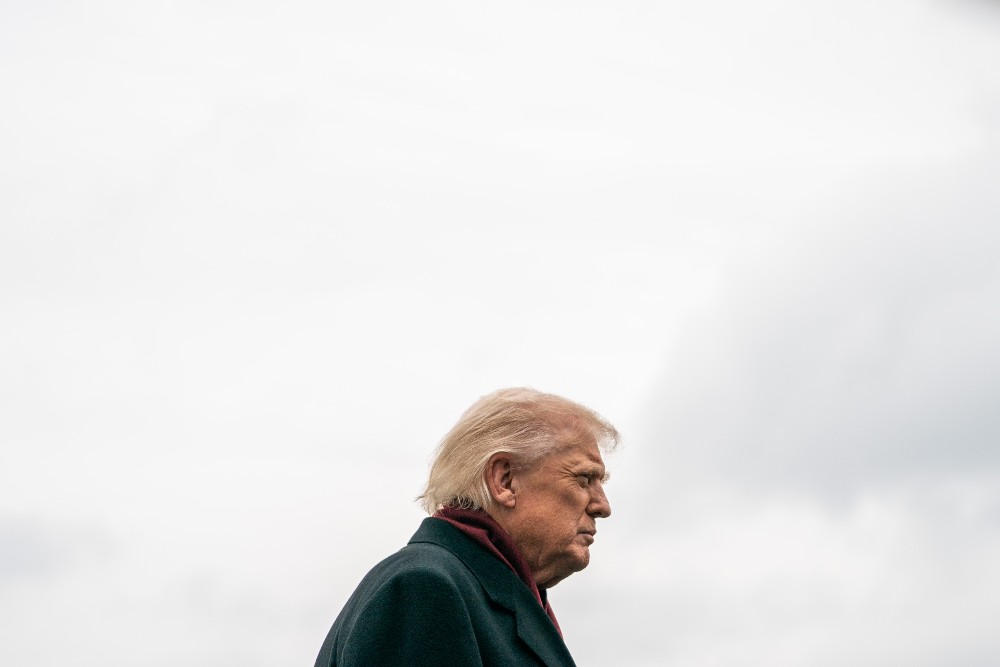
President Donald Trump is publicly pressing forward in defense of his global tariff scheme, which has been called into question increasingly as inflationary trends persist. But with a Supreme Court decision on the fate of the duties looming, the administration is also taking quieter steps that indicate a slight retreat or recalibration in trade strategy.
Notably, the president has neglected to make good on his threat to slap Canada with an additional 10 percent duty for running an anti-tariff ad featuring a voiceover of President Ronald Reagan in October. The president called the ad “fraudulent” (though genuine recordings of the Gipper were spliced together to make it) and terminated all negotiations with the country’s government as a result.
But the threat of action—which would have raised punitive duties on Canada to 45 percent from 35 percent—has all but died on the vine one month later.
That’s apparently fine with Canadian Prime Minister Mark Carney, who said trade negotiations with the United States would resume “when it’s appropriate.” Queried by reporters about his most recent communications with the American president, he said “Who cares—it’s a detail. I’ll speak to him again when it matters.”
Carney, who attended a G20 meeting in Johannesburg over the weekend, hinted that a discussion with Trump could happen in the next two weeks. According to Bloomberg, travel plans are being made for Carney to visit Washington, D.C. on Dec. 5 and take part in the draw for the 2026 World Cup, to be hosted by the U.S., Canada and Mexico—a could-be opportunity for a sideline meeting with Trump.
But in recent weeks, the Canadian leader has made it clear that the country’s export market can’t wait for the situationship with the U.S. to evolve into a breakup or a make-up.
Canada has been making inroads with other global trade partners in the interim, committing to deepening trade ties with Mexico in September following a meeting between the country’s president, Claudia Sheinbaum, and Carney. Meanwhile, over the weekend, Carney and Indian Prime Minister Narendra Modi announced their intention to kick off negotiations on a long-awaited trade deal.
And with the viability of the tariffs now literally on trial, their potency as a point of leverage with other global partners may be waning.
Trump on Monday confirmed that an in-person meeting with Chinese President Xi Jinping will take place in April. The two leaders, who met for the first time in six years at the end of October, reportedly made progress toward ending the simmering, years-long trade war that first fueled Trump’s wielding of tariffs as a cudgel to exert influence over foreign powers.
“There has been significant progress on both sides in keeping our agreements current and accurate. Now we can set our sights on the big picture,” Trump wrote on Truth Social after a phone call with Xi. “To that end, President Xi invited me to visit Beijing in April, which I accepted.”
The president’s recent efforts to repair relations with China and others indicate that he’s looking for an off ramp from the strategy that’s become the focal point of his second term, some experts have said. With the holidays fast approaching and heightened prices a top-tier concern for consumers, the administration is also campaigning to disabuse the public of the notion that tariffs are fueling inflation at retail.
“Interest rates are down, and now we are starting to see the affordability, the prices, get better,” Treasury Secretary Scott Bessent told Meet the Press on Sunday. When pressed on the fact that inflation has ballooned from 2 percent in April to 3 percent in September Bessent flatly denied the claim. “Inflation has not gone up,” he said.
Still, the nation’s chief financial officer insisted that prices will continue to come down over the coming weeks and months.
“Inflation is a composite number, and we look at everything. So we are trying… to push down the things we can control,” he said. The administration is focused on bringing down energy prices in the near term, “and everything flows from that,” Bessent added.
“I think we’re going to see these other prices come down. And again, many of these goods were part of trade deals with countries that have been in the works for months,” he said.
The president offered a window into his own thinking on the matter with a Truth Social post early Monday morning that attempted to justify the efficacy of the tariffs at raising revenue.
The “full benefit of the Tariffs has not yet been calculated in that many of the buyers of goods and products, in order to avoid paying the Tariffs in the short term, ‘STOCK UP’ by purchasing far more inventory than they can use,” he said, referring to the frontloading of merchandise by brands and retailers that was prevalent throughout the spring and summer.
“That heavy inventory purchase is now, however, wearing thin, and soon Tariffs will be paid on everything they apply to, without avoidance, and the amounts payable to the USA will SKYROCKET, over and above the already historic levels of dollars received,” he said.
In September, the Supreme Court acquiesced to the Trump administration’s request to expedite the timing of the hearing for the case against his International Emergency Economic Powers Act (IEEPA) tariffs, and the hearing, which took place last month, saw many justices sharply scrutinize the president’s authority to levy the duties.
In the meantime, Trump’s tariffs hang in the balance, with the president eagerly awaiting a final decision.
“I look so much forward to the United States Supreme Court’s decision on this urgent and time sensitive matter so that we can continue, in an uninterrupted manner to, MAKE AMERICA GREAT AGAIN!