post_date=”November 25, 2025 07:34″
pUrl=”https://www.fairobserver.com/region/central_south_asia/fo-talks-russia-and-chinas-hybrid-warfare-explained-what-are-nato-and-the-eus-options/” pid=”159297″
post-content=”
Fair Observer’s Video Producer Rohan Khattar Singh and Maurizio Geri, an EU Marie Curie global fellow and lieutenant reservist in the Italian Navy, discuss how Russia and China use hybrid warfare to pressure NATO and the European Union. Geri delivers a stark message: The West is already immersed in a permanent gray-zone struggle where politics, economics, technology and conflict merge into one continuum.
What is hybrid warfare?
Geri explains that hybrid warfare is ancient in logic — ancient Chinese philosopher Sun Tzu wrote about defeating an enemy without fighting — but unprecedented in reach because modern societies are hyper-connected, digitized and vulnerable at countless points. It is a low-intensity, sub-threshold conflict that can spike or ebb yet never stops. “The battlefield practically is everywhere… in society, in politics, in the economy,” Geri says.
He organizes state tools through the “Diamond Field” acronym, spelled “DIMEFIL:” Diplomacy, Information, Military, Economic, Finance, Intelligence and Lawfare. Diplomacy now includes intimidation and the use of diplomats for covert operations. Information warfare ranges from disinformation and bots to synthetic media and election interference. Military tools are mostly non-kinetic: GPS jamming, drone incursions, airspace violations and maritime sabotage. Economic and financial tools weaponize energy, sanctions, markets and strategic dependencies. Intelligence and lawfare cover espionage, influence networks, IP theft and legal gray areas exploited to pressure diaspora communities.
Russia and China vs NATO
Geri argues that Moscow and Beijing increasingly synchronize their efforts. They echo each other’s narratives, coordinate influence campaigns and run joint air patrols near Japan and South Korea. Iran and North Korea reinforce their cooperation with drones, cyber capabilities and manpower. Thus, they form an expanding axis of upheaval. This alignment is transactional rather than ideological but still effective, as it aims to fracture Western unity and overwhelm democratic decision-making.
Russia increasing hybrid attacks
The Ukraine war accelerates Russia’s hybrid strategy. Geri cites assessments showing attacks quadrupling from 2022 to 2023 and tripling again from 2023 to 2024. Russia targets transportation networks, government institutions, critical infrastructure and defense industries, often probing for weak spots rather than seeking decisive impact.
Energy remains Russia’s sharpest lever. Moscow manipulates gas flows, pressures economies in the European Union, sabotages pipelines and underwater cables and uses its “shadow fleet” to skirt sanctions. Cyber and physical disruptions, from railway failures to airport blockages, create political fragmentation rather than battlefield gain.
China’s hybrid tactics
China employs similar instruments but anchors its strategy in long-term economic leverage. Beijing is linked to undersea cable damage in the Baltic Sea while maintaining deniability. As Geri notes, hybrid warfare’s problem is the possibility of one side denying an attack, as it is difficult to detect and attribute responsibility to any given party.
China’s control of critical minerals, rare earths and clean-tech supply chains gives it extraordinary coercive power. Export threats instantly affect Western industries that depend on Chinese batteries, turbines, solar panels and semiconductors. Beijing also extends influence through Belt and Road Initiative projects, local partnerships, surveillance of diaspora communities and coordinated messaging that often complements Kremlin narratives.
NATO’s counter
Since 2016, NATO has treated hybrid attacks as potential Article 5 triggers. It now reinforces that with concrete actions. Baltic Sentry patrols underwater infrastructure, while Eastern Sentry strengthens air defenses and drone detection along the eastern flank. Allies pledge to move toward 5% of GDP on defense, with 1.5% dedicated to hybrid resilience and technology. NATO also expands intelligence-sharing, cybersecurity cooperation and joint defense production to reduce fragmentation among member states.
The EU adds its own toolkit: Defense Readiness 2030 to strengthen Europe’s defense capacity, new fiscal flexibility for defense budgets, RepowerEU to end Russian energy imports by 2027 and the Critical Raw Materials Act to reduce reliance on China. Yet democracies face inherent constraints, specifically transparency, accountability and law, which shape how they can respond to covert or deniable attacks.
An endless war?
Khattar Singh raises the “mirror image” claim that Russia and China see NATO encirclement and therefore act defensively. Geri disagrees, arguing that Western engagement and economic integration only fueled authoritarian militarization rather than moderation. From a realist perspective, he says, imperial regimes expand because the international system is anarchic — “There is no world government, so the big fish eat the small fish.” Democracies cluster in alliances; authoritarian states project power outward. The result is a durable, structural rivalry rather than a misunderstanding.
What’s next for hybrid warfare?
Geri sees energy and technology as the core drivers of the next era. Artificial intelligence systems, autonomous platforms, quantum computing and space assets will open new arenas for gray-zone activity. Still, he believes democratic strengths of innovation, open debate, civic participation and critical thinking remain powerful advantages. Hybrid warfare will grow more constant and more personalized, but societal resilience can rise with it.
The conflict may be endless, he suggests, but so is the democratic capacity to adapt.
[Lee Thompson-Kolar edited this piece.]
The views expressed in this article/video are the author’s own and do not necessarily reflect Fair Observer’s editorial policy.
”
post-content-short=”
Fair Observer’s Video Producer Rohan Khattar Singh and Maurizio Geri, an EU Marie Curie global fellow and lieutenant reservist in the Italian Navy, discuss how Russia and China use hybrid warfare to pressure NATO and the European Union. Geri delivers a stark message: The West is already immersed…”
post_summery=”In this episode of FO° Talks, Rohan Khattar Singh and Maurizio Geri examine how Russia and China use hybrid warfare to pressure NATO and the European Union. They discuss NATO/EU defense strategies, including Defense Readiness 2030, a new framework to strengthen military capacity and hybrid-warfare resilience. It reflects Europe’s shift toward strategic competition and coordinated security planning.”
post-date=”Nov 25, 2025″
post-title=”FO° Talks: Russia and China’s Hybrid Warfare Explained | What Are NATO and the EU’s Options?” slug-data=”fo-talks-russia-and-chinas-hybrid-warfare-explained-what-are-nato-and-the-eus-options”>
FO° Talks: Russia and China’s Hybrid Warfare Explained | What Are NATO and the EU’s Options?

post_date=”November 24, 2025 06:17″
pUrl=”https://www.fairobserver.com/region/europe/fo-talks-andrej-babis-and-europes-political-divide-populism-corruption-and-the-war-in-ukraine/” pid=”159271″
post-content=”
Chief Strategy Officer Peter Isackson and Slovakian journalist Petra Vrablicová discuss Andrej Babiš’s election victory in the Czech Republic and what it reveals about the political currents reshaping Central Europe. Their conversation explores Babiš’s ideological evolution, his controversial political record and how shifting public sentiment on Ukraine, migration and the European Union is remaking regional alliances.
As corruption scandals proliferate and democratic trust erodes, Vrablicová argues that voters are increasingly vulnerable to “relativization of information,” a trend that now defines politics across the region.
Who is Andrej Babiš?
Isackson opens by asking why Babiš, who failed to form a government in 2020, is now returning to power four years after his term as prime minister. Vrablicová explains that the October 2025 parliamentary election unfolded amid inflation, energy anxiety and dissatisfaction with the outgoing coalition. Babiš’s party, ANO, capitalized on the rising distrust of traditional institutions and the broader European swing toward nationalist and anti-Brussels narratives.
He now seeks to form a coalition with two far-right parties, Freedom and Direct Democracy (or Svoboda a přímá demokracie, SPD) and Motorists, whose demands are already shaping the policy horizon. Although Babiš insisted during the campaign that he would never back a referendum on leaving the EU or NATO, both partners strongly support holding one. His challenge will be to find a way of governing while balancing these incompatible positions.
Babiš’s ideology
ANO is less a right-wing party than a populist vehicle built around Babiš’s personal brand. Vrablicová describes it as more centrist, “not so much far-right,” though it shifts rightward when politically expedient. This elasticity mirrors the strategies of Hungarian Prime Minister Viktor Orbán and Slovakian Prime Minister Robert Fico. During the campaign, Babiš borrowed heavily from their playbook, emphasizing cultural grievance, sovereignty and opposition to EU influence.
The resulting coalition negotiations reflect this ideological ambiguity. Babiš continues to support the Czech Republic’s initiative to supply Ukraine with ammunition, but SPD and Motorists oppose it. He rejects a Czech exit from Western institutions, while his partners treat such a referendum as a core demand. Isackson highlights how this tension foreshadows a fragile and potentially unstable government.
War in Ukraine
The war in Ukraine has transformed political attitudes across Central Europe. Early unity — the Czech Republic, Poland and Slovakia aligning against Russian aggression — fractured as energy prices rose and refugee inflows strained domestic resources. Populist leaders have been highly effective at weaponizing public frustration.
A clear divide has emerged: The Czech Republic and Poland remain pro-Ukrainian, while Slovakia and Hungary lean more toward Russia. Polling in the latter two countries shows notable public sympathy for a Russian victory. Hungarian Chief of Office Antal Rogán has even floated a regional coalition — Hungary, Slovakia and the Czech Republic under Babiš — to form an explicitly anti-Ukrainian bloc.
Yet contradictions persist. Slovakia’s government claims to provide only humanitarian aid, even as private Slovak arms exports to Ukraine have doubled. Vrablicová stresses that public rhetoric and actual practice diverge sharply, making policymaking harder to read.
Migration crisis in Europe
Migration remains a major mobilizing force for Central Europe’s right-wing parties. The backlash long predates the Ukrainian refugee wave and is rooted in earlier Middle Eastern migration cycles. But the initial welcome given to Ukrainians faded as the war dragged on, integration faltered and economic pressure intensified.
In the Czech Republic’s campaign, anti-immigration narratives were amplified by Babiš’s coalition partners. SPD leader Tomio Okamura is under investigation for a racist campaign billboard depicting a black doctor holding a knife, surrounded by blood. Vrablicová cites this episode as emblematic of the political climate. These themes helped far-right parties frame themselves as defenders of national identity against both migrants and Belgium.
Politicians with criminal cases
Corruption scandals permeate the emerging coalition. Babiš faces charges related to €2 million ($2.3 million) in EU subsidy fraud tied to the Stork’s Nest project, which offers prenatal education and free baby items to pregnant women. Okamura faces investigation for inciting racial hatred. To Isackson, the normalization of leaders campaigning under active criminal proceedings signals a deeper crisis of democratic trust.
Vrablicová believes the issue goes beyond politicians themselves. It reflects voters’ willingness to dismiss established facts in an era of disinformation and polarization. “[The] electorate actually know what they are voting for,” she says, arguing that democratic erosion is increasingly driven from below as much as above.
Is Central Europe divided?
The Visegrad Group (V4) — the Czech Republic, Slovakia, Poland and Hungary — has become fractured in recent years, but Babiš’s return may revive it. Instead of a two-two split, the new dynamic could become three–one, with the Czech Republic, Hungary and Slovakia aligned against Poland. Early signs point in this direction: Fico has vowed that the V4 will block the EU’s ETS2 climate-policy framework, and Hungary has declared its intention to build an anti-Ukrainian bloc.
Belgium watches closely. While Vrablicová does not cite official reactions, she notes that the EU has learned from Hungary and now responds more quickly and forcefully with infringement procedures and financial pressure. The coming months will show whether the Czech Republic’s shift heralds a broader regional realignment — or whether populist coalitions crack under the weight of governing.
[Lee Thompson-Kolar edited this piece.]
The views expressed in this article/video are the author’s own and do not necessarily reflect Fair Observer’s editorial policy.
”
post-content-short=”
Chief Strategy Officer Peter Isackson and Slovakian journalist Petra Vrablicová discuss Andrej Babiš’s election victory in the Czech Republic and what it reveals about the political currents reshaping Central Europe. Their conversation explores Babiš’s ideological evolution, his…”
post_summery=”In this episode of FO° Talks, Peter Isackson and Petra Vrablicová examine Andrej Babiš’s return to power in the Czech Republic and what it reveals about rising populism in Central Europe. His coalition’s divisions over Ukraine, migration and Western alliances highlight a widening regional split. The resulting realignment will test the European Union’s capacity to respond to internal resistance.”
post-date=”Nov 24, 2025″
post-title=”FO° Talks: Andrej Babiš and Europe’s Political Divide: Populism, Corruption and the War in Ukraine” slug-data=”fo-talks-andrej-babis-and-europes-political-divide-populism-corruption-and-the-war-in-ukraine”>

FO° Talks: Andrej Babiš and Europe’s Political Divide: Populism, Corruption and the War in Ukraine

post_date=”November 23, 2025 05:57″
pUrl=”https://www.fairobserver.com/video/fo-talks-sudans-civil-war-explained-rsf-vs-saf-darfur-crisis-and-red-sea-geopolitics/” pid=”159260″
post-content=”
Fair Observer’s Video Producer Rohan Khattar Singh and Fernando Carvajal, the executive director of the American Center for South Yemen Studies, discuss Sudan’s devastating civil war. Their conversation moves from the origins of the SAF–RSF rupture to the broader structure of Sudanese society, showing why this war cannot be reduced to two men fighting over a palace. Carvajal portrays a country where rival militaries, ideological networks and regional patrons overlap, producing a conflict that is both local in texture and international in consequence.
The war in Sudan
Khattar Singh opens by asking how the war began. Carvajal links it to Sudan’s unresolved political rupture. The Sudanese Armed Forces (SAF), led by General Abdel Fattah al-Burhan, and the Rapid Support Forces (RSF), commanded by Mohamed Hamdan Dagalo (better known as Hemedti), once coexisted uneasily within the post-coup transitional council. Their rivalry is rooted in the era of former Sudanese President Omar al-Bashir and intensified after the 2021 military coup crushed hopes for a democratic transition. From the perspective of Sudanese civil society, Carvajal says the coup “was really a betrayal of the December revolution” from 2018, when protestors demanded economic reform and Bashir’s resignation from office.
When the SAF and RSF fell out in April 2023, the struggle for power escalated into a destructive nationwide war. The prospect of a civilian-led transition receded further into the distance.
Who controls Sudan?
Carvajal stresses that Sudan’s battlefield is far more fragmented than the media portrays. Sudan is tribal, sectarian and sharply regional, with politics shaped by the east, south, center, Nile corridor and Darfur region. Tribal militias, Islamist brigades and local factions have taken sides or broken away entirely, often shifting loyalties based on survival rather than doctrine.
On the SAF side, hardline Islamist groups have reemerged as decisive actors. Many Sudanese analysts, Carvajal notes, “really credit the Islamist factions … as really being behind … the transitional council.” The RSF, meanwhile, has expanded across western Sudan, exploiting local grievances and the collapse of state authority. Both forces claim legitimacy, yet neither governs effectively or credibly.
The Darfur crisis
The western Darfur region now hosts the war’s most extreme violence. The RSF has seized major towns while the SAF leans heavily on Islamist militias and courted tribal defectors to expand its manpower. Sudan has become the world’s largest internal displacement crisis: more than 12 million people uprooted and nearly half the population needing aid. After two years of conflict, Carvajal says Sudan “unfortunately takes on that title,” surpassing Yemen as the worst humanitarian disaster.
Aid delivery has nearly collapsed. UN convoys have been struck, officials expelled and access blocked. Confusion over attacks, with SAF supporters alleging the convoys carried weapons and UN agencies insisting they carried food, has paralyzed relief operations. If the RSF continues consolidating the region, it will be forced to prove it can secure roads and airports, not merely win battles.
Role of the UAE and Egypt
Multiple foreign powers have deepened the conflict. Egypt has aligned with the SAF, supplying equipment and flights and, according to some reports, intelligence or drone support. The Egyptian capital of Cairo fears spillover violence and illicit weapons flows.
Saudi Arabia is alarmed by potential Houthi expansion along the Red Sea and is pressing Washington to accelerate a ceasefire before a vacuum enables Iran-linked forces to establish new coastal footholds. The United Arab Emirates backs the RSF, driven by economic interests in Africa and a desire to curb Islamist influence. Turkey and Qatar, though outside the Quartet, seek roles as alternative mediators, partly because Burhan believes they would reduce RSF legitimacy. Meanwhile, the United States struggles to lead a coherent peace process amid competing regional agendas.
The collapse of Sudan
Khattar Singh asks whether Sudan has collapsed. Carvajal tells the grim truth that the state can no longer deliver basic services, pay salaries or protect civilians. The Sudanese capital of Khartoum, Darfur and Port Sudan now function as rival zones; famine conditions are spreading; hospitals have failed; UN access is blocked and donor support has been terrible.
Washington has even hinted at coercive measures, possibly peacekeepers, to secure humanitarian corridors if the parties fail to protect aid deliveries. Carvajal doubts the United Nations can mount such an effort without far greater funding.
Will Sudan break apart?
Despite fears of further fragmentation after South Sudan’s 2011 secession, Carvajal believes none of the major actors — SAF, RSF or Islamist factions — want Sudan to split. The country’s neighbors and Western governments also support unity, wary of a domino effect across already fragile borderlands. The Quad’s roadmap centers on reestablishing a civilian-led government in Khartoum and restarting constitutional reform, though the war’s trajectory makes stabilization difficult.
Still, if a credible peace initiative emerges — one not controlled by either warring faction — Sudan may yet avoid permanent fracture.
[Lee Thompson-Kolar edited this piece.]
The views expressed in this article/video are the author’s own and do not necessarily reflect Fair Observer’s editorial policy.
”
post-content-short=”
Fair Observer’s Video Producer Rohan Khattar Singh and Fernando Carvajal, the executive director of the American Center for South Yemen Studies, discuss Sudan’s devastating civil war. Their conversation moves from the origins of the SAF–RSF rupture to the broader structure of Sudanese…”
post_summery=”In this episode of FO° Talks, Rohan Khattar Singh and Fernando Carvajal examine how Sudan’s civil war grew into a multilayered conflict, tearing the country apart. They explore the collapse of state institutions, the humanitarian catastrophe in Darfur and the involvement of neighboring countries. Without a credible peace process and secure aid corridors, Sudan risks fragmentation and regional destabilization.”
post-date=”Nov 23, 2025″
post-title=”FO° Talks: Sudan’s Civil War Explained: RSF vs SAF, Darfur Crisis and Red Sea Geopolitics” slug-data=”fo-talks-sudans-civil-war-explained-rsf-vs-saf-darfur-crisis-and-red-sea-geopolitics”>
FO° Talks: Sudan’s Civil War Explained: RSF vs SAF, Darfur Crisis and Red Sea Geopolitics

post_date=”November 22, 2025 05:14″
pUrl=”https://www.fairobserver.com/more/environment/fo-talks-regenerative-design-and-how-to-keep-your-garden-slug-free/” pid=”159238″
post-content=”
Fair Observer’s Communications and Outreach officer, Roberta Campani, speaks with Rob Avis, Chief Engineering Officer at 5th World, about how simple, low-tech choices in a home garden reveal larger truths about ecological design. What begins as a practical conversation about slugs becomes a broader argument for shifting our mindset away from short-term fixes and toward regeneration. This philosophy restores rather than merely sustains natural systems.
Avis frames the discussion through an accessible lens: In a small backyard garden, every design choice carries ecological meaning. Slugs, aphids and nutrient-poor soil aren’t isolated annoyances. They are signals of missing relationships, missing predators and missing system elements. Understanding those relationships, he argues, is the heart of regeneration.
Rethinking knowledge and starting small
Campani asks why so many new gardeners feel overwhelmed. In response, Avis reflects on how knowledge transfer has changed in modern times. Instead of relying on intergenerational guidance, people now turn to YouTube, books or artificial intelligence tools — and while the volume of information can be dizzying, he notes that “a lot of it’s pretty good.”
However, the real challenge isn’t information, but rather scale. Too many beginners, especially men, leap into projects that are too big for them. Avis urges a different approach: Start with four square feet, a model drawn from American gardener Mel Bartholomew’s classic guide, Square Foot Gardening. Small successes build confidence. And when problems appear, you can look them up, adjust and try again. Regeneration, even at the level of a backyard, begins with humility and the willingness to experiment.
This philosophy extends beyond gardening advice. Avis sees it as a universal principle: systems thrive when we begin with manageable interventions and let learning compound over time. This small, resilient experiment becomes a foundation for larger regenerative practices.
Three natural fixes for slugs
From here, Campani steers the conversation in a practical direction: What can gardeners do about slugs? Avis offers three solutions, two available everywhere and one rooted firmly in permaculture:
Diatomaceous earth (DE)
DE is composed of fossilized diatoms — “basically microscopic seashells” — that sequestered carbon as they settled on ocean floors. When sprinkled around plants, the tiny particles give slugs tiny cuts as they crawl, causing them to dry out. It’s an organic method that adds no chemicals to the garden.
Beer traps
A bowl of beer attracts slugs, which then fall in and drown. It’s inexpensive, simple and effective, especially for urban gardeners.
Ducks
Avis’s preferred method, and the most ecological, involves integrating livestock. Ducks, he explains, devour slugs without touching vegetables because they’re seeking a high-protein snack. This leads to one of permaculture’s most beloved axioms: “You don’t have a slug problem, you have a duck deficiency.” For Avis, this isn’t just a joke; it’s design logic. When the right organism is present, the problem dissolves into the system itself.
Predators, missing elements and the regenerative mindset
This highlights a broader ecological principle: When pests appear, something in the system is absent. Regenerative design means identifying that missing element, usually a predator. A good ecologist asks: What predator will feed on this prey?
Avis illustrates the point with aphids. Many gardeners reach for pesticides, but this kills the aphids and harms the ladybugs that naturally feed on them. Instead of fighting nature, gardeners should create conditions where ladybugs thrive — habitat, shelter and food — and allow the ecological relationship to rebalance the system.
This principle scales upward. Whether in a backyard or a landscape, solutions emerge not from adding external inputs but from restoring ecological relationships that should already exist.
[Lee Thompson-Kolar edited this piece.]
The views expressed in this article/video are the author’s own and do not necessarily reflect Fair Observer’s editorial policy.
”
post-content-short=”
Fair Observer’s Communications and Outreach officer, Roberta Campani, speaks with Rob Avis, Chief Engineering Officer at 5th World, about how simple, low-tech choices in a home garden reveal larger truths about ecological design. What begins as a practical conversation about slugs becomes a…”
post_summery=”In this episode of FO° Talks, Roberta Campani and Rob Avis explore how little choices in a backyard garden can model the principles of regenerative design. Avis explains how starting small, observing system relationships and relying on natural predators, namely ducks, transforms simple pest problems into learning opportunities. Regeneration begins with restoring missing ecological connections.”
post-date=”Nov 22, 2025″
post-title=”FO° Talks: Regenerative Design and How To Keep Your Garden Slug-Free” slug-data=”fo-talks-regenerative-design-and-how-to-keep-your-garden-slug-free”>

FO° Talks: Regenerative Design and How To Keep Your Garden Slug-Free

post_date=”November 21, 2025 07:11″
pUrl=”https://www.fairobserver.com/more/environment/fo-talks-heres-why-more-americans-need-to-grow-their-own-food/” pid=”159235″
post-content=”
Fair Observer’s Communications and Outreach officer, Roberta Campani, speaks with Rob Avis, Chief Engineering Officer at 5th World, about why the United States’ 40 million acres of front lawns may be the country’s most overlooked resource. What begins as a reflection on wasted land and misplaced effort unfolds into a broader argument: Regeneration is possible, practical and far closer than people think. Avis insists the barrier isn’t technology or land scarcity, but rather culture — the stories people tell themselves about what landscapes should look like.
The scale problem we refuse to see
Campani opens by asking why the front lawn, an ordinary feature of American life, plays such an outsized role in environmental decline. Avis replies that the misallocation is so absurd that “some days I feel like we’re in a Shakespearean comedy,” because the data are widely known and yet culturally invisible.
The US maintains nearly 40 million acres of front lawn, roughly the same land base used to grow wheat. That comparison, he explains, makes the underlying opportunity impossible to ignore. When one of his students questioned whether cities could meaningfully contribute to food production, Avis ran a quick calculation. If every one of those acres grew nothing but wheat, the country would produce enough calories to feed the entire populace “a 2,000-calorie diet per day for two years.” No one advocates monocropping lawns, but the land base is already there.
Campani presses on the resource side of the problem. Beyond unused acreage, Americans expend staggering amounts of energy and money to maintain lawns that produce nothing. Avis notes that the gasoline used annually on this turf could drive a Hummer electric vehicle around the Earth 21,000 times. Lawn care also absorbs far more nitrogen, phosphorus, potassium, herbicides and pesticides than most commercial farms, largely because homeowners do not face the same economic constraints. This creates a system that consumes resources without delivering real value. As Avis puts it bluntly, maintaining the lawn “enslaves us.”
Paradigm is the real barrier
The conversation shifts from data to mindset. For Avis, the decisive obstacle to regeneration is cultural sentiment: the paradigms people operate within, the stories they inherit and repeat. Americans tend to treat lawns as symbols of order, beauty or status, even when those norms undermine ecological health.
Change the paradigm and food systems could be rebuilt from the ground up. Urban and peri-urban spaces could grow fruits and vegetables, while larger commercial farms shift back toward perennial systems far better suited to the continent’s ecology. This shift would not merely reduce harm; it would actively restore ecological function.
Avis points to a striking example drawn from ecological history and research. Before European settlement, the vast region stretching from North Dakota south to the Gulf of Mexico and east to the Mississippi River was grassland. If the corn, soy and wheat currently grown there were converted back into perennial grasses, the carbon storage effect alone could make the US carbon-neutral “overnight”. Such a transformation would also restore the Mississippi watershed and eliminate dead zones in the Gulf of Mexico.
The return of perennial grasslands would support healthier ruminants — cows and bison — in regions where they are ecologically appropriate. Avis acknowledges the political and moral debates around livestock but argues that the ecological system itself provides guidance.
Regeneration is simpler than we think
Campani closes by asking why, if the solutions are so obvious, society seems stuck. Avis responds that complexity at the global level masks the simplicity of the local fixes. People often assume that solving environmental problems requires advanced technology or sacrifice. It begins with recognizing overlooked assets, like the quiet sprawl of America’s lawns, and redesigning them in ways that work with, not against, natural systems.
The land exists, the solutions are there and the ecological benefits are measurable. What must change is the cultural lens. Once that shifts, regeneration becomes an achievable design choice.
[Lee Thompson-Kolar edited this piece.]
The views expressed in this article/video are the author’s own and do not necessarily reflect Fair Observer’s editorial policy.
”
post-content-short=”
Fair Observer’s Communications and Outreach officer, Roberta Campani, speaks with Rob Avis, Chief Engineering Officer at 5th World, about why the United States’ 40 million acres of front lawns may be the country’s most overlooked resource. What begins as a reflection on wasted land and…”
post_summery=”In this episode of FO° Talks, Roberta Campani and Rob Avis explore how America’s lawn space reflects a cultural barrier to ecological regeneration. Converting even a portion of this land into diverse food systems could transform urban nutrition and reduce environmental damage. Many regenerative solutions to seemingly complex global issues are surprisingly simple once cultural paradigms shift.”
post-date=”Nov 21, 2025″
post-title=”FO° Talks: Here’s Why More Americans Need to Grow Their Own Food” slug-data=”fo-talks-heres-why-more-americans-need-to-grow-their-own-food”>

FO° Talks: Here’s Why More Americans Need to Grow Their Own Food
post_date=”November 20, 2025 07:29″
pUrl=”https://www.fairobserver.com/region/asia_pacific/fo-talks-what-does-trumps-japan-visit-and-meeting-with-xi-jinping-mean-for-the-indo-pacific/” pid=”159204″
post-content=”
Fair Observer’s Video Producer Rohan Khattar Singh speaks with Saya Kiba, a professor at Kobe City University of Foreign Studies in Japan, about US President Donald Trump’s five-day tour of Japan, South Korea and Malaysia. The discussion examines how the newly inaugurated Japanese Prime Minister Sanae Takaichi handled Trump’s high-profile visit, how Beijing interpreted the optics and why the Association of Southeast Asian Nations (ASEAN) remains cautious as US–China rivalry sharpens.
Trump’s visit to Japan
Khattar Singh opens by asking whether Takaichi maximized the opportunities presented by Trump’s visit. Kiba notes that Japanese media gave the summit strong reviews, crediting Takaichi for her energy, visibility and political poise. Simultaneously, she stresses that the agreements Trump and Takaichi highlighted on rare earths, tariffs and defense were not new. They had been “prepared even before Takaichi was elected,” she explains, drafted by bureaucrats under the preceding administration of former Japanese Prime Minister Shigeru Ishiba.
Even so, Kiba argues that the diplomatic choreography mattered. Takaichi had just completed back-to-back visits to Malaysia for ASEAN and to South Korea for Asia-Pacific Economic Cooperation before hosting Trump in Tokyo. The sequence created an impression of momentum and international readiness despite her recent inauguration. However, it is too early to conclude what tangible outcomes Takaichi can deliver from this surge of activity.
Takaichi’s policies
Global media have quickly branded Takaichi as a right-wing, defense-forward leader. She has pledged to increase Japan’s defense budget, but Kiba questions whether such ambitions are fiscally realistic. Takaichi has simultaneously promised to preserve high-quality social welfare and explore tax reform. As Kiba wonders aloud, “What is the source of the budget for the defense budget?” Even former Prime Minister Fumio Kishida’s pledge to expand defense spending came without a concrete financing plan.
Japan’s signaling, Kiba explains, targets two distinct audiences. To the United States, especially under “Trump 2.0,” Tokyo wants to show that it is meeting alliance expectations and carrying its security burden. To its Asian neighbors, the message is different: Japan’s growing military posture is not destabilizing but is instead tied to its commitment to a “free, open and rule-based international order.”
China’s stance
The optics of Takaichi’s warm rapport with Trump quickly went viral across East Asia. Yet Kiba highlights that she moved directly from hosting Trump in Yokosuka, Japan, to holding a bilateral meeting with Chinese President Xi Jinping in South Korea. Despite Takaichi’s reputation in China as a conservative and ally of former Japanese Prime Minister Shinzo Abe, Kiba says she “toned down her very hard stance toward China,” and Beijing has already taken note.
Their summit was pragmatic. Takaichi voiced concerns over China’s rare-earth export controls, while both leaders agreed to strengthen communication between defense authorities and ensure effective crisis-management mechanisms. Japan’s approach is to deepen cooperation with the US while simultaneously using diplomacy to maintain predictability in relations with Beijing.
The Trump–Xi meeting
Japanese analysts watched the Trump–Xi meeting with particular concern. The moment Trump used the term “G2” — referring to the hypothetical Group of Two relationship between the US and China — Japanese media amplified it instantly. For Tokyo, the concept suggests two dominant blocs dividing the world into opposing spheres of influence. Japan, Kiba argues, rejects this binary framing. “We maintain autonomy in our own diplomacy,” she says. Japan does not want a world in which the US and China alone set the rules.
Japan and other Group of Seven partners support the liberal international order but are not aligned with Washington on every issue. A rigid US–China condominium would leave little room for middle powers to maneuver. Tokyo instead prefers a multipolar system with diverse, multinational actors — an environment more compatible with Japan’s strategic interests and its preference for consensus-driven diplomacy.
ASEAN is watching closely
While US allies such as Japan, Australia, South Korea and the Philippines welcomed the outcomes of Trump’s tour, ASEAN’s reaction has been noticeably subdued. Kiba says Southeast Asian governments are in “wait and see” mode. They are neither enthusiastic nor alarmed; rather, they are calibrating their positions amid a fast-shifting strategic landscape.
ASEAN states remain skeptical of US commitments, still critical of Washington’s handling of the Israel–Hamas conflict and wary of what Kiba describes as the erosion of “so-called democratization” under Trump’s return to power. At the same time, they recognize the practical benefits of continued US engagement, especially in defense and supply-chain resilience.
Looking ahead, Kiba believes Japan will widen its multilateral initiatives across the region, including in emerging areas such as energy transition, climate cooperation, supply-chain governance and intellectual-property protection. More “minilaterals” and tailored coalitions built around specific issues will define the next phase of Asian diplomacy.
[Lee Thompson-Kolar edited this piece.]
The views expressed in this article/video are the author’s own and do not necessarily reflect Fair Observer’s editorial policy.
”
post-content-short=”
Fair Observer’s Video Producer Rohan Khattar Singh speaks with Saya Kiba, a professor at Kobe City University of Foreign Studies in Japan, about US President Donald Trump’s five-day tour of Japan, South Korea and Malaysia. The discussion examines how the newly inaugurated Japanese Prime…”
post_summery=”In this episode of FO° Talks, Rohan Khattar Singh and Saya Kiba examine US President Donald Trump’s visit to the Asia-Pacific and what it reveals about shifting power dynamics. Japanese Prime Minister Sanae Takaichi now holds a difficult balancing act, strengthening the US alliance and easing tensions with China. ASEAN’s cautious posture is shaping the region’s evolving diplomatic landscape.”
post-date=”Nov 20, 2025″
post-title=”FO° Talks: What Does Trump’s Japan Visit and Meeting with Xi Jinping Mean for the Indo-Pacific?” slug-data=”fo-talks-what-does-trumps-japan-visit-and-meeting-with-xi-jinping-mean-for-the-indo-pacific”>
FO° Talks: What Does Trump’s Japan Visit and Meeting with Xi Jinping Mean for the Indo-Pacific?

post_date=”November 18, 2025 06:31″
pUrl=”https://www.fairobserver.com/more/environment/fo-talks-want-to-save-the-planet-beavers-have-the-answers/” pid=”159168″
post-content=”
Fair Observer’s Communications and Outreach officer, Roberta Campani, speaks with Rob Avis, Chief Engineering Officer at 5th World, about how we must rethink humanity’s relationship with the environment. Avis lays out three paradigms for how societies view their impact on nature: the conventional system, the sustainable system and the regenerative system. The first is collapsing, the second is insufficient and only the third truly transforms how humans live on — and with — the planet.
To make the concept tangible, Avis turns to an unexpected teacher: the beaver, an animal whose actions look destructive but actually revitalize entire ecosystems. He offers a blueprint for how human systems can shift from extracting value to creating life.
The limits of conventional thinking and the illusion of sustainability
Avis defines regeneration by first explaining what it is not. The conventional paradigm, he argues, is “business as usual” — a system built on endless GDP growth, shareholder primacy and the externalization of ecological harm. This model is now visibly fraying, as soil and oceans have degraded, air quality is worsening, food nutrient density is collapsing and hormonal health is declining. “Everybody pretty much knows that at some point the party’s going to end,” he says. The costs are multiplying in ways that can no longer be ignored.
Yet the second paradigm, sustainability, fails to offer real transformation. It frames humans as inherently destructive, and the best we can do is tread lightly, shrink our footprint, or aspire to net zero. Avis is critical of the mindset behind zero-impact philosophies, which are “put forward as positive, but they’re actually negative” because they presume the ideal solution is human absence. That logic ends in misanthropy: If we are always a liability, the only true solution is to reduce ourselves to nothing.
Sustainability is, in his view, a linguistic trap. It invites small fixes and incremental improvements, but never asks how natural systems actually function, or how humanity might participate in those systems as a generative force. Avis insists that the next step requires fully rejecting the premise that humans must minimize harm. Instead, we must learn to maximize benefit. That means flipping the question from, “How do we do less damage?” to, “How do we create more life?”
The regenerative paradigm: learning from beavers
The regenerative paradigm begins with a radical premise: Humans are not separate from nature; we are nature. It is impossible to have no footprint. Every action produces a reaction. If the footprint cannot be erased, the real challenge becomes: How do we optimize it?
To illustrate, Avis turns to the beaver. On his own 160-acre property in northern Alberta, Canada, he coexists with eight beaver families. The previous owner shot them, but Avis welcomed them back. To visitors, the fallen trees, chewed bark and flooded creeks make the beaver’s work look like destruction. Avis loves capitalizing on this frequent misconception to change their mental model.
Beavers are ecosystem engineers. Their dams hold millions of liters of water, slowing runoff and restoring natural hydrology. Their appetite creates open space and new growth. Most importantly, they don’t just sustain life — they expand it. Biodiversity increases 28-fold where beavers build. That means more opportunity for life to flourish.
The beaver has a footprint, but it disturbs in a way that produces abundance. In ecological terms, it is not neutral. It is regenerative.
Choosing our impact
Humans, Avis argues, must learn to be regenerative as well. He contrasts the three paradigms simply:
Conventional eliminates life and turns it into products.
Sustainable sees the human footprint as a liability that must be minimized.
Regenerative accepts that humans have an impact and chooses whether that impact is positive or negative.
“There is no such thing as neutral,” Avis comments. We are always moving toward more or less life.
The regenerative paradigm is therefore not a moral plea, nor a nostalgic call to return to a pre-industrial past. It is a systems-level redesign based on ecology, feedback and abundance. It treats humans not as interlopers in a natural world, but as participants with the capacity to restore, enhance and even accelerate life.
The future, Avis concludes, is not about sustaining a damaged Earth — it is about regenerating it.
[Lee Thompson-Kolar edited this piece.]
The views expressed in this article/video are the author’s own and do not necessarily reflect Fair Observer’s editorial policy.
”
post-content-short=”
Fair Observer’s Communications and Outreach officer, Roberta Campani, speaks with Rob Avis, Chief Engineering Officer at 5th World, about how we must rethink humanity’s relationship with the environment. Avis lays out three paradigms for how societies view their impact on nature: the…”
post_summery=”In this episode of FO° Talks, Roberta Campani and Rob Avis argue that humanity must move beyond both extractive growth and minimalist sustainability toward a regenerative approach rooted in ecology. Beavers exemplify positive ecological disturbance, increasing biodiversity rather than reducing impact. Humans will always leave a footprint, but the choice is whether it creates more life or less.”
post-date=”Nov 18, 2025″
post-title=”FO° Talks: Want to Save the Planet? Beavers Have the Answers” slug-data=”fo-talks-want-to-save-the-planet-beavers-have-the-answers”>

FO° Talks: Want to Save the Planet? Beavers Have the Answers
post_date=”November 17, 2025 07:41″
pUrl=”https://www.fairobserver.com/video/fo-talks-bolivia-turns-right-how-rodrigo-paz-ended-20-years-of-left-wing-rule/” pid=”159157″
post-content=”
Fair Observer’s Video Producer Rohan Khattar Singh and political consultant Erik Geurts discuss Rodrigo Paz’s historic presidential victory in Bolivia. After nearly two decades of left-wing dominance under the Movement for Socialism (Movimiento al Socialismo, MAS), Paz’s win on October 19 marks a dramatic shift. The conversation explores what this transition means for Bolivia’s fragile economy, its deep social divides and the wider rightward turn sweeping Latin America.
Geurts argues that Paz’s election signals the collapse of a political and economic model that has dominated Bolivia since 2006. But whether the new direction can endure remains an open question.
Rodrigo Paz wins in Bolivia
Geurts begins by describing the election as “definitely a turning point in Bolivia,” not merely a reaction to incumbents or fatigue with the MAS establishment. In his view, the key story is the end of the 21st-century socialist model associated with former Bolivian President Evo Morales and his party. For years, that model relied on centralized control, gas rents and heavy subsidies. As reserves dried up and the Central Bank was used as a political checkbook, the model became exhausted.
Paz’s election victory reflects the public’s desire for a new approach that reopens the country to private enterprise and global markets. The shift will also reshape foreign relations. Bolivia is expected to move away from its alignment with Russia, China, Iran, Cuba, Venezuela and Nicaragua. Now, experts believe it will seek stronger ties with neighbors like Argentina and Chile, as well as the United States to the north.
Paz’s victory, Geurts says, is like a “Cinderella story,” as he was a complete underdog who defied expectations and rose to great heights. In the first round, he trailed badly in the polls but ended up ahead of the field. In the runoff, he defeated former Bolivian President Jorge “Tuto” Quiroga, a political heavyweight, despite running on a much vaguer economic message. Paz presented himself as the less threatening option, a leader who promised change without the sharp edges of shock therapy.
Fixing Bolivia’s economy
Sworn into office on November 8, Paz has inherited an economy strained by inflation, shrinking gas output, fiscal deficits and a severely overvalued currency. Much of the crisis stems from years of underinvestment in the energy sector and an exchange-rate policy that encouraged imports while stifling private exports.
Paz offered few specifics during his campaign, but he may be forced to make tough choices as president. That includes seeking International Monetary Fund support — something Bolivian voters associate with austerity and foreign interference — and potentially floating the exchange rate. Paz has rejected the idea publicly, favoring a strategy of backtracking. Geurts insists that gradual adjustments do not “solve the issue of overvaluation.”
Despite these challenges, Paz is beginning his term with a sizable parliamentary advantage. His party and two allied pro-business parties together hold more than 80% of seats, giving him the votes needed for structural reform. These alliances are reinforced by personal and political ties: Quiroga has pledged cooperation, and Bolivian politician Samuel Doria Medina — whose party is the third-largest — has lent advisors and political capital to Paz.
Still, the president faces internal complications. His own party grew too quickly to be cohesive or experienced. His vice president, former Bolivian police officer Edmand Lara Montaño, is controversial for the radical way he expresses himself in public, such as stating it is his job to hold Paz accountable and denounce the president if he finds corruption. Implementing an economic overhaul will require discipline across a coalition that was not originally built for governing.
Polarization in Bolivia
Bolivia’s divides are longstanding: highlands versus lowlands, indigenous versus urban, MAS loyalists versus opponents. Roughly 70% of Bolivians now live in cities and are deeply embedded in the national economy. These voters urgently want dollars, fuel and stability; if Paz can deliver those basics, they will likely stay with him.
But the MAS base remains powerful. Morales, who is now breaking with his own party and forming a new movement, Evo Pueblo, still commands intense loyalty in the northern Chapare region. According to Geurts, his supporters there “really see him like a kind of a messiah.” Road blockages, marches toward the Bolivian political capital of La Paz and political agitation could quickly return. Managing Morales will likely be Paz’s primary challenge.
The state bureaucracy provides another hurdle. Key judicial and prosecutorial posts remain filled with MAS appointees. Paz will need to overhaul these institutions carefully to avoid accusations of politicization while still enabling effective governance.
The right-wing’s rise in Latin America
Zooming out, Geurts argues that Paz’s win is part of a broader regional cycle. From President Javier Milei in Argentina to President Nayib Bukele in El Salvador and conservative gains in Peru, much of Latin America is turning away from statist economic models and toward leaders promising discipline, security and markets.
Latin American neighbors see Bolivia’s shift as more evidence that the 21st-century socialist wave has crested. Even though left-wing governments in Colombia and Brazil remain in power, they no longer resemble the transformative projects once seen in Bolivia, Ecuador or Venezuela.
For now, Paz represents a break from Bolivia’s past. His leadership will test whether the region’s new right-leaning cycle can move beyond rhetoric and deliver results.
[Lee Thompson-Kolar edited this piece.]
The views expressed in this article/video are the author’s own and do not necessarily reflect Fair Observer’s editorial policy.
”
post-content-short=”
Fair Observer’s Video Producer Rohan Khattar Singh and political consultant Erik Geurts discuss Rodrigo Paz’s historic presidential victory in Bolivia. After nearly two decades of left-wing dominance under the Movement for Socialism (Movimiento al Socialismo, MAS), Paz’s win on October 19…”
post_summery=”In this episode of FO° Talks, Rohan Khattar Singh and Erik Geurts discuss Bolivian President Rodrigo Paz Pereira’s unexpected rise to power. Despite starting with a strong pro-business coalition, he must navigate a collapsing economic model and former Bolivian President Evo Morales’s resistance. Paz will test whether the new rightward shift that’s sweeping Latin America can deliver economically.”
post-date=”Nov 17, 2025″
post-title=”FO° Talks: Bolivia Turns Right: How Rodrigo Paz Ended 20 Years of Left-Wing Rule” slug-data=”fo-talks-bolivia-turns-right-how-rodrigo-paz-ended-20-years-of-left-wing-rule”>

FO° Talks: Bolivia Turns Right: How Rodrigo Paz Ended 20 Years of Left-Wing Rule

post_date=”November 15, 2025 06:03″
pUrl=”https://www.fairobserver.com/video/fo-talks-trumps-20-point-peace-deal-can-israel-and-hamas-finally-end-the-war/” pid=”159130″
post-content=”
Editor-in-Chief Atul Singh and former US Ambassador Gary Grappo, who served as Envoy and Head of Mission of the Office of the Quartet Representative Tony Blair in Jerusalem, discuss US President Donald Trump’s 20-point peace deal. The agreement has halted more than two years of war in Gaza and opened a narrow path toward political talks. Gary argues that this is “probably the best chance Israelis and Palestinians have had in at least a decade,” but only if Trump sustains pressure, regional actors cooperate and both sides accept deep, uncomfortable compromises.
Trump’s 20-point peace deal
Atul begins by asking Gary what the deal actually does. Gary explains that the 20-point plan was designed with two specific goals: to stop the fighting in Gaza and secure the release of Israeli hostages. In those terms, it has largely worked.
Yet the plan is intentionally narrow. It is not a grand Middle East peace framework; it focuses almost entirely on Gaza. The West Bank — the deeper, more complex question — appears only in two closing points about Palestinian reform and a future horizon for statehood. The deal’s architecture reflects who shaped it. Outside actors drove the negotiations: the United States, Egypt, Turkey and several Gulf states. Palestinians, apart from their pressured Sunni nationalist militant group, Hamas, had virtually no role in writing the text. That absence of local ownership is one of its core weaknesses.
What next for Gaza?
The agreement lays out three pillars for Gaza’s immediate future: a hostage–prisoner exchange, a transitional authority that excludes Hamas and the disarmament of Hamas’s military infrastructure. That last condition is the most challenging. On the question of Hamas disarmament, Gary admits he is doubtful.
Security is meant to be handled by an International Stabilization Force — a multinational presence inside Gaza. But no country wants to place its troops between Israel’s military, the Israeli Defense Forces and Hamas. Additionally, Israel has already ruled out some likely contributors. Without a credible force on the ground, enforcing disarmament will be extremely difficult.
Meanwhile, Gaza finds itself with staggering humanitarian needs. Gary says that roughly 80% of housing has been damaged or destroyed, basic services have been “largely decimated” and about two million people lack adequate shelter. Aid is now flowing more steadily and famine indicators have improved. However, reconstruction will require an estimated $50–60 billion and credible assurances that Gaza will not return to war in a few years.
How the deal happened
Atul then inquires why the deal happened now. Gary points to Israel’s strike on Hamas leaders in Doha, Qatar. Hitting a state that hosts the largest US base in the Middle East infuriated Trump and united the Gulf in protest. For the first time since the war began in October 2023, Trump chose wider regional interests over unconditional support for Israel.
Trump then applied direct pressure on Israeli Prime Minister Benjamin Netanyahu, warning that Israel’s international standing had collapsed and that sanctions were being discussed in some capitals. Netanyahu, already weakened at home, had little space to resist.
At the same time, Qatar, Egypt and Turkey leaned heavily on Hamas, leaving the movement with no realistic way to decline. Ironically, Gary notes, the Trump deal looks rather similar to a framework former US President Joe Biden had advanced a year earlier; what changed was leverage and timing, not the basic outline.
What’s next for Israel?
Israel’s calculus is fraught. Netanyahu governs with far-right partners who reject any move toward Palestinian self-determination. Accepting the plan meant swallowing language that hints at a path to Palestinian statehood, which the Israeli right considers anathema.
Israel has withdrawn from roughly half of Gaza but does not want to leave entirely. Many Israelis view the current pause as just round one of a larger confrontation. If Hamas fails to deliver on any key obligation, Israel will have a ready argument for returning militarily, and parts of its leadership expect exactly that.
Politically, Netanyahu also pays a domestic price for appearing to bow to US pressure, deepening questions about how long he can last in office.
International community’s role
Gary argues that the plan would benefit from formal endorsement by the UN Security Council, which would provide legal grounding and global legitimacy. So far, neither Washington nor Israel’s Jerusalem seems interested; they appear to prefer flexibility over binding commitments.
Without broad international buy-in, the reconstruction of Gaza will be slow and vulnerable to renewed violence. Yet regional donors will not invest tens of billions of dollars unless they see a durable political horizon — meaning progress on the Palestinian question that goes beyond Gaza alone.
Will the peace deal hold?
Gary is cautious in his prognosis of the deal. He believes “The odds are not even 50/50 in their favor right now, despite what President Trump might say,” he states. After all, the peace plan faces tremendous obstacles: Hamas’s resistance to disarmament, Israel’s reluctance to withdraw fully and the huge task of building a functioning governing authority and security force in a shattered territory.
Crucially, he stresses that the deal relies on Trump’s personal, sustained engagement. If the White House’s attention drifts even briefly, the plan could unravel quickly.
Gary concludes with a structural truth: Gaza and the West Bank cannot be solved separately. Every serious peace effort has recognized that the core issues — territory, identity, security, statehood and trust — run across both. The current plan is a necessary start, but until both territories are engaged within a single political framework, and until leadership on all sides rebuilds a minimum of trust, no agreement can truly endure.
[Lee Thompson-Kolar edited this piece.]
The views expressed in this article/video are the author’s own and do not necessarily reflect Fair Observer’s editorial policy.
”
post-content-short=”
Editor-in-Chief Atul Singh and former US Ambassador Gary Grappo, who served as Envoy and Head of Mission of the Office of the Quartet Representative Tony Blair in Jerusalem, discuss US President Donald Trump’s 20-point peace deal. The agreement has halted more than two years of war in Gaza and…”
post_summery=”In this episode of FO° Talks, Atul Singh and Gary Grappo examine US President Donald Trump’s 20-point peace deal, which has halted Gaza bloodshed and secured a hostage release. The plan, though the strongest diplomacy in a decade, faces enormous obstacles, including Hamas’s refusal to disarm and Israel’s reluctance to accept Palestinian statehood. The deal’s endurance requires sustained US pressure.”
post-date=”Nov 15, 2025″
post-title=”FO° Talks: Trump’s 20-Point Peace Deal: Can Israel and Hamas Finally End the War?” slug-data=”fo-talks-trumps-20-point-peace-deal-can-israel-and-hamas-finally-end-the-war”>

FO° Talks: Trump’s 20-Point Peace Deal: Can Israel and Hamas Finally End the War?

post_date=”November 14, 2025 05:32″
pUrl=”https://www.fairobserver.com/politics/fo-talks-javier-mileis-chainsaw-revolution-what-his-midterm-victory-means-for-argentina/” pid=”159117″
post-content=”
Fair Observer’s Video Producer Rohan Khattar Singh and Argentine international-relations analyst Ricardo Vanella discuss Argentine President Javier Milei’s sweeping midterm victory. The election marks a change of direction for Argentina and global politics. Argentina’s voters, weary of decline and disillusioned with the establishment, have chosen disruption over tradition.
Vanella describes the moment as a collective search for “direction, credibility and effectiveness in public life.” From Washington to Latin America, Argentina is being watched as a test case for whether a nation long defined by volatility can reconcile freedom with stability and national identity with global integration. The vote, he argues, was a statement that now must be translated into results through balance, strong institutions and a capable international posture. What is ultimately at stake is Argentina’s ability to trust itself once more.
Milei’s chainsaw politics
Khattar Singh turns to Milei’s fiscal revolution — his “chainsaw politics.” Vanella notes that the president inherited an economy wrecked by inflation, deficits and institutional fatigue. Drastic budget cuts and public-sector layoffs were dramatized for campaign effect, but in truth, the president did not cut everything. Instead, this could be a calculated impact strategy: the perception of radical action to restore fiscal credibility while avoiding mass upheaval.
The reforms are proceeding with surprising social calm. Argentines have endured a century of stop-start crises, and that inertia remains Milei’s biggest domestic obstacle. Economic transformation without social cohesion won’t be sustainable. The president’s alliance with former Argentine President Mauricio Macri’s Republican Proposal party and long-standing US support could prove decisive in maintaining stability during this reset.
Challenges for Milei
For ordinary Argentines, inflation is easing, but prices remain “salty.” The Argentine peso’s overvaluation against the US dollar keeps living costs high and wages weak. Vanella explains the country’s vicious cycle: devaluing the peso instantly lifts street prices. Any monetary adjustment, therefore, requires delicate “fine-tuning of the dollar … in baby steps” to align currency levels with real productivity while avoiding another price surge.
Even with consumer confidence ticking upward and inflation slowing to 2.1% per month, expectations are fragile. Citizens anxiously hope the new government will let them see “the light at the end of the tunnel.” Fiscal discipline is necessary, he says, but not sufficient: “You cannot build prosperity just by cutting costs.” True growth must come from production, trade and innovation, which he calls “smart economics.”
Milei’s foreign policy
Internationally, Milei is reanchoring Argentina toward the West. He labeled China an assassin state, rejected Argentina’s entry into the BRICS bloc in December 2023 and pledged to move the Israeli embassy to Jerusalem in 2026. These steps, alongside closer ties with Washington, signal strategic westward diversification.
Still, China remains indispensable as a buyer of soy, lithium and energy. Argentina seeks to align itself with the West, not isolate itself from China. The shift is geopolitical, not commercial: Argentina’s capital of Buenos Aires leans politically toward the US and Israel while maintaining trade with all partners. In this balancing act, Argentina seeks influence without dependence.
Milei’s most radical economic promise, full dollarization, illustrates the same trade-off logic. Dollarization can crush inflation and reduce volatility, as Ecuador and El Salvador have illustrated, but it strips away policy tools. For now, Milei’s team has halted the plan while stabilization proceeds. “Dollarization can kill inflation,” Vanella observes, “but it can’t replace institutions.”
Milei’s influence in South America
Milei’s rise reverberates beyond Argentina. His victory underscores a regional break from long-entrenched parties and ideologies. From Bolivia, where the once-dominant Movement for Socialism movement failed to reach the presidential election’s final round on October 19, to Chile, where voters are restless ahead of new polls for its upcoming November 16 presidential election, South America’s political map is being redrawn.
Vanella calls Argentina “a laboratory of liberal experimentation in Latin America.” The region’s new divide is no longer left versus right but establishment versus anti-establishment. Citizens now reward outsiders and staunch reformers who promise competence and integrity over ideological purity. The new axis, in his words, is “efficacy and integrity versus the old machine.”
Whether Milei’s revolution endures will depend on converting disruption into durable governance, restoring trust at home while redefining leadership across the hemisphere. For now, Argentina stands as the loudest chapter in a continental experiment. It’s a nation testing whether liberty, discipline and credibility can coexist long enough to build a new future.
[Lee Thompson-Kolar edited this piece.]
The views expressed in this article/video are the author’s own and do not necessarily reflect Fair Observer’s editorial policy.
”
post-content-short=”
Fair Observer’s Video Producer Rohan Khattar Singh and Argentine international-relations analyst Ricardo Vanella discuss Argentine President Javier Milei’s sweeping midterm victory. The election marks a change of direction for Argentina and global politics. Argentina’s voters, weary of…”
post_summery=”In this episode of FO° Talks, Rohan Khattar Singh and Ricardo Vanella examine how Argentine President Javier Milei’s midterm landslide has transformed Argentina into a test of libertarian reform. Milei must turn disruption into stable governance while redefining Argentina’s alliances. His “chainsaw politics” are already reshaping South America’s political landscape.”
post-date=”Nov 14, 2025″
post-title=”FO° Talks: Javier Milei’s Chainsaw Revolution: What His Midterm Victory Means for Argentina” slug-data=”fo-talks-javier-mileis-chainsaw-revolution-what-his-midterm-victory-means-for-argentina”>

FO° Talks: Javier Milei’s Chainsaw Revolution: What His Midterm Victory Means for Argentina

post_date=”November 13, 2025 07:17″
pUrl=”https://www.fairobserver.com/world-news/us-news/fo-talks-snap-in-danger-what-the-us-government-shutdown-means-for-40-million-americans/” pid=”159110″
post-content=”
[On November 12, US President Donald Trump signed a funding bill, officially ending the US government shutdown.]
Fair Observer’s Video Producer Rohan Khattar Singh and political analyst Sam Raus discuss the historically long US government shutdown that began on October 1. Their conversation examines why Washington failed to keep the lights on, how the crisis threatened Supplemental Nutrition Assistance Program (SNAP) benefits for nearly 40 million Americans, and what the moment reveals about deeper structural problems — from wage stagnation to the widening economic divide. What emerges is a portrait of a country whose social safety net is straining under political dysfunction and economic pressure.
Shutdown explained
Khattar Singh begins by asking why the government once again ground to a halt. Raus explains that shutdowns have become almost routine because Congress repeatedly fails to pass a full budget and instead relies on temporary continuing resolutions to extend current spending levels. This year, that stopgap measure failed.
According to Raus, Democrats refused to back the Grand Old Party-drafted spending bills because they want the Trump administration’s healthcare reforms reversed and some Covid-era insurance subsidies extended. As a result, Congress deadlocked and federal funding lapsed on October 1.
At that time, the shutdown primarily hit federal workers and agencies. Museums, congressional offices and several government departments closed. Private donations even covered military paychecks — a striking reminder of how vulnerable federal operations become when political negotiations collapse.
What happened to SNAP benefits?
A major controversy of the shutdown came with the fate of the SNAP, a federal program that provides monthly benefits to low-income families to help them purchase food. Congress could not reopen the government or pass a standalone bill funding SNAP, so its clients ultimately saw their benefits disappear on November 1.
More than 40 million Americans rely on its monthly electronic benefit transfer disbursements to afford basic groceries. Roughly 12–13% of the US population depends on food stamps, and recipients are overwhelmingly concentrated in low-income communities: rural areas of the South, inner cities and regions where job growth and upward mobility have stalled.
SNAP serves many who work but remain trapped in unstable, low-wage jobs or the gig economy. For these families, the loss of benefits is an existential crisis. Raus notes that, unlike healthcare policy, the effects here are immediate: “People eat every single day and so they’re going to notice this in their pocketbooks really, really fast.”
Wage crisis in America
The dependence of so many working families on food stamps, Raus argues, points to a much deeper problem: the stagnation of working-class wages. While inflation has cooled slowly since the pandemic, prices remain far higher than pre-COVID-19 norms. Wage growth has not kept pace.
Most Americans do not experience economic health through the stock market or GDP figures. They experience it through the purchasing power of their paycheck. When grocery, energy and housing costs remain high, a barely-moving paycheck becomes a catastrophe. This is precisely why SNAP has become not just a poverty program but a working-class stabilizer.
The strain, he suggests, reveals “a crisis of government dependency” — not because people are lazy, but because the private-sector wage structure is failing to support basic needs.
Consequences of shutdown
The longer any government shutdown continues, the more economic and social instability it breeds. Raus expresses worry about civil unrest, noting that online threats of theft and break-ins reflect profound desperation. As he puts it, “We know hungry people … do rather irrational things.”
Beyond SNAP, layoffs across federal agencies accelerated as the Office of Management and Budget used the shutdown to downsize government workforces. Many who believed federal jobs were secure likely received a rude awakening. No job, public or private, is immune to sudden disruption.
Raus sees the lasting memory of this crisis reshaping political narratives. One side will demand more universal social programs, arguing that inconsistent funding makes selective benefits too vulnerable. The other side will call for a reduced federal role, insisting that an unreliable government should not be responsible for essential services in the first place.
Growing economic divide
Khattar Singh asks whether the shutdown will widen America’s economic inequality. Raus believes the divide stems from long-standing forces — wage stagnation, inflation, industry disruption — but says the shutdown intensifies the stress on communities already near the edge.
He expects different sectors and regions to recalibrate. Government-dependent industries will shrink. Families who relied on stable benefits will face new uncertainty. States, charities and local institutions may shoulder more responsibility as trust in federal institutions remains at historic lows.
In Raus’s view, this moment exposes the fragility of American safety nets. Social Security faces long-term shortfalls. Healthcare remains, in his words, “such a hot mess.” And the shutdown shows how easily even core programs can collapse when Congress cannot perform the basic function of funding the government.
This crisis may force the country to finally confront realities it has avoided for decades — that the systems meant to protect Americans are quite fragile, and deeply vulnerable to political paralysis.
[Lee Thompson-Kolar edited this piece.]
The views expressed in this article/video are the author’s own and do not necessarily reflect Fair Observer’s editorial policy.
”
post-content-short=”
Fair Observer’s Video Producer Rohan Khattar Singh and political analyst Sam Raus discuss the historically long US government shutdown that began on October 1. Their conversation…”
post_summery=”In this episode of FO° Talks, Rohan Khattar Singh and Sam Raus explore why the October–November US government shutdown threatened benefits for nearly 40 million Americans. The crisis exposed deeper structural weaknesses, from stagnant wages to fragile safety-net systems. The shutdown, now officially concluded, highlights how political dysfunction can quickly spill into economic hardship for working families.”
post-date=”Nov 13, 2025″
post-title=”FO° Talks: SNAP in Danger: What the US Government Shutdown Means for 40 Million Americans” slug-data=”fo-talks-snap-in-danger-what-the-us-government-shutdown-means-for-40-million-americans”>
FO° Talks: SNAP in Danger: What the US Government Shutdown Means for 40 Million Americans

post_date=”November 12, 2025 07:14″
pUrl=”https://www.fairobserver.com/region/asia_pacific/fo-exclusive-chinas-purges-japans-far-right-and-americas-gamble-the-new-asian-order/” pid=”159087″
post-content=”
Editor-in-Chief Atul Singh and FOI Senior Partner Glenn Carle, a retired CIA officer who now advises companies, governments and organizations on geopolitical risk, examine the fast-moving power shifts across East Asia and the Pacific. Their conversation spans new leadership in Japan and South Korea, the United States’ strategic realignment and the intensifying economic and political confrontation between Washington and Beijing.
Japan’s first female prime minister
Japan’s new leader, Prime Minister Sanae Takaichi, stands for strong patriotism and culture-warrior traditionalism. The first woman to lead Japan in nearly a thousand years, she is a protégé of the late Japanese Prime Minister Shinzo Abe and models herself on his legacy. Like Abe, she champions the “three arrows:” fiscal expansion, monetary easing and structural reform.
However, Takaichi does not seem to care about structural reform. If she repeats Abe’s spending and easing policies, the yen could crash spectacularly. She faces a changed economic landscape — overall inflation is at 2.7% and food inflation is above 7% — and limited room to maneuver. There are significant dangers in her economic approach and assertive nationalism.
Takaichi has also aligned herself with former US President Donald Trump’s $550 billion investment pledge in exchange for tariff relief, signaling continuity with Washington rather than confrontation. Yet her nationalist views have strained regional ties. She visits the Yasukuni Shrine, which honors Japan’s war dead (including convicted war criminals), more often than most of her predecessors. She portrays Japan’s imperial-era actions as anti-colonial and pro-Asian, echoing the propaganda of the wartime Greater East Asia Co-Prosperity Sphere — a World War II concept promoting Asian unity under Japanese domination.
South Korea’s new direction
South Korean President Lee Jae-myung, a reformist former governor of Gyeonggi Province, came to power on June 4 after a coup attempt by his predecessor, President Yoon Suk Yeol. The transition ended months of political turmoil but opened debate over his softer stance toward North Korea and China. He is also pursuing a historic opening toward Japan, despite public skepticism.
This outreach remains fraught because of Japan’s resurgent nationalism and unresolved historical trauma — memories of wartime aggression and racial hierarchy that remain raw and bitter. Reconciliation efforts now collide with Japan’s revival of prewar symbols and narratives.
America’s strategic shift
Turning westward, US military and diplomatic doctrine is undergoing a substantial historic shift toward the Indo-Pacific. This shift is designed, as Glenn describes, to “rope India into helping the United States parry China.” Washington is pressing allies to double their defense budgets, and both Japan and Australia have responded through initiatives like the AUKUS submarine pact with the US and the United Kingdom.
The Pentagon’s strategy now emphasizes dispersed operations such as Agile Combat Employment and Expeditionary Advanced Base Operations, adapting to China’s vastly larger navy and long-range missile arsenal. Glenn likens the moment to past struggles between maritime coalitions and continental powers — from the Triple Entente of France, Great Britain and Russia before World War I to the various Ottoman–Venetian wars (1396–1718).
Smaller coastal states are hedging their bets. They are now balancing ties with the rising hegemon, China, while relying on the distant hegemon, the US, for defense. This dynamic, Glenn concludes, is “proof of a relative US decline,” prompting regional actors to diversify their security and trade relationships.
A cold war without peace
A senior US State Department official tells FOI that the US and China are now in a full-scale cold war. Washington has restricted Chinese access to advanced technology and leaned on allies to follow suit. The Dutch government, under US pressure, nationalized the Chinese-owned semiconductor firm Nexperia to curb technology transfer.
Beijing retaliated by restricting exports of rare earth minerals, which are critical for manufacturing countless electronic products and electric vehicles. China dominates this field, controlling about 60% of global mining and over 90% of refining capacity. In response, Trump threatened a 100% tariff on Chinese goods, briefly erasing $2 trillion from stock markets before retreating. (After this episode was recorded, from October 31–November 1, Trump and Chinese President Xi Jinping met at the Asia-Pacific Economic Cooperation summit in Gyeongju, South Korea, to seek leverage for a trade deal.)
China has suspended imports of soybeans, coal, oil and liquefied natural gas from the US, devastating farm states. “People in the Midwest are saying that, look, last year, China imported 1.7 million metric tons of soybean from the US … this year, in September, China imported none,” Atul remarks.
China’s own economy shows deep strain. Growth slowed to 4.8% in the third quarter of 2025, and factory-gate prices have fallen for three consecutive years. The Chinese Communist Party’s recent plenary session, the Fourth Plenary Session of the 20th Central Committee held in Beijing from October 20–23, saw the purge of 11 Central Committee members and 22 generals. Atul calls it “Maoism without Mao.” The late Deng Xiaoping’s era of reform and opening up to the world appears over as Beijing doubles down on technology self-sufficiency, supply-chain security and control over Taiwan.
Both powers are paying heavy costs. The US could restrict spare parts for China’s Boeing aircraft fleet, while Beijing could block pharmaceutical ingredients vital to American medicine. Each side is increasing the pressure without fully grasping the other’s culture or calculus.
In summary, East Asia is experiencing historic changes that cannot be stopped. Across the Pacific, from Tokyo to Seoul, Beijing to Washington, the region stands at the center of a new global struggle — one defined not by ideology, but by hard competition for security, resources and technological dominance.
[Lee Thompson-Kolar edited this piece.]
The views expressed in this article/video are the author’s own and do not necessarily reflect Fair Observer’s editorial policy.
”
post-content-short=”
Editor-in-Chief Atul Singh and FOI Senior Partner Glenn Carle, a retired CIA officer who now advises companies, governments and organizations on geopolitical risk, examine the fast-moving power shifts across East Asia and the Pacific. Their conversation spans new leadership in Japan and South…”
post_summery=”In this section of the October 2025 episode of FO° Exclusive, Atul Singh and Glenn Carle examine East Asia’s shifting power balance. Japan turns toward nationalism under Prime Minister Sanae Takaichi, South Korea reforms after political upheaval and the US redefines its Indo-Pacific strategy. Meanwhile, a deepening US–China cold war now reshapes trade, technology and the global economy.”
post-date=”Nov 12, 2025″
post-title=”FO° Exclusive: China’s Purges, Japan’s Far-Right and America’s Gamble: The New Asian Order” slug-data=”fo-exclusive-chinas-purges-japans-far-right-and-americas-gamble-the-new-asian-order”>
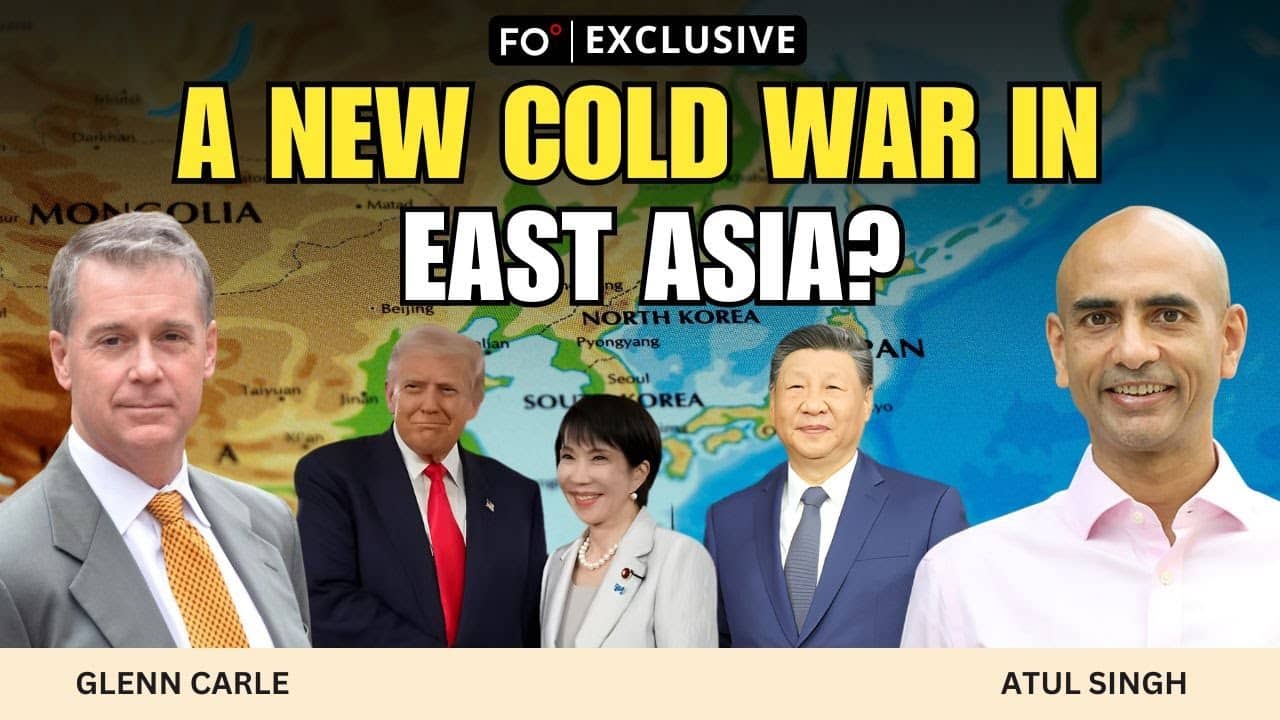
FO° Exclusive: China’s Purges, Japan’s Far-Right and America’s Gamble: The New Asian Order

post_date=”November 11, 2025 06:44″
pUrl=”https://www.fairobserver.com/video/fo-exclusive-us-government-shutdown-polarization-project-2025-and-debt-crippling-america/” pid=”159072″
post-content=”
Editor-in-Chief Atul Singh and FOI Senior Partner Glenn Carle, a retired CIA officer who now advises companies, governments and organizations on geopolitical risk, discuss the US government shutdown that began on October 1. Washington, DC, currently sees discussion during all waking hours and a shutdown at night.
The federal government has halted most operations. About 1.4 million employees have been told to stay home or work without pay. Three million contractors suffer and some positions are being eliminated. More than one million active-duty military personnel remain on the job and still receive pay, though even Republicans concede that redirecting funds might not be completely legal. Atul notes, “Some people are suffering enormously, as you can imagine.”
The hardship spreads far beyond Washington. Airports, hospitals and local governments that rely on federal data and funding feel the strain — they have reported delays in disbursements for infrastructure and education programs, while hospital administrators warn that Medicare and Medicaid reimbursements could soon slow. Additionally, contractors who provide essential services, from cybersecurity to food delivery, are left in limbo.
Cause of the shutdown
The shutdown stems from Congress again failing to pass a continuing resolution (CR) after missing appropriations deadlines for the fiscal year beginning September 1. The legislature holds the power to approve all spending from the Treasury. In theory, both houses pass the same budget, the president signs it and the government runs for the year.
In practice, however, Washington now governs by CRs — stopgaps that avoid genuine budgeting. Republicans control both chambers, but Senate rules require 60 votes. With 53 Republicans, the majority must win seven Democrats or independents, and has not. The result: paralysis. The previous record-setting shutdown under US President Donald Trump, from December 2018 to January 2019, lasted 34 days. Could this one beat its record?
Battle lines
Democrats say Trump and the Republicans have acted in bad faith and don’t want to feel cheated again. They are fighting to extend enhanced Affordable Care Act subsidies that expire at year’s end — a policy from US President Joe Biden’s administration that keeps premiums lower for 24 million Americans. More than half the recipients live in states that voted for Trump in 2024, which Democrats cite as proof that the extension is a bipartisan necessity. They also want funding restored to National Public Radio (NPR) and the television Public Broadcasting Service (PBS), calling them civic pillars that embody the public good.
Republicans counter that Democrats are clinging to temporary pandemic programs. They estimate the extension would cost $350–450 billion over ten years, which is untenable with the national debt at $37 trillion. To them, NPR and PBS are partisan mouthpieces. One Capitol Hill Republican told FOI they would “never give a thin red cent to NPR” and would let the shutdown continue rather than “feed the hand that bites us.” This fury cuts both ways: Democrats accuse Trump of destroying institutions while Republicans see Democrats as arrogant, despite their minority status.
The blame game and human toll
Food assistance for 42 million Americans through the Supplemental Nutrition Assistance Program ended on November 1. Even some Republicans, including Senator Josh Hawley from Missouri, privately admit they don’t want premiums to spike for their voters. Yet neither side has backed down. Atul calls it the blame game; “each side wants the other side to be seen as responsible for the shutdown and each side is unwilling to blink.”
Both parties privately believe they are winning this game. Democrats argue that voters will reject higher health premiums and view Republicans as reckless. Republicans counter that Democrats are overplaying their hand and will take the blame for economic pain.
The real-world effects mount. Federal workers seek temporary jobs in retail or delivery. FOI data show 57% of food-aid recipients live in Trump-voting states. Air traffic delays already exceed last year’s levels. If the shutdown lasts more than eight weeks, data collection, small-business lending, science grants and immigration processing will all stall.
A clash of philosophies
The deadlock hides an ideological war. “There truly is a deeply philosophical fundamental clash of principle,” Glenn comments.
Republicans pursue Project 2025, a blueprint to shrink the federal workforce and halve government responsibilities compared to January 1. They argue Washington should not subsidize media, healthcare or child nutrition. Democrats defend an activist state that feeds the hungry, combats disease and keeps citizens informed. This fight is less about numbers than about competing ideas of what government should be.
Economic fallout and democratic dilemma
Markets are already reacting. Air traffic controllers work unpaid, and investors demand higher returns on US bonds. FOI estimates that every week of shutdown trims 0.1 percentage points from annualized growth. If it lasts past mid-November, US Secretary of the Treasury Scott Bessent warns that the military itself may lose pay. Glenn fears prolonged uncertainty will strain global confidence in US finance and invite comparisons with debt crises once unthinkable for America.
The deeper issue here is democratic erosion, Atul believes. “Polarization … at its extreme is terrible for a democracy because democracy is about trade-offs, it’s about compromise, it’s about having at least a certain minimum agenda that you agree upon.” Glenn recalls that during the Cold War, “politics stopped at the shore.” Today, even that baseline is gone.
This battle over fiscal arithmetic is really a test of national character. The government may reopen, but the gulf between minimalist and activist visions of America will remain. For now, Washington remains frozen while the world’s largest economy waits to see which side blinks first.
[Lee Thompson-Kolar edited this piece.]
The views expressed in this article/video are the author’s own and do not necessarily reflect Fair Observer’s editorial policy.
”
post-content-short=”
Editor-in-Chief Atul Singh and FOI Senior Partner Glenn Carle, a retired CIA officer who now advises companies, governments and organizations on geopolitical risk, discuss the US government shutdown that began on October 1. Washington, DC, currently sees discussion during all waking hours and a…”
post_summery=”In this section of the October 2025 episode of FO° Exclusive, Atul Singh and Glenn Carle unpack the US government shutdown. Partisan brinkmanship has replaced governance and turned budgeting into warfare. This shutdown proves that America’s real conflict is over the role of the government itself.”
post-date=”Nov 11, 2025″
post-title=”FO° Exclusive: US Government Shutdown: Polarization, Project 2025 and Debt Crippling America?” slug-data=”fo-exclusive-us-government-shutdown-polarization-project-2025-and-debt-crippling-america”>
FO° Exclusive: US Government Shutdown: Polarization, Project 2025 and Debt Crippling America?
post_date=”November 10, 2025 07:46″
pUrl=”https://www.fairobserver.com/world-news/middle-east-news/fo-exclusive-israel-hamas-ceasefire-explained-trumps-20-point-plan-and-what-comes-next/” pid=”159054″
post-content=”
Editor-in-Chief Atul Singh and FOI Senior Partner Glenn Carle, a retired CIA officer who now advises companies, governments and organizations on geopolitical risk, dissect the Israel–Hamas ceasefire and US President Donald Trump’s 20-point “Comprehensive Plan to End the Gaza Conflict.” They weigh whether this represents genuine progress or only a temporary pause in a generational struggle.
Old patterns, new variables
Middle Eastern crises often repeat themselves: change the dates and the story stays largely the same. However, this conflict is different. After two years of fighting following the October 7 attacks in Gaza, Israel and the Sunni Palestinian group Hamas have reached exhaustion. Hamas, which won a single disputed election back in 2006, has been battered, while Israel’s politics have drifted further right. Glenn quips, “They probably won the election the way Stalin did — which was at the end of a gun … well, not probably, they did.”
The conversation turns to history. In 1993, Israeli Prime Minister Yitzhak Rabin and Palestinian leader Yasser Arafat signed the Oslo Accords for peace, but within months, Hamas carried out its first suicide bombing. Two years later, Rabin’s assassination by Jewish extremist Yigal Amir killed the peace process. Neither Hamas nor Israel’s religious right wings have changed since then.
Trump’s 20-point plan
Glenn describes Trump’s peace initiative as “imposed rather than negotiated,” but concedes that “the prospects … for a lasting peace between Israel and the Palestinians … are greater today than at any time since the Oslo Accords.” With characteristic irony, he adds that US President Woodrow Wilson’s plan had only 14 points against Trump’s 20, so we know Trump’s is the biggest and best.
Four provisions form the plan’s immediate backbone: a fragile ceasefire, Israeli troop withdrawal from half of Gaza, reciprocal hostage releases and humanitarian aid flows that Israel had long restricted. These changes are meaningful in themselves. After all, in war, an absence of casualties is typically better than mounds of them.
Trump’s approach is not diplomatic but transactional — an imposition shaped by leverage and timing. Exhaustion, public fatigue and shifting alliances created a rare window, one Trump exploited effectively, even if unintentionally. His unpredictability, often condemned by critics, paradoxically gave him the flexibility to push both Israel and Hamas when conventional leaders would have hesitated.
The new Middle East
Israel’s war effort has decimated Hamas’s fighters and tunnels, eliminating as many as 20,000 Hamas fighters and destroying 80% of the group’s vast underground network. The campaign has crippled the Lebanese Shia paramilitary group Hezbollah and accelerated Syria’s collapse. Now, Syria’s new leader, former al-Qaeda fighter Ahmed al-Sharaa (now known as Abu Mohammad al-Julani), is a proxy for the Turkish intelligence agency Millî İstihbarat Teşkilatı, or MIT. Syria is now “pockmarked like Swiss cheese,” Atul states. Glenn agrees, citing jubilant Israeli officers who told him that they’ve destroyed the whole air force.
In Israel, two-thirds of citizens now support ending the fighting. In July, the Arab League for the first time urged Hamas to disarm. This is a historic first; the Arab capitals that once tacitly supported Palestinian militancy are now openly urging restraint. Yet the real shift lies in Washington: Trump’s tight grip over Congress, unlike any president before him, lets him override the traditional pro-Israel consensus. Further, his dominance of the Republican Party enabled him to pressure Israeli Prime Minister Benjamin Netanyahu to accept a peace deal, something no previous US president managed.
Netanyahu ignored warnings from Israeli intelligence chiefs not to strike Hamas in Qatar. Far-right Minister of National Security Itamar Ben-Gvir and Minister of Finance Bezalel Smotrich pushed him to act, triggering Trump’s intervention. The result was a ceasefire that both sides accepted out of exhaustion, not reconciliation.
Domestic currents and lingering dangers
Israel’s demography is tilting power toward the ultra-Orthodox right. The secular Jewish Ashkenazi elite that once led Israel’s Mossad intelligence and the Israel Defense Forces’ special operations has fewer children and diminishing political power. Israel’s domestic politics now point further right. The ceasefire will likely prove to be a mere prelude to another round of fighting.
The plan’s second phase — lasting peace — faces towering obstacles. Hamas refuses to disarm, twisting the agreement’s language to its advantage. A proposed international stabilization force has no firm backers, and Israel rejects Turkish participation outright. Governance of Gaza is also unresolved: Hamas insists on inclusion, while Israel wants it excluded.
The reconstruction effort, projected at $50–70 billion, hinges on Saudi Arabia and other Muslim states’ cooperation — and on a “Grand Bargain” linking Saudi normalization with Israel–US guarantees against Iran and a two-state solution. Glenn warns that this would demand “years of daily cajoling, harassing, imposing,” something he doubts Trump can sustain. That vision faces hurdles at home, too, as both conservative Republicans and progressive Democrats in Congress oppose extending nuclear cooperation or security guarantees to the Saudi capital of Riyadh.
The ceasefire’s endurance will depend less on written agreements than on political will. Without consistent US engagement, regional mediation and trust-building on the ground, even the best plan risks unraveling. For now, the guns are silent, but history suggests silence rarely lasts for long. And in the Middle East, every lull risks becoming a moment of calm before the next storm.
[Lee Thompson-Kolar edited this piece.]
The views expressed in this article/video are the author’s own and do not necessarily reflect Fair Observer’s editorial policy.
”
post-content-short=”
Editor-in-Chief Atul Singh and FOI Senior Partner Glenn Carle, a retired CIA officer who now advises companies, governments and organizations on geopolitical risk, dissect the Israel–Hamas ceasefire and US President Donald Trump’s 20-point “Comprehensive Plan to End the Gaza Conflict.”…”
post_summery=”In this section of the October 2025 episode of FO° Exclusive, Atul Singh and Glenn Carle analyze the Israel–Hamas ceasefire and US President Donald Trump’s 20-point Gaza peace plan. It marks a rare moment of leverage in Middle East diplomacy, but it’s exhaustion, not reconciliation, that drives the ceasefire. Without sustained US pressure, today’s calm could become tomorrow’s war.”
post-date=”Nov 10, 2025″
post-title=”FO° Exclusive: Israel–Hamas Ceasefire Explained: Trump’s 20-Point Plan and What Comes Next” slug-data=”fo-exclusive-israel-hamas-ceasefire-explained-trumps-20-point-plan-and-what-comes-next”>

FO° Exclusive: Israel–Hamas Ceasefire Explained: Trump’s 20-Point Plan and What Comes Next
post_date=”November 09, 2025 09:34″
pUrl=”https://www.fairobserver.com/world-news/fo-exclusive-global-lightning-roundup-of-october-2025/” pid=”159041″
post-content=”
Editor-in-Chief Atul Singh and FOI Senior Partner Glenn Carle, a retired CIA officer who now advises companies, governments and organizations on geopolitical risk, review a turbulent month of global change. They trace how political crises in Europe, leadership transitions in Asia and shifting alliances in the Americas reveal an accelerating breakdown of old certainties. This month may well have been more eventful than the last.
Politics of France and the United Kingdom
The FO° Exclusive opens with France, where turmoil again exposes the fragility of the Fifth Republic. French President Emmanuel Macron appointed Sébastien Lecornu as prime minister on September 9, only to see him resign on October 6 after failing to win Parliament’s confidence. On October 10, Macron promptly reappointed him. The two men, reportedly close friends who share scotch at the president’s Élysée Palace, now face the challenge of passing a budget amid deep frustration.
Former French President Nicolas Sarkozy’s imprisonment appears as proof that France’s culture of impunity has ended. Convicted for channeling illicit Libyan money into his 2007 election campaign, on October 21, Sarkozy became the first former French head of state to be jailed since French Marshal Philippe Pétain.
Across Europe, in Britain, religion and politics have unexpectedly intersected. On October 23, King Charles III and Pope Leo XIV prayed together in the Vatican’s Sistine Chapel — the first such event since King Henry VIII’s break with Rome. As Atul says, some Christians view this as “a symbolic step towards reconciliation between the Roman Catholic and Anglican churches, and some sort of unity of Christendom.”
Tony Blair of the Labour Party and Boris Johnson of the Conservative Party are both Catholics, as is Nigel Farage of the Reform UK party, who told Mishal Husain in an interview that he is most disposed toward the Catholic Church. Some right-wingers believe this may be the beginning of a new Christian crusade against Islam.
However, as head of the Church of England, Charles has attended pagan ceremonies and prayed with Muslims and Jews. Further, he chose the title “Defender of Faith” rather than “Defender of the Faith.” These moves suggest pluralism, even as Europe drifts politically rightward.
While the King prayed for unity, conservative Tory party leader Kemi Badenoch announced that Britain would withdraw from the European Convention on Human Rights, aligning with Farage’s Reform UK. “Reform UK and Nigel Farage are setting the British political weather now,” Atul observes. Meanwhile, on October 3, UK Prime Minister Keir Starmer’s Labour government appointed Dame Sarah Mullally as the first female Archbishop of Canterbury, set to take power on January 28, 2026. This landmark decision underscores the moral crosscurrents shaping modern Britain.
Political turbulence in Asia, the Middle East and Africa
Shifting to Asia, on October 21, Japan saw the historic appointment of Takaichi Sanae, the country’s first woman prime minister. A former television journalist, heavy metal drummer and admirer of former UK Prime Minister Margaret Thatcher, Takaichi embodies both reformist energy and conservative resolve. She hawkishly advocates revising Japan’s pacifist constitution and expanding defense spending.
In the Middle East, Afghanistan and Pakistan clashed starting on October 9. Protests in Madagascar removed former President Andry Rajoelina from the presidential palace on October 14. The military is back in charge, although, taking a page from Pakistan’s book, it has named a largely civilian government.
Shifting winds in Latin America
Latin America is experiencing major change. On October 10, Peruvian President Dina Boluarte was ousted amid unrest and rising crime, replaced by congressional chief José Jerí — the country’s seventh leader in nine years. On October 27, Argentinian President Javier Milei achieved a sweeping midterm victory that expanded his right-wing La Libertad Avanza party’s seats across both chambers. His “chainsaw” austerity agenda drew backing from Washington, as US President Donald Trump’s administration offered a $40 billion aid package reportedly contingent on his success.
Bolivia also turned the page: On October 20, Centrist Rodrigo Paz Pereira defeated conservatives, ending two decades of rule by former Bolivian President Evo Morales’s Movement Toward Socialism. Paz has pledged pro-market reforms while protecting welfare programs. Atul quips that “maybe the CIA doesn’t need to do coups anymore.” The region’s “pink tide” has ebbed, replaced by a cautious embrace of markets and cooperation with Washington.
Central Europe’s populist surge
In the Czech Republic, populist billionaire Andrej Babiš won the October 4 parliamentary election, setting him to return as prime minister. Hungary is seeking to coordinate with Czechia and Slovakia to form a Ukraine-skeptic bloc within the European Union. This significant move, Atul believes, suggests that “the unity of Europe over Ukraine seems certainly to be crumbling.”
Vendetta politics in Washington
The discussion ends in the United States, where Atul says, “vendetta is in the air.” The Trump administration has launched investigations targeting former FBI Director James Comey and ex-National Security Advisor John Bolton. Despite Bolton being known for having an “abrasive and arrogant” demeanor, his prosecution on October 16 sets a troubling precedent for the nation.
Washington insiders believe Comey will avoid legal peril, but Bolton — nicknamed “Mr. Walrus” — could face serious consequences. Even as Americans debate the erosion of institutional independence, many citizens from both sides of American politics are quietly enjoying the proceedings.
[Lee Thompson-Kolar edited this piece.]
The views expressed in this article/video are the author’s own and do not necessarily reflect Fair Observer’s editorial policy.
”
post-content-short=”
Editor-in-Chief Atul Singh and FOI Senior Partner Glenn Carle, a retired CIA officer who now advises companies, governments and organizations on geopolitical risk, review a turbulent month of global change. They trace how political crises in Europe, leadership transitions in Asia and shifting…”
post_summery=”In this section of the October 2025 episode of FO° Exclusive, Atul Singh and Glenn Carle reflect on a world in flux, where leaders struggle to manage crises that blur domestic and global boundaries. They move from Europe’s political disarray and religious symbolism to shifting powers in Asia and Latin America. October’s events signal a deeper unraveling of the global postwar order.”
post-date=”Nov 09, 2025″
post-title=”FO° Exclusive: Global Lightning Roundup of October 2025″ slug-data=”fo-exclusive-global-lightning-roundup-of-october-2025″>

FO° Exclusive: Global Lightning Roundup of October 2025
post_date=”November 08, 2025 05:39″
pUrl=”https://www.fairobserver.com/politics/fo-talks-bolivia-heads-to-presidential-runoff-as-voters-end-two-decades-of-left-wing-politics/” pid=”159027″
post-content=”
[This video was recorded in the days preceding the second round of Bolivia’s election. This write-up has been updated to include more recent information.]
Fair Observer’s Video Producer Rohan Khattar Singh speaks with Pablo Bejar, a country risk analyst with experience at the International Monetary Fund and the World Bank, about the stunning outcome of Bolivia’s recent presidential election. On October 19, the contest entered a runoff between Senator Rodrigo Paz Pereira and former Bolivian President Jorge “Tuto” Quiroga — a social democrat from the Christian Democratic Party and a center-right technocrat, respectively — marking the first center-right face-off in roughly two decades.
For Bejar, this moment signals a profound shift in Bolivia’s political trajectory after years under the rule of the Movement Toward Socialism (Movimiento al Socialismo, or MAS).
Bolivia demands change
Bejar describes the faceoff as “a unique opportunity,” underscoring the symbolic end of the MAS era. After 20 years of dominance, the socialist movement that rose with former Bolivian President Evo Morales and was governed under his successor now commands only around 8% of the vote across its affiliate parties. Opposition parties have seized control of parliament, and roughly nine in ten Bolivians have expressed a desire for “complete, radical change.”
This discontent was visible long before election day. Shortages of diesel, gas, hard currency, and the highest inflation levels seen in almost 40 years left citizens exhausted by the economic crisis. Bejar argues that the MAS government rode a long-gone commodity boom and completely failed to sustain its gains. Once Bolivia’s gas fields declined and foreign reserves dwindled, the macroeconomic stability, democratic alternation of power and liberalizing reforms and investments of the 1990s and early 2000s — later harnessed but ultimately squandered by the Morales-Arce MAS governments from 2006 to 2025 — gave way to deep structural economic scars.
The youth vote
Nearly half of all ballots came from young voters who have known no political reality other than MAS rule. Their turnout reflected frustration rather than ideology: They wanted jobs, stability and honest governance. Bejar explains that many of these voters were hoping for change, and their votes tipped the balance against the establishment. The shortages of foreign exchange and basic goods — particularly diesel and gasoline — as well as inflationary pressures, convinced much of the population that the system itself had failed.
Khattar Singh observes that this generational shift carries regional echoes. Latin America’s youth, from Buenos Aires in Argentina to Quito in Ecuador, have grown up skeptical of populist promises. Bejar adds that this sentiment could reshape the continent’s political balance as younger generations favor pragmatic competence over charisma.
Paz vs. Quiroga
Paz and Quiroga offered distinct yet overlapping visions. Paz, the son of former Bolivian President Paz Zamora, served as a mayor and senator but has never led the national government. Bejar says Bolivians consider him “more of a social democrat,” emphasizing his anti-corruption platform. His popular vice-presidential running mate, Edmand Lara Montaño, is a former policeman whose appeal lies with lower-income, less educated and former MAS voters. Quiroga, by contrast, is a veteran figure: He briefly served as president after the death of Bolivian President Hugo Banzer in 2001 and represents the country’s traditional technocratic bloc.
Paz’s campaign was unprepared for its own success. It lacked a full slate of congressional candidates and has now recruited new members — some of them former MAS politicians. A further complication lay in internal divisions: Paz and his running mate appear to hold disparate views on policy, particularly over subsidies and fiscal discipline. Quiroga, Bejar suggests, exploited these contradictions, but it was not enough.
Quiroga’s preliminary advantage
Quiroga’s greatest strength was his experience. With over three decades in politics, he offered voters a sense of stability that contrasted with Paz’s untested optimism. His long association with the pre-MAS era of the 90s could have alienated rural voters, but Bejar argues that his administrative credibility might’ve won over those who prioritize competence over novelty. Moreover, the cordial relationship between the two candidates, rooted in Quiroga’s past service as finance minister under Paz’s father, lent the race an air of civility unusual in Bolivian politics.
The runoff was unpredictable. Bejar believes the outcome hinged on which candidate could better convince voters that he represented real, sustainable change rather than a recycled elite. And in the end, that was Paz — he won the runoff with 54.5% of the vote against Quiroga’s 45.5%, confirming that Bolivia’s electorate favored renewal over experience.
Libertarianism on the rise
Khattar Singh closes the discussion by situating Bolivia’s vote within a continental pattern. Across Latin America, libertarian, right-leaning and more pragmatic candidates have recently triumphed in Argentina, Ecuador and El Salvador, respectively, and with a high likelihood of change from the left in the upcoming presidential elections in Chile and Colombia next year. Bejar sees these results as evidence of a broader ideological turn. The victory of Argentinian President Javier Milei — a libertarian — was a major boost to advocates of free markets and lower state interventionism, and a warning to leftist governments across the region and the world. Populations frustrated with high levels of bureaucracy and corruption, and coupled with severe economic mismanagement, are gravitating toward smaller governments, fiscal restraint and lower taxes.
Whether Bolivia’s own rightward movement will produce renewal or relapse remains to be seen. For now, the electorate has spoken clearly: After two decades of one-party leftist rule, Bolivians are ready to follow a different path.
[Lee Thompson-Kolar edited this piece.]
The views expressed in this article/video are the author’s own and do not necessarily reflect Fair Observer’s editorial policy.
”
post-content-short=”
Fair Observer’s Video Producer Rohan Khattar Singh speaks with Pablo Bejar, a country risk analyst with experience at the International…”
post_summery=”In this episode of FO° Talks, Rohan Khattar Singh and Pablo Bejar discuss Bolivia’s historic 2025 election, which ended two decades of left-wing rule by the Movement Toward Socialism party. Bejar explains why voters, especially young ones, demanded radical change. President-elect Rodrigo Paz Pereira’s runoff victory over Jorge “Tuto” Quiroga reflects that mood, signaling Bolivia’s shift toward renewal.”
post-date=”Nov 08, 2025″
post-title=”FO° Talks: Bolivia Heads to Presidential Runoff as Voters End Two Decades of Left-Wing Politics” slug-data=”fo-talks-bolivia-heads-to-presidential-runoff-as-voters-end-two-decades-of-left-wing-politics”>

FO° Talks: Bolivia Heads to Presidential Runoff as Voters End Two Decades of Left-Wing Politics

post_date=”November 07, 2025 07:17″
pUrl=”https://www.fairobserver.com/world-news/middle-east-news/fo-talks-pashtuns-vs-punjabis-the-ethnic-rift-fueling-clashes-between-pakistan-and-afghanistan/” pid=”159010″
post-content=”
Editor-in-Chief Atul Singh and Professor Thomas Barfield explore the sudden collapse of Pakistan’s long alliance with the Taliban, the ethnic and ideological roots of their conflict and India’s quiet reentry into Afghan diplomacy.
After decades of covert cooperation, the Taliban’s defiance of the Pakistani capital of Islamabad has ignited border clashes and reshaped South Asia’s balance of power. Singh and Barfield trace how history, ethnicity and theology intersect — from the Durand Line dispute to the Deobandi movement that inspired the Taliban’s worldview.
Pakistan–Taliban tensions
For nearly 30 years, Pakistan backed Islamist factions in Afghanistan to install a friendly government in its capital of Kabul and secure “strategic depth” against India. Each time its clients took power — under Mullah Omar in the 1990s and again in 2021 — they turned nationalist instead of loyal. Afghanistan, Barfield reminds, was the only country to vote against Pakistan’s entry into the United Nations in 1947, rejecting its legitimacy.
That hostility endures in the Taliban’s refusal to recognize the Durand Line, the colonial border dividing the two states. Islamabad expected its protégés to accept it; their rejection exposed a fundamental break. The relationship worsened when Pakistan began deporting one million Afghan refugees, many born on its soil, back into a drought-stricken and aid-starved Afghanistan. By protecting Pakistani Taliban militants and striking back at cross-border raids, the Taliban have made the conflict public and unmistakable — a rupture no longer hidden by diplomatic language.
Pashtuns vs Punjabis
Beneath the political feud runs an ethnic divide. Pakistan’s military elite is largely Punjabi, while the Taliban are overwhelmingly Pashtun. Barfield explains that there “definitely are more Pashtuns in Pakistan than there are in Afghanistan,” creating a population that straddles both sides of the frontier but belongs fully to neither.
Although the Taliban define themselves as a religious rather than ethnic movement, their Pashtun core makes them acutely sensitive to the plight of their brethren in Pakistan’s northwest. The Durand Line, drawn in 1893 by the British, bisected what had once been a single tribal world. Its continued contestation binds identity and sovereignty together. As Barfield puts it, Pakistan is “in a way an empire of the Punjab,” ruling over peoples who have never entirely accepted that hierarchy.
India–Taliban ties
Amid these tensions, India has quietly entered the scene. Without recognizing the Taliban regime, the Indian capital of New Delhi has upgraded its embassy, hosted Taliban Foreign Minister Amir Khan Muttaqi and opened talks on reconstruction. Singh calls this a political coup, since Pakistan long assumed that a Pashtun Islamist government would never draw close to India.
Barfield interprets this as a classic Afghan balancing act: an old game where Kabul moves toward Delhi when relations with Islamabad sour. In the 1990s, the Taliban trained fighters for Kashmir; today, insurgents cross instead into Pakistan. India gains strategic leverage while the Taliban gains legitimacy. Still, Barfield doubts that India will bankroll them — “it’s too much at odds with Indian values and world values.” China and Russia, he adds, are cautious and cash-strapped, leaving the Taliban “really stuck for money and resources.”
Taliban and Deoband
The Taliban foreign minister’s stop at India’s Darul Uloom Deoband — a major Islamic seminary — carried immense symbolism. He was honored as a hero, showered with rose petals at the 19th-century Islamic seminary that birthed the Deobandi school of thought. Barfield sees this as an attempt to situate the Taliban within South Asia’s longer Islamic history — one that predates both Afghanistan and Pakistan.
Darul Uloom Deoband was founded in 1866 after the Mughal Empire’s collapse and the failed 1857 rebellion. Its scholars preached moral revival to restore Muslim strength after colonial conquest. By invoking that heritage, the Taliban claim ideological legitimacy from a pan-Indian Islamic tradition rather than from Pakistan’s military patronage. It is a message, Barfield notes, that they predate Pakistan and see themselves as heirs to a broader civilizational project.
History of Islam in India
The Darul Uloom Deoband lineage links modern Taliban politics to older movements that blurred the line between faith and nationalism. When the British dethroned the last Mughal emperor in 1858, they ended centuries of nominal Muslim sovereignty. Reformers and clerics sought revival through education and unity. Later, the 1919 Caliphate Movement, which even drew support from Mahatma Gandhi, tried to restore the Ottoman caliphate and rally Muslims across South Asia.
Barfield situates the Taliban’s outreach to India within this continuum. Afghanistan and India have shared centuries of trade, conquest and cultural exchange. By appealing to that shared past, the Taliban imply that their movement — religiously puritanical but politically independent — represents continuity with Islamic traditions that long preceded Pakistan’s creation in 1947.
Darul Uloom Deoband’s ideology
Yet Darul Uloom Deoband’s legacy also carries a deeply conservative worldview. Singh notes that its clerics oppose women playing sports or studying alongside men — restrictions that mirror Taliban policies in Afghanistan. Barfield says this vision is “not a popular one,” even among religious Muslims.
He contrasts today’s Taliban with Saudi Arabia, which has liberalized dramatically, leaving them “isolated in the Muslim world” and culturally outdated. Their gender apartheid violates both Islamic precedent and Afghan custom, where women traditionally served as teachers and caregivers. These policies are not only alienating potential allies but may fracture the movement itself.
Financially and ideologically cornered, the Taliban are courting India and invoking Darul Uloom Deoband to seek relevance beyond their borders. But their ultraconservative theology and ethnic nationalism have trapped them in a past the rest of the Muslim world — and even their own people — are rapidly leaving behind.
[Lee Thompson-Kolar edited this piece.]
The views expressed in this article/video are the author’s own and do not necessarily reflect Fair Observer’s editorial policy.
”
post-content-short=”
Editor-in-Chief Atul Singh and Professor Thomas Barfield explore the sudden collapse of Pakistan’s long alliance with the Taliban, the ethnic and ideological roots of their conflict and India’s quiet reentry into Afghan diplomacy.
After decades of covert cooperation, the Taliban’s…”
post_summery=”In this episode of FO° Talks, Atul Singh and Thomas Barfield trace how Pakistan’s decades-long bet on a pliant Taliban has collapsed, fueling open clashes along the Durand Line. They unpack the Pashtun–Punjabi fault line and mass deportations. India’s quiet outreach and the Taliban’s Deobandi symbolism raise the stakes but do not solve the Taliban’s cash-and-ideology bind.”
post-date=”Nov 07, 2025″
post-title=”FO° Talks: Pashtuns vs Punjabis: The Ethnic Rift Fueling Clashes Between Pakistan and Afghanistan” slug-data=”fo-talks-pashtuns-vs-punjabis-the-ethnic-rift-fueling-clashes-between-pakistan-and-afghanistan”>

FO° Talks: Pashtuns vs Punjabis: The Ethnic Rift Fueling Clashes Between Pakistan and Afghanistan

post_date=”November 06, 2025 05:55″
pUrl=”https://www.fairobserver.com/world-news/middle-east-news/fo-talks-the-gaza-peace-deal-remains-shaky-as-hamas-carries-out-public-executions/” pid=”158998″
post-content=”
Fair Observer’s Video Producer Rohan Khattar Singh speaks with Abdullah O Hayek, an independent Middle East analyst and Young Voices contributor based in Washington, DC. They discuss the October 2023 Israel–Hamas ceasefire, exploring how it was built, where it is already showing strain and whether US President Donald Trump’s peacemaking can stabilize one of the world’s most volatile regions.
Achieving a ceasefire
The Israeli government and the Sunni Palestinian nationalist group Hamas signed the ceasefire on October 9, 2023, in Sharm el-Sheikh, Egypt. It took effect the following day. It is not a simple halt in fighting but a multi-phase roadmap designed to test compliance. Under Phase One, Hamas was to release its remaining 20 Israeli hostages and return the bodies of up to 28 others within 72 hours. In exchange, Israel would free 2,000 Palestinian detainees, pull back troops to pre-agreed lines and reopen crossings to allow large-scale humanitarian aid into Gaza.
Hayek emphasizes that this is “not a passive peace agreement but it is a delicate, step-by-step … transactional framework of mutual obligations, enforcement escalators and transition mechanics.” Later phases required Hamas to surrender heavy weapons, including rockets and tunnels, under intrusive verification. Funding for Gaza’s reconstruction was to come from Saudi Arabia, Qatar and the United Arab Emirates, while a joint Arab stabilization force handled security oversight.
The agreement allowed Israel to resume military action if Hamas violated core terms, such as falsifying remains or withholding weapons, making the truce conditional from the start.
Will the peace deal collapse?
When Khattar Singh asks whether the ceasefire can hold, Hayek admits it already shows cracks. Only three days after taking effect, Israel accused Hamas of breaching its obligations by misidentifying a body during the return of remains. The error — one of the deceased was allegedly a Palestinian informant — quickly triggered mutual recriminations and new strikes.
Hayek says the fragility of the ceasefire is enormous and warns that while its success is possible, “failure is the more likely path.” The requirement for body identification, he explains, is a tipping clause that could collapse the framework. If Hamas falters, Israel can retaliate or cut aid, punishing Gaza’s civilians rather than its leadership.
He also points out that 97% of Gaza’s infrastructure lies in ruins, making compliance nearly impossible. His forecast: a 40–50% chance that the deal endures beyond its first year.
Trump’s diplomacy
Trump’s intervention marks the most dramatic shift in months of stalled mediation. By late 2023, both Israel and Hamas were strategically exhausted: Gaza was devastated, Israel faced domestic war fatigue and global outrage was mounting. Into this vacuum stepped Trump, seeking to reestablish US leverage and demonstrate that Washington could still broker peace.
Hayek credits the US president’s “phased incremental model” as key to getting both sides to sign. Rather than demand total trust, Trump built trust by architecture — a design of sequencing, verification and third-party enforcement. He embedded Qatar and Egypt as guarantors and enlisted Turkish President Recep Tayyip Erdoğan, whose late-stage involvement Hayek compares to a substitute player scoring the winning goal.
Trump also secured Gulf funding for reconstruction, creating economic incentives for Hamas to comply, and threatened renewed force if it did not. This resulted in a high-stakes gamble: compliance could lift Gaza from isolation, while defection could invite joint US-Israeli intervention.
Gaza Peace Summit in Egypt
The Gaza Peace Summit in Sharm el-Sheikh served as Trump’s diplomatic showcase rather than a negotiation table. Over 30 leaders attended, including Erdoğan, Egyptian President Abdel Fattah el-Sisi, Qatari Emir Tamim bin Hamad Al Thani and Jordanian King Abdullah II. Notably, Israel and Hamas were absent — a sign that the summit’s goal was legitimacy, not dialogue.
For Hayek, the event “functioned more as a diplomatic stage and legitimacy exercise than a negotiating forum,” signaling collective endorsement of Trump’s 20-point peace plan. The resulting declaration committed Arab states to reconstruction and peace enforcement, locking them into shared accountability. The summit’s absence of direct combatants paradoxically strengthened it — any violation of the ceasefire would now appear as defiance of regional consensus, not just bilateral betrayal.
What is Hamas doing?
The truce has not stopped violence inside Gaza. Hamas’s public pledge to disarm contrasts sharply with its internal purges and executions of alleged dissenters and informants. Gaza is a volatile crucible where forced transition collides with factional resistance. Rival clans — especially the powerful Doghmush clan — have faced raids and extrajudicial killings.
Hayek condemns the acts as war crimes, noting that Hamas is trying to eliminate internal rivals before passing along its weapons. In effect, the group is consolidating control even as it promises demilitarization. The ceasefire envisions eventual rule by a technocratic Palestinian transitional body under Arab and international supervision, but Hayek doubts hybrid arrangements would work. In his view, only a reformed Palestinian Authority can unify governance and restore diplomacy, provided it modernizes, fights corruption and reconnects with the Gazan population.
What next for Netanyahu?
In Israel, the ceasefire has unleashed political chaos. Far-right ministers have denounced the deal as capitulation, accusing Israeli Prime Minister Benjamin Netanyahu of betraying national interests. Netanyahu is “operating on thinning ice,” Hayek says. His fragile coalition faces internal rebellion, corruption trials and public outrage over the war’s handling.
While Netanyahu still projects defiance, insisting Hamas must disarm or face renewed force, his ability to balance hardliners and moderates is evaporating. If coalition partners defect or early elections are called, his long political dominance could end. Hayek believes Netanyahu’s survival depends on his proving that the ceasefire delivers real security dividends rather than just political delay.
[Lee Thompson-Kolar edited this piece.]
The views expressed in this article/video are the author’s own and do not necessarily reflect Fair Observer’s editorial policy.
”
post-content-short=”
Fair Observer’s Video Producer Rohan Khattar Singh speaks with Abdullah O Hayek, an independent Middle East analyst and Young Voices contributor based in Washington, DC. They discuss the October 2023 Israel–Hamas ceasefire, exploring how it was built, where it is already showing strain and…”
post_summery=”In this episode of FO° Talks, Rohan Khattar Singh and Abdullah O Hayek dissect the fragile Israel–Hamas ceasefire signed in October 2023. Hayek describes it as a conditional, high-risk framework born from exhaustion and revived by Donald Trump’s diplomatic architecture. Yet with purges in Gaza and political fractures in Israel, collapse remains more likely than peace.”
post-date=”Nov 06, 2025″
post-title=”FO° Talks: The Gaza Peace Deal Remains Shaky as Hamas Carries Out Public Executions” slug-data=”fo-talks-the-gaza-peace-deal-remains-shaky-as-hamas-carries-out-public-executions”>

FO° Talks: The Gaza Peace Deal Remains Shaky as Hamas Carries Out Public Executions

post_date=”November 05, 2025 07:21″
pUrl=”https://www.fairobserver.com/video/fo-talks-peru-in-crisis-dina-boluarte-impeached-controversial-jose-jeri-takes-power/” pid=”158992″
post-content=”
Fair Observer’s Video Producer Rohan Khattar Singh speaks with political consultant Erik Geurts about Peru’s latest bout of political chaos: the impeachment of former Peruvian President Dina Boluarte and the sudden ascent of President José Jerí. Their conversation unpacks why Peru’s presidency has become a revolving door, how institutions have crumbled under the strain of corruption and public anger, and what this crisis means for Latin America’s shifting geopolitical map.
A president falls yet again
Boluarte’s removal marks yet another moment in Peru’s unending cycle of political collapse. Since 2016, the country has cycled through six presidents: Pedro Pablo Kuczynski (July 2016–March 2018), Martín Vizcarra (March 2018–November 2020), Manuel Merino (November 2020), Francisco Sagasti (November 2020–July 2021) and Boluarte (December 2022–October 2025). Each fell to scandal, impeachment or resignation. Boluarte’s downfall followed mounting corruption allegations and her failure to build a functioning coalition in Congress. Her administration, he argues, became defined by paralysis. She lost both legitimacy and leverage as street protests intensified and opposition lawmakers united against her.
The impeachment vote passed overwhelmingly after revelations that Boluarte allegedly accepted undeclared gifts from major business groups. Yet, as Geurts points out, corruption charges in Peru often mask deeper structural tensions. Successive governments have governed on razor-thin mandates, and Congress, which is fragmented among dozens of small parties, wields disproportionate power to unseat presidents. The result is a system built to fail, where institutional weakness becomes a political weapon.
Enter Jerí
Into this vacuum steps Jerí, a relatively unknown centrist congressman who built his career on anti-corruption rhetoric and pragmatic dealmaking. Khattar Singh presses Geurts on whether Jerí’s rise reflects genuine reformist momentum or another tactical reshuffling among elites. Geerts answers that Jerí’s appeal lies in his neutrality. He is neither the street nor the establishment. That ambiguity, Geurts suggests, helped him gain temporary support from both weary voters and opportunistic lawmakers.
Still, Peruvians remain deeply skeptical. Jerí has inherited a nation exhausted by political drama, economic stagnation and protests that have repeatedly paralyzed mining regions — vital to the country’s export economy. Geurts notes that Jerí’s first challenge will be survival itself. Peru’s presidency has become a poisoned chalice, its occupants crushed between an ungovernable Congress and a furious populace demanding change.
A crisis of governance, not just of leaders
Khattar Singh steers the conversation toward institutional decay. Why, he asks, has Peru been unable to produce stable governments despite holding regular elections? Geurts points to a long erosion of party systems dating back to the 1990s, when President Alberto Kenya Fujimori Inomoto dismantled traditional political structures. Since then, Peruvians have voted for personalities rather than parties, giving rise to fragmented parliaments and weak mandates.
Geurts argues that what looks like political instability is really a chronic failure of governance. Presidents lack disciplined coalitions to pass reforms, while Congress thrives on obstruction and short-term dealmaking. Each new administration promises to root out corruption, only to become ensnared in the same web of patronage and impunity. Public trust, already fragile, collapses further with each impeachment. The recurring turmoil, he says, is about the broken state.
Geopolitical ripples
Peru’s domestic turmoil has also attracted the attention of outside powers. The United States views Peru as a key ally in regional stability and mining supply chains, while China remains the largest investor in the country’s infrastructure and mineral sectors. Geurts observes that every leadership crisis in the Peruvian capital of Lima raises questions about where future contracts and loyalties will fall. Washington and Beijing, he points out, compete quietly through loans, trade and diplomatic pressure rather than open confrontation.
Neighboring countries, too, are watching closely. Bolivia, Chile and Brazil all depend on stable cross-border supply networks. Each time Peru’s government collapses, investors grow nervous and capital flees. Khattar Singh notes that this volatility weakens the credibility of democratic governance across the region, reinforcing cynicism about whether elections can deliver real progress.
Can Jerí break the cycle?
As the conversation turns to the future, Khattar Singh and Geurts agree that Jerí faces an impossible balancing act. The new president must rebuild credibility with the public while negotiating with the same Congress that deposed his predecessor. Geurts doubts that any president can govern effectively without systemic reform — reducing Congress’s unchecked power, strengthening political parties and overhauling campaign finance laws. Yet he concedes that even small gestures toward transparency could buy Jerí time.
The interview closes on a sober note. Peru’s turmoil is not the product of one corrupt leader but of decades of institutional erosion. Whether Jerí endures or falls, stability will remain elusive until Peru rebuilds the foundations of democratic trust.
[Lee Thompson-Kolar edited this piece.]
The views expressed in this article/video are the author’s own and do not necessarily reflect Fair Observer’s editorial policy.
”
post-content-short=”
Fair Observer’s Video Producer Rohan Khattar Singh speaks with political consultant Erik Geurts about Peru’s latest bout of political chaos: the impeachment of former Peruvian President Dina Boluarte and the sudden ascent of President José Jerí. Their conversation unpacks why Peru’s…”
post_summery=”In this episode of FO° Talks, Rohan Khattar Singh and Erik Geurts discuss the impeachment of former Peruvian President Dina Boluarte and the rise of Peruvian President José Jerí amid deep political turmoil. Corruption, institutional weakness and public distrust have turned the country’s presidency into a revolving door. What geopolitical consequences will Peru’s instability yield?”
post-date=”Nov 05, 2025″
post-title=”FO° Talks: Peru in Crisis: Dina Boluarte Impeached, Controversial José Jeri Takes Power” slug-data=”fo-talks-peru-in-crisis-dina-boluarte-impeached-controversial-jose-jeri-takes-power”>

FO° Talks: Peru in Crisis: Dina Boluarte Impeached, Controversial José Jeri Takes Power
post_date=”November 04, 2025 07:12″
pUrl=”https://www.fairobserver.com/politics/fo-talks-are-american-cities-becoming-unlivable-understanding-the-revolving-door-of-crime/” pid=”158970″
post-content=”
Fair Observer’s Video Producer Rohan Khattar Singh speaks with Ed Tarnowski, a Young Voices contributor and policy advocate, about why many Americans no longer feel safe in their own cities. Their discussion traces how repeat offenders, mental health failures and ideological divisions have converged to make urban life increasingly precarious — and what it would take to reverse the decline.
Unlivable cities
Khattar Singh opens by asking why so many Americans describe their cities as unlivable. Tarnowski, who has lived in major cities himself, loves their culture, energy and public spaces but believes safety has greatly eroded. The issue, he argues, is not widespread lawlessness but a small number of repeat offenders who account for a disproportionate share of crime.
He cites data showing that in 2022, 30% of New York’s 22,000 shoplifting arrests involved just 327 individuals who together accumulated more than 6,600 charges. Similar patterns appear across the country: Two-thirds of those released from prison in Washington, DC, reoffend; 1,000 offenders caused 40% of Atlanta’s crimes in 2022 and more than three-quarters of Philadelphia’s shooting suspects between 2015 and 2021 had prior arrests. Tarnowski calls this the “revolving door” of justice — an endless cycle that catches and releases offenders to reoffend with little consequence.
One case, he says, captured the nation’s attention: the murder of 23-year-old Ukrainian refugee Iryna Zarutska in Charlotte, North Carolina. The accused, one Decarlos Brown Jr., had been jailed 14 times and diagnosed with schizophrenia, yet remained on the streets. Tarnowski considers that tragedy emblematic of a failed philosophy masquerading as compassion: allowing dangerous or unstable individuals to roam free harms both them and the public.
The revolving door of policy
Khattar Singh presses on the causes of this breakdown. Tarnowski says it stems from both misguided policy and flawed philosophy. Criminal justice reforms designed to reduce incarceration have too often ignored their unintended consequences. “We have to judge policies by the results, not by their intentions,” he remarks.
According to Tarnowski, leniency sends the wrong signal not just to habitual offenders, but to young people watching them evade punishment. He points to Washington, DC, which has seen a surge in carjackings by teens as young as 14. In his view, such patterns arise when offenders expect minimal penalties. When deterrence disappears, so does accountability, and with it public confidence in the system.
The host notes that supporters of reform often argue from empathy, citing poverty, addiction and racial inequities. Tarnowski doesn’t dismiss those concerns but contends that empathy detached from enforcement becomes destructive. True compassion, he says, must protect both the vulnerable individual and the wider community.
Ideology and public safety
The conversation turns to the growing ideological divide between state and city governments. Some jurisdictions have pursued aggressive prosecution, while others have limited police budgets or relaxed bail laws. Khattar Singh references the capital’s recent experience under US President Donald Trump’s administration, when National Guard patrols in Washington, DC, briefly coincided with a drop in carjackings and assaults.
Tarnowski sees this as evidence that accountability works. “When people started being held accountable again, particularly in DC,” he says, “we did see a sharp reduction in crime.” He insists that the debate should be guided by data rather than politics, arguing that “a battle of public safety versus disproven ideology” has become the real fault line. He recognizes that the use of the National Guard raises democratic concerns, but he emphasizes that consequences deter crime. Cities ignoring this fact pay a price in fear and disorder.
Restoring accountability and care
Asked what he would do as a policymaker, Tarnowski offers two broad reforms. First, he argues for restoring accountability — enforcing laws firmly yet fairly, and signaling that crime carries real consequences. Letting people get away with criminal behavior ultimately leads them down a worse path.
Second, he calls for a more serious response to mental illness and chronic homelessness. Tarnowski insists that leaving people to languish on the streets is not compassion, but neglect. Cities must strengthen treatment systems and, when necessary, allow for court-ordered care that respects due process and human dignity. For him, protecting the public and rehabilitating individuals are inseparable goals.
Khattar Singh closes by noting how Tarnowski’s analysis connects policy, philosophy and politics into a single question: Can America still govern its cities well enough to make them livable again? Tarnowski believes it can if reformers replace good intentions with clear results, and restore both accountability and compassion to the center of urban life.
[Lee Thompson-Kolar edited this piece.]
The views expressed in this article/video are the author’s own and do not necessarily reflect Fair Observer’s editorial policy.
”
post-content-short=”
Fair Observer’s Video Producer Rohan Khattar Singh speaks with Ed Tarnowski, a Young Voices contributor and policy advocate, about why many Americans no longer feel safe in their own cities. Their discussion traces how repeat offenders, mental health failures and ideological divisions have…”
post_summery=”In this episode of FO° Talks, Rohan Khattar Singh and Ed Tarnowski examine why violent crime and disorder are rising in American cities. Tarnowski argues that repeat offenders and lax enforcement have eroded safety and public trust. With renewed accountability and results-guided policies, America may solve its dangerous dilemma.”
post-date=”Nov 04, 2025″
post-title=”FO° Talks: Are American Cities Becoming Unlivable? Understanding the Revolving Door of Crime” slug-data=”fo-talks-are-american-cities-becoming-unlivable-understanding-the-revolving-door-of-crime”>

FO° Talks: Are American Cities Becoming Unlivable? Understanding the Revolving Door of Crime