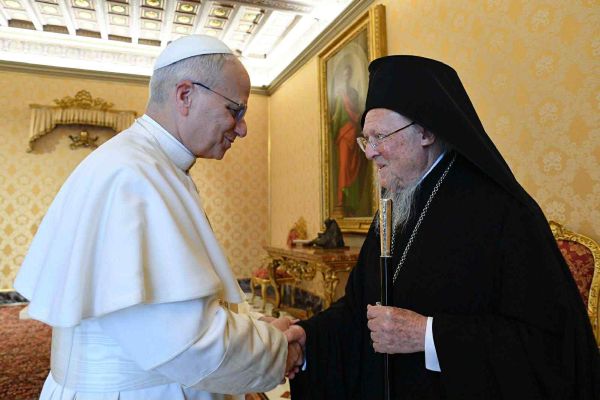
 Pope Leo XIV greets Orthodox Ecumenical Patriarch Bartholomew of Constantinople at the Vatican May 19. The patriarch, who came to Rome for the pope’s inauguration, will host Pope Leo at several prayer services and meetings in Istanbul during Pope Leo’s first papal trip. (Photo: CNS/Vatican Media)
Pope Leo XIV has steadfastly voiced his concerns for the Christians living in the Middle East. Putting those words into action, for his first papal trip abroad, he has traveled to the region to meet with political and religious leaders.
Pope Leo was scheduled to arrive in Turkey on Nov. 27 and travel to Lebanon on Nov. 30, where he will stay until Dec. 2.
While in Turkey, Pope Leo will also mark the 1,700th anniversary of the Council of Nicaea, when all Christians from the East and West were united as one Church. The Nicene Creed is still recited in churches worldwide.
“You look at some of the beautiful comments he’s made about Church unity — he longs for it, and this is an opportune time, especially in the face of secularism and anti-Christian sentiments throughout the world,” Bishop Gregory Mansour of the Eparchy of Saint Maron of Brooklyn told The Tablet. “This is the time for the Churches of the East to get together and not be divided.”
Father Antoine Rizk, superior general of the Basilian Salvatorian Order, an Eastern Catholic monastic order in Joun, El-Chouf, near Sidon, Lebanon, told The Tablet the central message of Pope Leo’s visit to Turkey and Lebanon is that “Christians are not forgotten, and that we have hope to live in peace with everyone.”
RELATED: Pope Leo’s First Trip Will Focus on Ecumenical, Interreligious Relations
According to the Vatican, while in Turkey, Pope Leo will first travel to the town of Iznik, which is modern-day Nicaea. He will then visit the mausoleum of Mustafa Kemal Atatürk, the founder of the Republic of Turkey, before attending a welcoming ceremony at the Presidential Palace and meeting with President Tayyip Erdogan.
The Holy Father will also meet with local Catholic and Orthodox clergy.
On Nov. 29, he will meet with Ecumenical Patriarch Bartholomew of Constantinople, the spiritual leader of the Eastern Orthodox Church, at the Patriarchal Palace. There, they plan to jointly sign a declaration, the topic of which has not been disclosed.
On Nov. 30, the two faith leaders will partake in an ecumenical blessing before Pope Leo departs for Lebanon.
Father Rizk, the former pastor at the Melkite Catholic Church of the Virgin Mary in Park Slope, said he views the Pope’s visit to Turkey as a significant step in support of Orthodox Christians locally and internationally.
“We need to maintain stability and work towards peace. Christians throughout the region are excited for the Pope’s visit,” Father Rizk said. “He is boosting their morale as well and telling them that he stands beside them.”
As for Lebanon, Pope Leo told reporters that he hopes to bring a message of peace to the country, which has been ravaged by war.
He will arrive in Beirut on Nov. 30, a city once described as the “Paris of the Middle East.”
One year ago, Lebanon was hit by a barrage of Israeli missiles targeting Hezbollah strongholds in the southern part of the country, where Christians were trapped amid the bombings. At the time, Pope Francis said he was saddened by the violence in the region and expressed a hope to visit the country himself.
Pope Francis’ intention adds a layer of significance to Pope Leo’s journey.
During his visit to Lebanon, Pope Leo plans to meet with Lebanese President Joseph Aoun, a Maronite Catholic, at the Presidential Palace, the Vatican said.
When Lebanon won independence from France in 1940, there was a national pact to create a democracy. The agreement, Bishop Mansour explained, mandated that the president would always be a Maronite, the speaker of the house would always be a Shiite, and the prime minister would always be a Sunni.
“It was done that way so that nobody could dominate, and it would always be a shared democracy,” Bishop Mansour said, noting that modern-day Lebanon was founded as a country focused on a harmonious existence between Christians, Sunnis, and Shiites.
He called Lebanon “the crossroad between Christianity and Islam.”
“It’s Catholic and Orthodox and was created unlike the other 21 Arab states as a refuge for both Muslim and Christian,” he added. “ And it does not rely on Islamic law for all its citizens, it’s created where Christians and Muslims can be on equal terms, that’s unlike all the Arab world.”
Following his meeting with President Aoun, the pope plans to meet with Prime Minister Nawaf Salam, and on Dec. 1, he will visit and pray at the tomb of St. Charbel at the Monastery of St. Maroun in Annaya. He will meet with bishops, priests, and others at the Shrine of Our Lady of Lebanon in Harissa.
Father Rizk said that Lebanon is his homeland and holds a deep place in his heart.
“[Pope Leo’s] visit signals the importance of the presence of Christians in the Middle East,” Father Rizk said. “It’s a pastoral gesture on his part since the Christians in the Middle East are very fragile and scared, so as a shepherd he is looking to comfort his flock.”