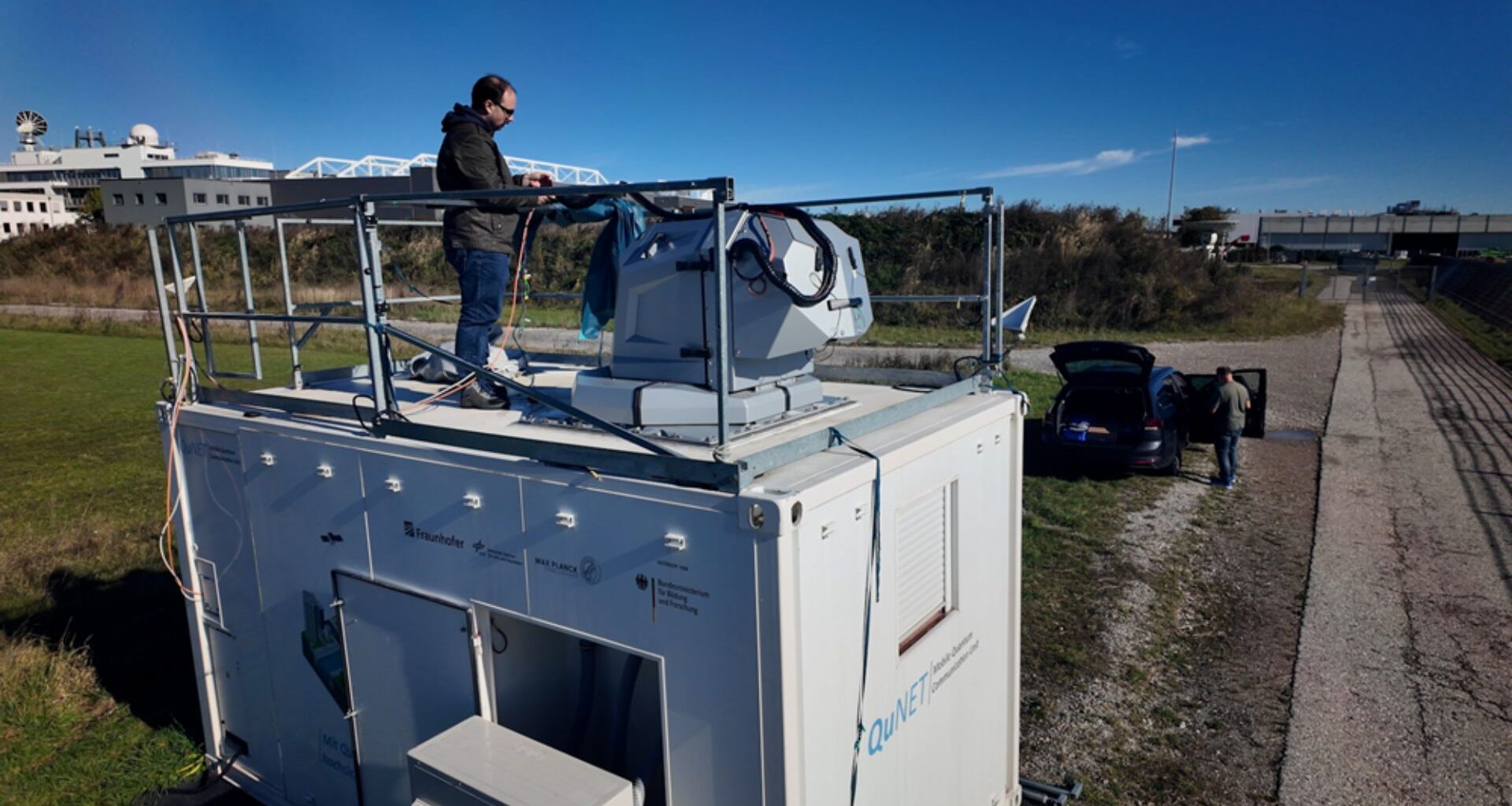
Germany has taken a significant step toward secure digital communication. Researchers under the QuNET research program have shown that quantum key distribution (QKD) can work reliably across hybrid and mobile communication channels.
The achievement marks a milestone for future quantum-secured networks and strengthens Germany’s push for technological sovereignty in cybersecurity.
Quantum communication is gaining importance as conventional encryption faces threats from advancing computing technologies. QKD uses the principles of quantum physics to generate secure digital keys.
These keys are impossible to copy undetected because the signals often contain only a handful of photons.
The German Federal Ministry for Research, Technology, and Space is backing this development. It has invested €125 million (approximately US $145 million) in the QuNET project.
The Fraunhofer IOF and Fraunhofer HHI work alongside the Max Planck Institute for the Science of Light, Friedrich-Alexander University Erlangen-Nuremberg, and the DLR Institute of Communication and Navigation.
The consortium has completed multiple real-world tests over the past four years.
In 2021, the team held the first quantum-secured video conference between two federal agencies. In 2023, they demonstrated an ad-hoc point-to-point link in Jena.
By 2024, personal data traveled securely across Berlin’s municipal fiber network.
Earlier in 2025, researchers transmitted quantum information to a DLR research aircraft to test mobile compatibility.
Each milestone demonstrated performance under increasingly complex and realistic conditions.
The latest publication compiles these experiments and shows progress in blending diverse technologies into one working system.
“We have shown that different QKD protocols and link types can be integrated into a functioning overall network. This heterogeneity has not been published worldwide before,” said Dr. Matthias Goy of Fraunhofer IOF.
Building mobility into secure networks
Researchers also addressed stability challenges. Quantum signals degrade quickly, especially in turbulent air.
The team tested several systems in Jena that transmitted keys through moving air columns using free-jet technology.
The approach enables mobile, temporary, and long-range secure channels. It can also bridge gaps where fiber infrastructure does not yet exist.
Hardware and software integration played a key role. Networks must combine fiber, free-space optical links, and future satellite nodes.
The experiments demonstrate that different architectures can work together without undermining security.
“This allows us to create technological expertise in Germany and reduce dependencies in a security-critical field of the future,” Goy added.
These developments show momentum toward a scalable, future-proof system that can adapt as quantum hardware evolves.
Next phase
The next step is to link Berlin, Jena, Erlangen, and Oberpfaffenhofen into a hybrid national quantum network.
The plan mixes fiber lines, free-space links, and optical ground stations for satellite communications. “We are thus preparing the transition from local test sites to scalable networks,” said Goy.
Long term, researchers aim to establish a sovereign quantum network for government, industry, and critical infrastructure.
The rollout would mark a shift from experimentation to deployment, building the foundation for a secure communication era in Europe.