South Africa declares gender-based violence a national disaster • FRANCE 24 English
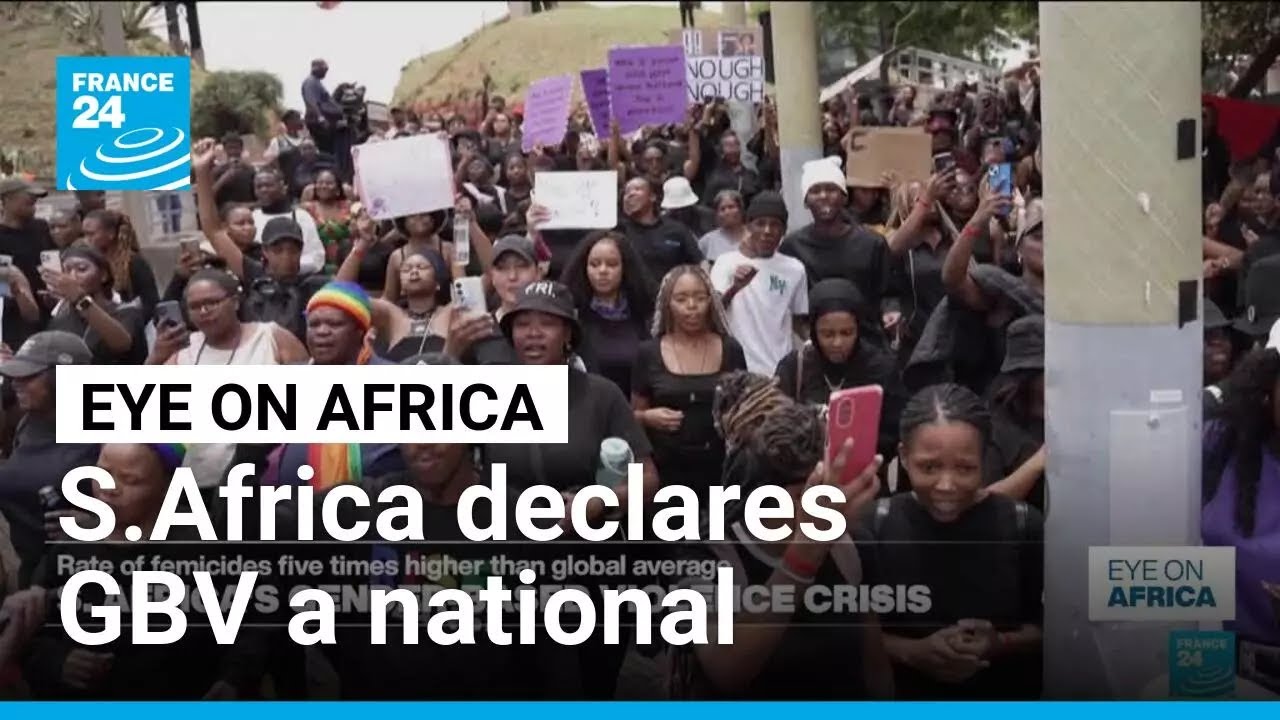
Hello and welcome to Ion Africa. I’m Clarice Fortune and here are the top stories from across the continent. As the world marks the International Day for the Elimination of Violence Against Women in South Africa, 15 women are killed every single day. Nationwide protests have pushed the government to finally declare gender-based violence a national disaster. In Nigeria, the 24 school girls abducted in Kebab state have been rescued. But the kidnapping crisis is far from over. More than 350 children taken in just one week and a new attack in Quir State where gunmen seized women and children. And no ceasefire in sight for Sudan. Washington’s latest proposal has been rejected by both waring sides. And as diplomacy stalls, fighting intensifies with the army repelling a new RSF assault in the south. On November 25th, the world turns its attention to violence against women, a crisis that remains devastatingly widespread. In South Africa, anger has recently spilled onto the streets. Women across the country staged a symbolic shutdown, lying still for 15 minutes to honor the 15 women murdered every day. After years of pressure, the government has now declared violence against women a national disaster. acknowledging what the UN calls one of the highest femicide rates in the world. Cameroon Casambala is a spokesperson for Women for Change, one of South Africa’s leading voices in a fight against gender-based violence and femicide and she joins us live from Jesusburg. So welcome to our program. So South Africa has just classified violence against women a national disaster in part thanks to your mobilization. So what do you think of that decision in practical terms? What does that change? I think for us it’s an affirmation that it is as much of a crisis I’ve been trying to show them. I think we’ve been having this conversation for a long time. So finally having them you know classify it as a national disaster speaks to the magnitude of the issue and I mean our our statistics are terrifying. You know we have six times the global average rate of femicide. We have 117 rape cases reported every day. like our numbers are terrifying. So this was a very key moment, an important um admission of the government to say that we recognize that this is a national disaster. On a more practical level, I think for us, what we’re expecting to see is more efficient implementation of existing frameworks and legislation. We don’t need new promises from them. We don’t need more declarations or papers signed. We have great frameworks and um policies in place. So what we want to see is the efficient implementation of them. So that looks at clear auditing and transparency in terms of funds and when funds are being released as well as looking at reports, full breakdowns, um mobilizing and arranging a multi-ministerial um civil society and private organization committee. So like trying to have that kind of multi-layered approach because we do need to tackle this comprehensively. Cameron, so why is South Africa’s level of gender-based violence so extreme compared to global averages? I think there’s multiple elements that come into play in South Africa. We have a history, you know, of violence with the apartate system where violence and and power and control and masculinity were kind of interwoven together. And so then it became this culture and this normalization that to be powerful and to be a man means being violent and being controlling. And I think that seeped into the psyche of of men in South Africa. and then it you know translated into other generations and this is when we speak about intergenerational trauma you know but then there’s also the added element of the patriarchal systems which label women as secondass systems and even objects to to men and so I think what happens there is you can imagine if you bump a table you’re not going to feel bad that you bump the table and that is almost the equivalent of how you know women and queer people are seen within South Africa and then we also have extremely high unemployment and substance use issues which attribute and and and contribute to higher levels of gender based violence as well. So where do you think uh the system is failing? Policing, justice, uh social services and so what do you think needs to be changed first? I think the unfortunate thing with gender based violence and femicide is it can’t be tackled from just one particular area. We need to look at the justice and the court systems because we have a poor conviction rate and we often have um people leaving on very low bail. I don’t know the equivalent, but something as simple as 300 g bail being released um having raped someone, which is a very very low bail rate. We also have law enforcement issues with police themselves rejecting victims and turning them away should they reach out for help. We have bureaucracy issues where there’s mishandling of cases. We have medical issues where we’ve had a a backlog on DNA um you know being um analyzed. And so we have so much backlog within the service delivery part on multiple levels that it’s very hard for victims and you know survivors to come forward should something happen to them. And then on a social cultural element this violence has seeped into the social norms and the cultural dynamics. And so within the communities themselves we continue to perpetuate this violence um and and keep reinforcing it within our communities. So I think it it takes looking at all of these various elements very closely and I think that’s why for us it was so important that this was declared a national disaster because we have a national strategic plan to tackle GBV and femicide but it wasn’t being implemented properly and it’s actually very comprehensive and this is what we’re expecting now that implementation does then look at the judicial system law enforcement service delivery um our tutusella care centers ensuring that there’s a steering committee managing this like it it takes so much more control over the crisis and looks at it from all the elements it needs to be analyzed from. And obviously South Africa is not the only country in Kenya for the year 2024 the silencing women association has recorded 127 cases of femicide compared to 82 in 23. Do you work your organization work with other countries as well on the continent? No. So our organization is primarily focused on South Africa and I think for us maybe the comparison as well is to see how drastic the issue is here and that’s why we focus so much is we had 5,578 women killed in 2023 to 2024. So the magnitude of the issue means that our capacity is so tightly woven in South Africa and my organization women for change we are a team of five people so we are so limited in our ability to do the work you know we don’t have external funding coming in so our our work really predominantly focuses within South Africa and what is within our reach and our capacity to work on so I think that’s been kind of our focus but what we have seen is that we’ve been able to communicate with other organizations across the world who are also doing the same kind of work and learning from each other bringing insight into each other’s experience and particularly with our shutdown we saw multiple countries engaging in some kind of shutdown or protest of their own in solidarity of that movement because gender based violence and femicide is a global issue it’s just particularly you know harrowing in South Africa South Africa thank you very much Cameon Casmbala spokesperson for women for change now to Nigeria where all 24 school girls abducted from a school in KB state last week have now been rescued among moment of relief. Am I a surge in mass kidnappings across Nigeria but elsewhere the crisis continues in a village in western Quir State gunmen have seized 10 women and children. In total more than 350 school children have been taken in the past week alone reuniting national outrage over Nigeria’s deepening kidnapping epidemic. France 24’s Sam Olukoya has the latest on this growing wave of attacks. Well, it took about the same pattern with what we’ve seen before, except that in this case, you have gunmen entering a village and then shooting indiscriminately and then picking those they can pick and at the end of the day, at the end of the operation, they went away with 10 people. It’s u it’s a bit concerning for those in the area because it was in the same area. 38 people were abducted a little over a week ago and then they were just only just released two days ago and you have people released just two days ago and within 48 hours or 24 hours government returned to the area and kidnap more people there means the insecurity in the area is still very much there. There had been a lot of uh outpouring of emotion calls on the government to do something very very urgently before the problem even escalates. I mean the more people are kidnapped and ransom is paid the more the government are armed and the more they become very dangerous. Schools of the 19 states in northern Nigeria. Schools in 10 states have closed because of this insecurity. The Nigerian Union of Teachers has warned that they may have to go on strike if this uh situation continues because uh if there’s no security in the schools then there’s no way they can teach under that kind of environment and it could threaten the educational advancement of the country. So there’s a lot of outcry that the government has to do more and from the way we see it is not as if the government is doing enough. The recent kidnapping of the in the school where more than 200 children were taken away the Catholic church owners of this of the school said the government has not done much in terms of the efforts to rescue those who have been kidnapped. So to a large extent people have lost faith in the government’s ability to protect them. US’s Africa envoy Masel Bulah says neither of Sudan’s waring sides had accepted a new ceasefire proposal despite urging both to agree to the plan presented by Washington without preconditions. Meanwhile, violence continues. The Sudanese army rippled an RSF assault on a key southern city a day after the paramilitary group declared unidil lateral three months truth. Lawrence Beresa has more. A day after the leader of Sudan’s rapid support forces announced a unilateral humanitarian truce, US Africa envoy Masad Bulos urged both of the waring sides to formally accept the latest peace plan put forth by Washington. We would like them to see accept the specific text that we presented to them which is quite comprehensive and was extensively discussed with both sides. The other side as well welcomed the proposal if you recall a few weeks ago but has not accepted uh formally accepted our our text. On Sunday, Sudanese Army Chief Abdel Fatal Burhan slammed the US proposal as the worst one yet, saying it would eliminate the armed forces while keeping the militias in place. In an ominous sign for future negotiations, Al Burhan also specifically criticized Bulos, calling him an obstacle to peace and denounced the participation of the United Arab Emirates as a mediator in the peace process. Sudan’s military government has repeatedly accused Abu Dhabi of backing the RSF, a claim that’s been supported by multiple experts and UN reports, but which the United Arab Emirates continues to deny. Dising claims and misinformation campaigns will not deter us from continuing to work with regional and international partners and with the United States to end the war and to support the Sudanese people. The exact contents of the latest peace plan remain unknown, but an earlier version, which both parties rejected in September, called for a three-month ceasefire and a transition to civilian rule that excluded the waring sides. Despite announcing a unilateral ceasefire on Monday, the RSF haven’t formally agreed to the plan either. On Tuesday, the Sudanese army said it repelled a major assault by the militia on the strategic city of Babusa in West Cordovan. In Aricost, the law has mandated a 30% quota for women in legislative elections in major constituencies since 2019, just over a month before the vote. And with the electoral commission having just validated the candidacies, the quarter has not been met. For Jasmine Tre, this is a milestone moment. She is standing to become a substitute member of parliament. She is one of the few women applying to run in the December general election. From the moment I expressed my desire to run for parliament, my family opposed it. Some people told me quite clearly that I couldn’t do certain things simply because I’m a woman. Why should we exclude ourselves from the political scene? If men can do it, I think we can too. Since 2019, political parties have been required to nominate 30% women candidates in major constituencies. But this quot has never been met. For the upcoming vote, women make up only 11% of approved applications. There needs to be a connection between a specific law on quotas and the electoral code and a provision must be implemented that is a coercive measure, not an incentive. People don’t care about incentives. To bridge this gap, the National Human Rights Council has introduced a political training program for future women leaders in politics. With only 12% female representation in parliament since 2021, these efforts are unlikely to deliver gender equality. And we conclude our program with this scary site for many Ethiopians. Highly gooby waking up. The volcano has erupted for the first time after 12,000 years. The plume of volcanic ash you can see has swept across the Red Sea through Oman and reach India, disrupting flights there. Some residents in northern Ethiopia’s Athera district were coughing and mobile medical services from the Afa region have been launched in the remote area. And this concludes today’s edition of Iron Africa. Thank you for joining us. Keep on watching France 24. [Music] The Golden Triangle region bordering Laos, Thailand, and Myanmar is notorious for drugs. From poppy fields to makeshift labs, from drug traffickers to Chinese mafia, [Music] from opium to synthetic drugs, the infamous golden triangle. is still the heart of drug trafficking. Don’t miss this exclusive report on France 24.
In tonight’s edition, as the world marks the International Day for the Elimination of Violence Against Women, in South Africa, 15 women are killed every single day.
Also, in Nigeria, the 24 schoolgirls abducted in Kebbi State have been rescued.
And Washington’s latest proposal of a ceasefire for Sudan has been rejected by both warring sides.
#EyeOnAfrica #Kebbi #Sudan
Read more about this story in our article: https://f24.my/Ba8D.y
🔔 Subscribe to France 24 now: https://f24.my/YTen
🔴 LIVE – Watch FRANCE 24 English 24/7 here: https://f24.my/YTliveEN
🌍 Read the latest International News and Top Stories: https://www.france24.com/en/
Like us on Facebook: https://f24.my/FBen
Follow us on X: https://f24.my/Xen
Bluesky: https://f24.my/BSen and Threads: https://f24.my/THen
Browse the news in pictures on Instagram: https://f24.my/IGen
Discover our TikTok videos: https://f24.my/TKen
Get the latest top stories on Telegram: https://f24.my/TGen
7 comments
i mean, i agree, seems like this is a big problem in all of africa…
but also what isnt a national disaster in south africa?
south africa as a whole is a human disaster. xD
they cant provide electricity, as much as i agree that domestic violence is an issue, i dont think you will ever see any effective implementation.
if you cant even provide the basics of human living to your people, effective implementation of already existing systems and laws is impossible.
i dont think this will change anything. unfortunately.
also hilarious that you blame apartheid for this, it will never change, because you refuse to acknowledge reality and always look for the comfort of the scapegoat.
thats how you know nothing will change.
F24 is a national disaster
, you turned a functioning 1st world country into an African sh.. hole.
Blame yourself…
Gender based violence is our culture. Look it up.
So blaming white people didn't solve their problems? What a shocker.
Africa was unironically better under europeon influence
Comments are closed.