Carin Schoppmeyer
NWA Democrat-Gazette
“Canopy is first and foremost a refugee resettlement organization,” said Devon Newman, entrepreneurship coordinator. But 2020, as more refugees were being settled in this area and many had an interest in starting a business, the group established an entrepreneurship program.
The 12-week course is open to all immigrants and children of immigrants in Northwest Arkansas, Newman said. Through the program, the nonprofit has helped launch more than 30 immigrant-owned businesses in the area, according to Newman.
Highlights include the “Entrepreneurship Pitch Competition,” which occurs in the 10th week of instruction and the Entrepreneurship Expo graduation event in the 12th week.
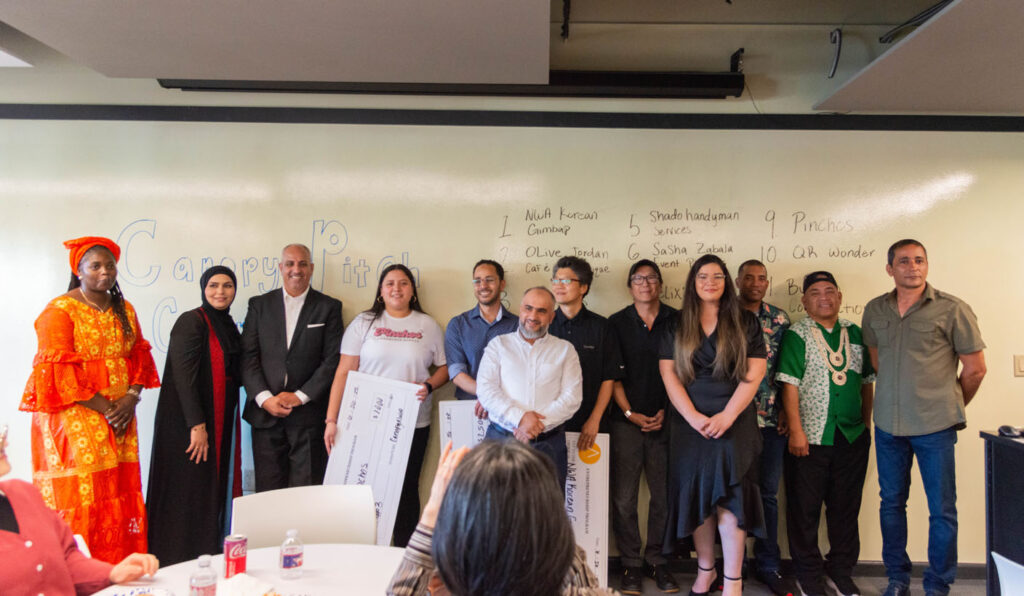 Canopy NWA Entrepreneurship Program 2025 spring cohort members gather for a photo after their Entrepreneurship Pitch Competition. Current class members will square off to pitch their businesses to judges on Dec. 4 at Secaru Coffee Roasters in Fayetteville.
(Courtesy photo)
The current cohort will square off in the pitch competition at 6 p.m. Dec. 4 at Sicaru Coffee Roasters, located at 716 W. Sycamore St. in Fayetteville. The prize for first place is $2,500, $1,500 for second and $1,000 for third place.
Class participants have 60 seconds to pitch their business to three judges.
“They just have to craft their pitch,” Newman said. “It’s something we work on each class until the pitch competition, and we also can work on it in one-on-ones, if anybody is especially nervous. But it’s up to the judges from there.” Judges rank the pitches based on uniqueness, feasibility, accessibility and then overall presentation.
Canopy’s commerce course culminates with the graduation day Entrepreneurship Expo, happening from 6 to 7:30 p.m. Dec. 18 at the Fayetteville Public Library, located at 401 W. Mountain St.
Each entrepreneur has an opportunity to showcase their business and their culture.
“The expo is really fun because there’s typically lots of free food — even if they’re not a food business, a lot of the entrepreneurs like to make food to share their culture,” Newman said. “It’s a chance just to network with new entrepreneurs and seasoned entrepreneurs, and also just see how diverse Northwest Arkansas really is.
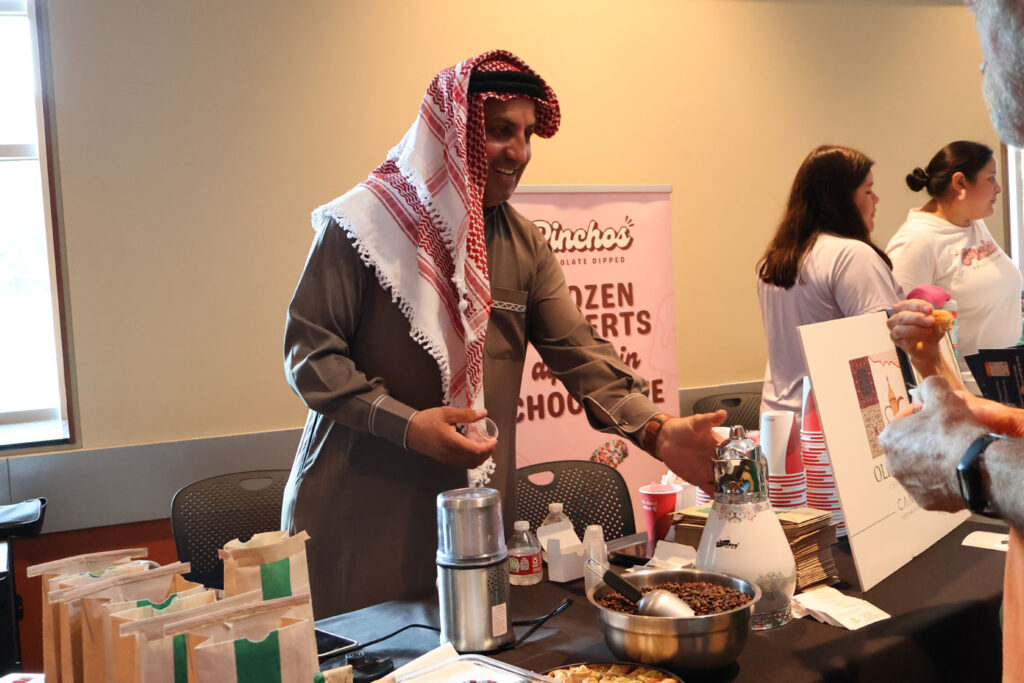 Ahmad Abuhalimeh, Canopy NWA Entrepreneurship graduate, discusses his new company at a previous Entrepreneurship Expo. The next Expo will take place on Dec. 18 at the Fayetteville Public Library.
(Courtesy photo)
“So it’s just really cool to come out and meet people from Afghanistan and meet people from El Salvador or or wherever else they happen to be from,” he added.
Founded in 2016, Canopy NWA has welcomed more than 950 refugees from 29 countries around the world, providing them with assistance to resettle in Northwest Arkansas. The nonprofit organization’s mission is “to create a community where refugees are welcomed and equipped with all they need to build new lives.”
Support includes resettlement assistance, intensive case management and assistance with basic needs like finding stable housing, health services and providing job training. In 2019, the organization began what they call the Long Welcome, which provides immigration legal services, integration support, career and employment and economic advancement.
To equip emerging entrepreneurs with tools to successfully launch their businesses, the 12-week course is offered in spring and fall cohorts and focuses on four pillars — entrepreneurship training, loan assistance, business services and real estate.
Newman provides instruction for the class and brings in guest speakers throughout the course.
“We go over everything from what is an LLC versus a sole proprietorship, what kind of licenses or permits might be needed, how to create a website, how to maintain it, online marketing — really, everything you need to know to also build a business plan, including financial projections,” Newman explained. The goal is that by the end of the course, “they have a fully fledged business plan that they can enact and open their business with.”
Graduates receive assistance in applying for loans through Community Development Financial Institution (CDFI) and/or help in locating other funding resources in the community.
“We’re with our entrepreneurs for two years. So, if six months later, they decide they want to start a new segment of their business and they need help with the license, or they need help creating a website, because they never got around to whatever their need is those two years, we help them,” Newman stated.
Non-monetary real estate assistance and guidance regarding leases, rent negotiation and location selection is also offered.
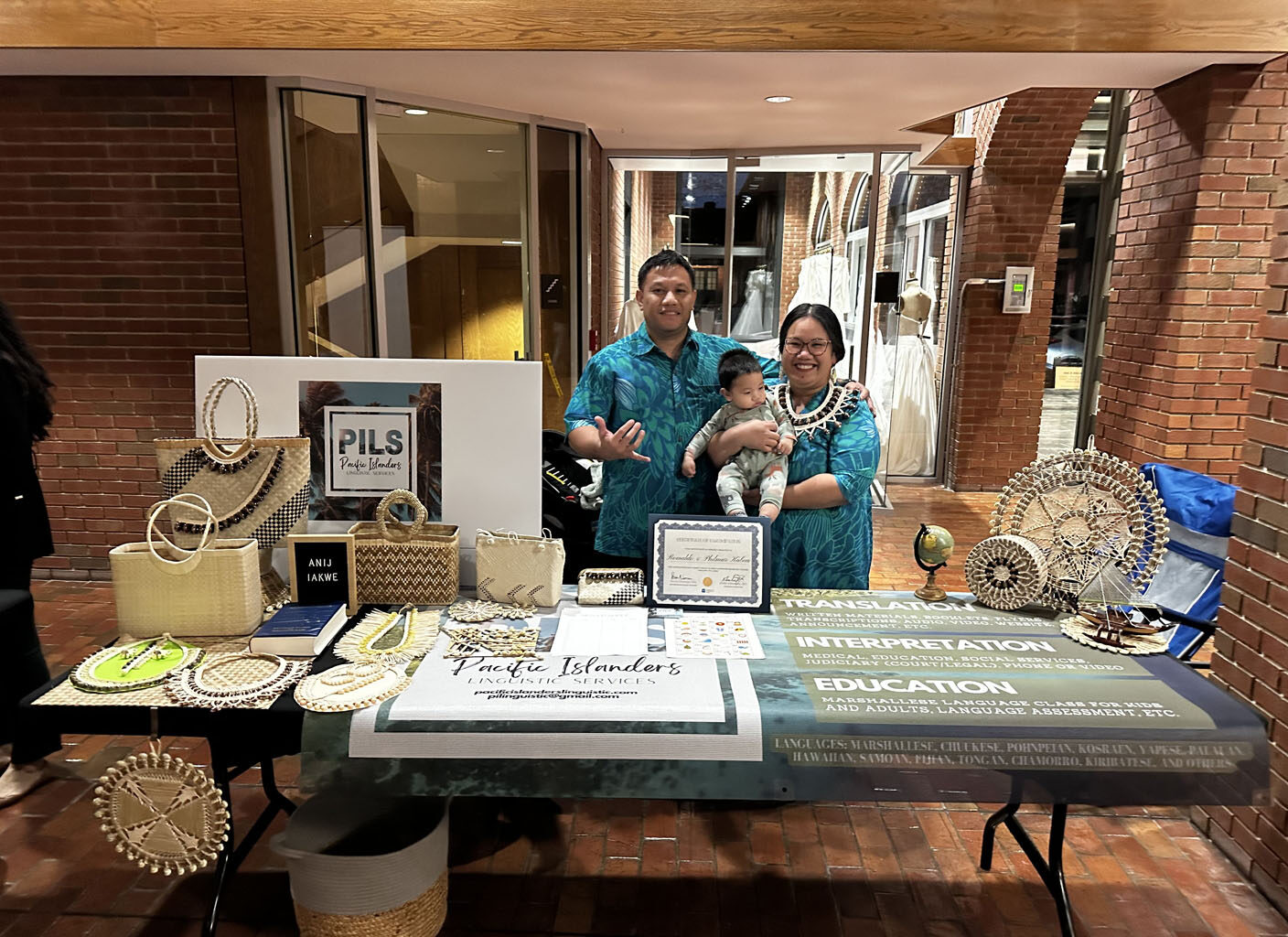
Romaldo and Philmar Kabua, co-founders of Pacific Islanders Linguistic Services (PILS), were born and raised in the Marshall Islands and moved to Arkansas from Hawaii in 2021. Romaldo Kabua said they were referred to Canopy NWA through the Arkansas Coalition of Marshallese and enrolled in the entrepreneurship program in 2023.
Kabua said the program helps entrepreneurs establish and build their business, “from being a dream to the name of it, to all the way to bringing it to life, and then more in-depth with things like, taxes and how to get a loan and opening up a bank account for the business and all that.”
“Pacific Islander Linguistic Services is here to break down the Marshallese language and the cultural barriers, because we know that this is the next Marshall Islands,” Kabua said. “It’s got like 15-20,000 Marshallese here. But our clientele is not the Marshallese themselves. It’s actually the bigger businesses like Walmart, the Walton Foundation — any English, non-Marshallese-speaking (organization).
“We translate, incorporate, interpret and do cultural humility trainings to these bigger corporations and businesses so that they can try to convey whatever message they’re trying to convey to their Marshallese staff, employees, partners and clientele,” he said.
Kabua took first place in their cohort’s pitch competition. “It actually helped me better understand, number one, what my business was about,” Romaldo Kabua said. “And number two, it really made me concise and convey the message within a minute or two to the client or the receiver. And number three, it it made me come out of my shell, my shyness.”
Applicants for the class must be an immigrant or a child of an immigrant with a business idea, have conversational English or supply their own translator and want to start a business that isn’t seen as a detriment to the community, such as a liquor store, for example.
“The criteria is really pretty easy,” Newman said. “We want it to be very flexible.” She meets with each applicant to ensure their idea is one that the community needs, and also is a good idea and culturally works in the U.S.