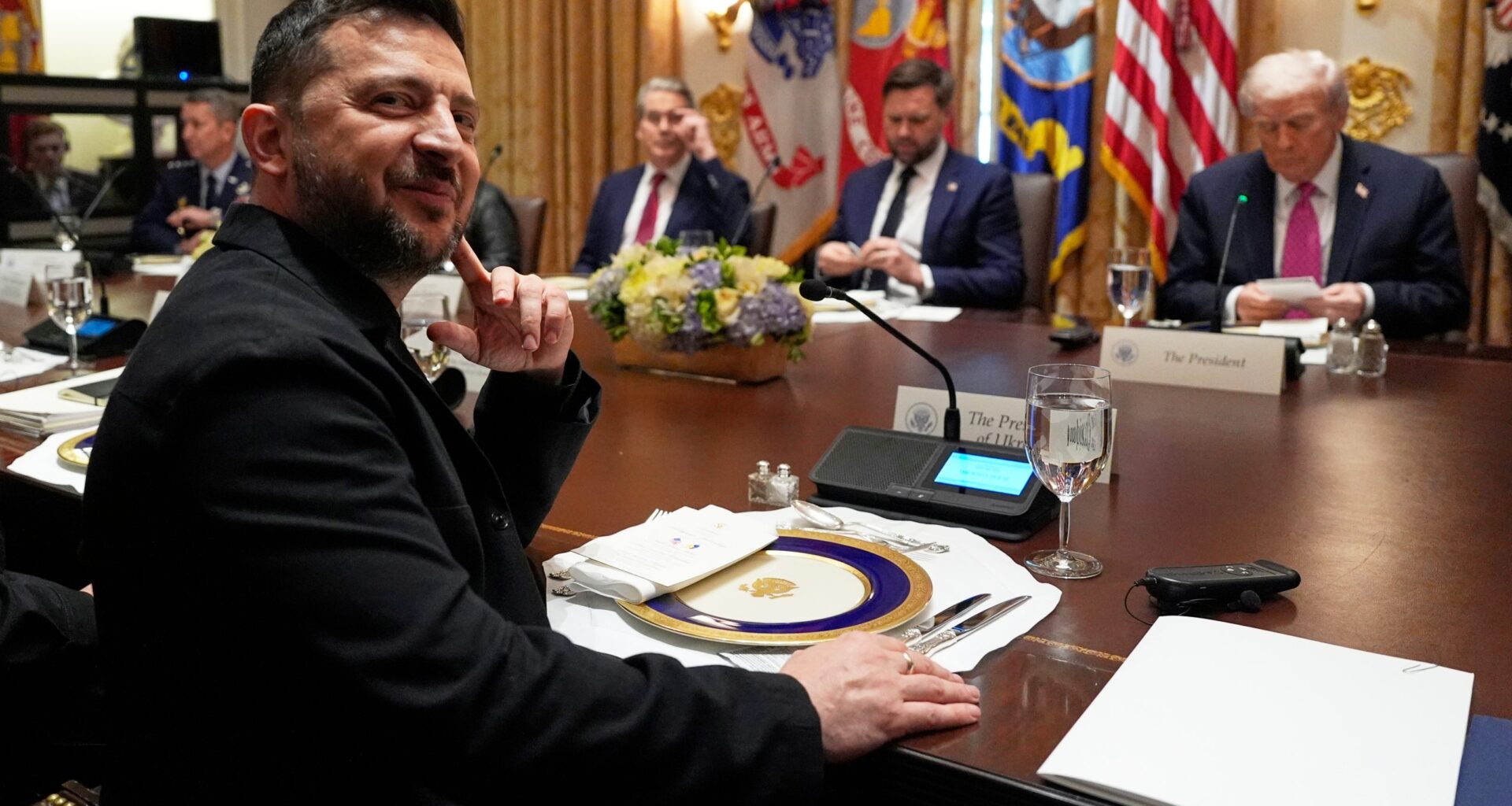
Ever since Donald Trump won the 2024 election, I have assumed Ukraine was doomed to fall to Russian President Vladimir Putin since no one would be able to stop the 47th president ending military support for Ukraine.
In office, Trump has often mocked Ukraine’s ability to defeat Russia on the battlefield, promoted ceding Ukrainian land to Russia, and threatened to yank support. Last Friday, he gave Ukrainian President Volodymyr Zelensky a Thanksgiving deadline to accept a 28-point “peace” plan heavily favoring Russian interests. (Please read Tamar Jacoby’s chilling analysis of what’s in that plan.)
Then, things got weird.
On Saturday, Trump said the plan was “not my final offer,” and Secretary of State Marco Rubio told a bipartisan group of pro-Ukraine senators that the plan wasn’t even America’s plan but Russia’s. But late in the day, Rubio posted on X that “The peace proposal was authored by the U.S.” with input from Russia and Ukraine.
On Sunday, Trump ranted on his social media site about how “UKRAINE ‘LEADERSHIP’ HAS EXPRESSED ZERO GRATITUDE FOR OUR EFFORTS” and “THE USA CONTINUES TO SELL MASSIVE $AMOUNTS OF WEAPONS TO NATO, FOR DISTRIBUTION TO UKRAINE (CROOKED JOE GAVE EVERYTHING, FREE, FREE, FREE, INCLUDING ‘BIG’ MONEY!).” But also on Sunday, U.S.-Ukraine negotiations intensified. On Tuesday, an anonymous American official told CBS News that Ukraine “agreed to a peace deal” with details pending. Other reports were less declaratory, and the Russian foreign minister took a skeptical tone toward the nascent deal. “If the spirit and letter of the Anchorage agreement are erased,” he said, referring to the agreement made between Trump and Putin last August that informed the 28-point plan, “we’ll be in a fundamentally different situation.” The Washington Post reported, “Most analysts think the latest changes will be unacceptable to Moscow.”
What explains the whiplash-inducing remarks from the White House, and especially from Rubio? Toronto Star columnist Justin Ling, reporting from an international security forum in Nova Scotia, argued that “[Vice President J.D.] Vance and his hard-right janissaries have long wanted Rubio gone ([Ukraine envoy General Keith] Kellogg is already departing.) It seems they out manoeuvred [sic] him by drafting and leaking the plan behind his back, then forcing his capitulation after he denounced it.”
A New York Times account of the negotiation zigs and the zags is more circumspect but tracks Ling’s analysis: “By any measure, the administration’s rollout of the new plan was maladroit at best. The White House was taken by surprise by the leak of its details … Mr. Rubio downplayed the proposal last Wednesday as ‘a list of potential ideas,’ while Mr. Trump, Vice President JD Vance and Karoline Leavitt, the White House press secretary, embraced it.” European leaders and pro-Ukraine Republicans were horrified by the plan, prompting the series of conflicting White House statements. Still, “by Sunday night Mr. Rubio appeared to have wrestled back control of the negotiations. He excised — for now — sections that would forever bar Ukraine from joining NATO and that banned NATO member states from forming a security force inside Ukraine that would deter Russia from launching a new invasion.”
But Rubio wouldn’t have the leeway to conduct negotiations with Ukraine without Trump’s permission. Other Trump officials have been sent packing for less subordinate behavior. Why is Rubio still around?
Granted, Rubio might get fired before this column is published. But assuming he still has his job, I think the answer lies in Ling’s observation that Trump “doesn’t care what happens to Ukraine. He is motivated only by a pathetic and delusional desire to win the Nobel Peace Prize.”
Trump must know he would never win a Nobel for washing his hands of Ukraine, ending military support, and letting Moscow steamroll Kyiv. Any fantasies of a medal ceremony in Oslo hinge on an actual peace agreement.
The president’s insatiable thirst for shiny awards and recognition from elites he otherwise disdains gives him reason to grant Rubio latitude to negotiate. Most crucially, it offers Ukraine leverage to resist a bad deal. But it gives Putin nothing.
The Washington Post recently explored Putin’s endgame:
Putin is willing to fight on despite the economic pain and stunning casualties that dwarf the losses of the United States in Iraq or the Soviet Union in Afghanistan because he senses U.S. and European weakness and Ukrainian exhaustion, according to analysts.
For Putin, the cost is worth it because it is not a question so much of conquering land but of reversing the Soviet Union’s loss of the Cold War and reasserting Russia’s status as a global power, said former Russian diplomat Boris Bondarev.
“He’s fighting not for villages in Ukraine. He’s fighting not for territory in Ukraine, not even for rare earths in Ukraine. He is fighting for a much bigger outcome,” he said. “He wants the United States, first of all, and Europe to admit that Russia has its exclusive sphere of influence where the United States and Europe are forbidden to interfere.”
“It’s not about territory. It depends on how long Ukrainians are going to fight, so his goal is to crush their appetite to resist.”
If that is true, then what Rubio and Zelensky reportedly are devising—a deal to allow NATO forces inside Ukraine—won’t give Putin an “exclusive sphere of influence” and is unlikely to win his blessing. And Putin has reason to hold out; if the next American president is Vance, who appears more than ready to pull up stakes, then in three years, Russia could be handed Ukraine on a silver platter.
Fundamentally, the three leaders want different things. Putin wants an exclusive sphere of influence beyond Russia’s borders. Zelensky wants no Russian influence within Ukraine’s borders. Trump wants a medal and a better lead on his obituary than “first president to be convicted of fraud and impeached twice.” These interests do not align. Trump could give Putin what he wants by ending military support for Ukraine, but that’s not going to impress the jurors in Oslo and therefore does not give Trump what he wants. Only a negotiated settlement between Putin and Zelensky would suffice. If a deal just came down to drawing new borders, perhaps a painful but acceptable middle ground, literally, could be found. But if Zelensky wants security guarantees backed up by NATO, and Putin wants NATO out of his backyard, then there’s no middle ground.
In other words, Trump’s narcissistic and futile compulsion for a Nobel Peace Prize may be what allows Ukraine to fight on.
Related