Last month a Honduran man who for six years had been working as a dishwasher and paying taxes in the Scranton, Pa., area was intercepted by Immigration and Customs Enforcement agents while biking to work. He was taken away with his sixth-grade daughter. His neighbors and coworkers told reporters that he had done no harm to anyone and had merely missed an immigration hearing—the kind that increasingly entails immediate deportation, separating families. His daughter’s classmates were left horrified by her sudden disappearance.
It was just one of thousands of ICE actions across the country—and one of several locally in recent weeks—justified by the calumny that undocumented immigrants are invaders and criminals.
This is a small, quiet community. Scranton hosts a Jesuit university (the University of Scranton) and is home to the descendants of European immigrants who came to the region in the late 19th and early 20th centuries to mine anthracite coal. Our city is also home to more recent waves of immigrants, especially from Latin America (Scranton today has about 75,000 people and is roughly 20 percent Hispanic) but also the Middle East, Africa and South Asia. Long welcoming of new arrivals, Scranton has been shaken by the current campaign of mass deportations.
The Catholic parish my family attends on the south side of Scranton, St. Teresa of Calcutta, embodies the cultural and ethnic streams here. The result of a recent consolidation between a historically Irish church (Nativity) and a historically Polish church (Sacred Hearts), it has held a Stations of the Cross procession in Spanish every Good Friday for more than a decade. With many others I have participated in this re-enactment of Jesus’ passion that runs through the streets of southern Scranton, one of the many cultural and religious gifts the Latino community has brought to northeastern Pennsylvania.
Evelio Menjivar-Ayala, an auxiliary bishop based in Washington, D.C., and the only Salvadoran-born U.S. bishop—himself undocumented at one time—wrote in plain and powerful words back in April: “The church remembers Christ’s suffering, death, and resurrection of Jesus in a spiritual and sacramental way during Holy Week and the Easter Triduum, but some people actually experience the Passion in a tangible and personal way in their very lives. Among them are members of the immigrant and refugee communities today.”
And, in another context, the Auschwitz survivor and French author Marceline Loridan-Ivens wrote, “Our history, the history of European Jews, is that they [the non-Jews] will never forgive us for the evil they have done to us!” Today in the United States, it may be said that as a society we cannot forgive our undocumented immigrants for the evil we have done to them, not only by exploiting their labor but by perpetuating lies about them.
For decades, undocumented immigrants have on average worked longer hours for lower wages than American citizens, driving down prices for food and other consumer goods while paying billions of dollars in taxes but remaining ineligible for most government benefits. As a society, the United States has long exploited the undocumented immigrants it is now spitting out: “They have oppressed the poor and needy, and have extorted from the sojourner without justice” (Ez 22:29).
Ms. Loridan-Ivens’s words reflect a frightening psychological and spiritual truth: Once a society has embarked on mistreating a group of people, it must either repent or scapegoat them more and more. Pope Leo XIV has put it bluntly: “With the abuse of vulnerable migrants, we are not witnessing the legitimate exercise of national sovereignty, but rather serious crimes committed or tolerated by the state. Increasingly inhumane measures are being taken—even politically celebrated—to treat these ‘undesirables’ as if they were garbage and not human beings.”
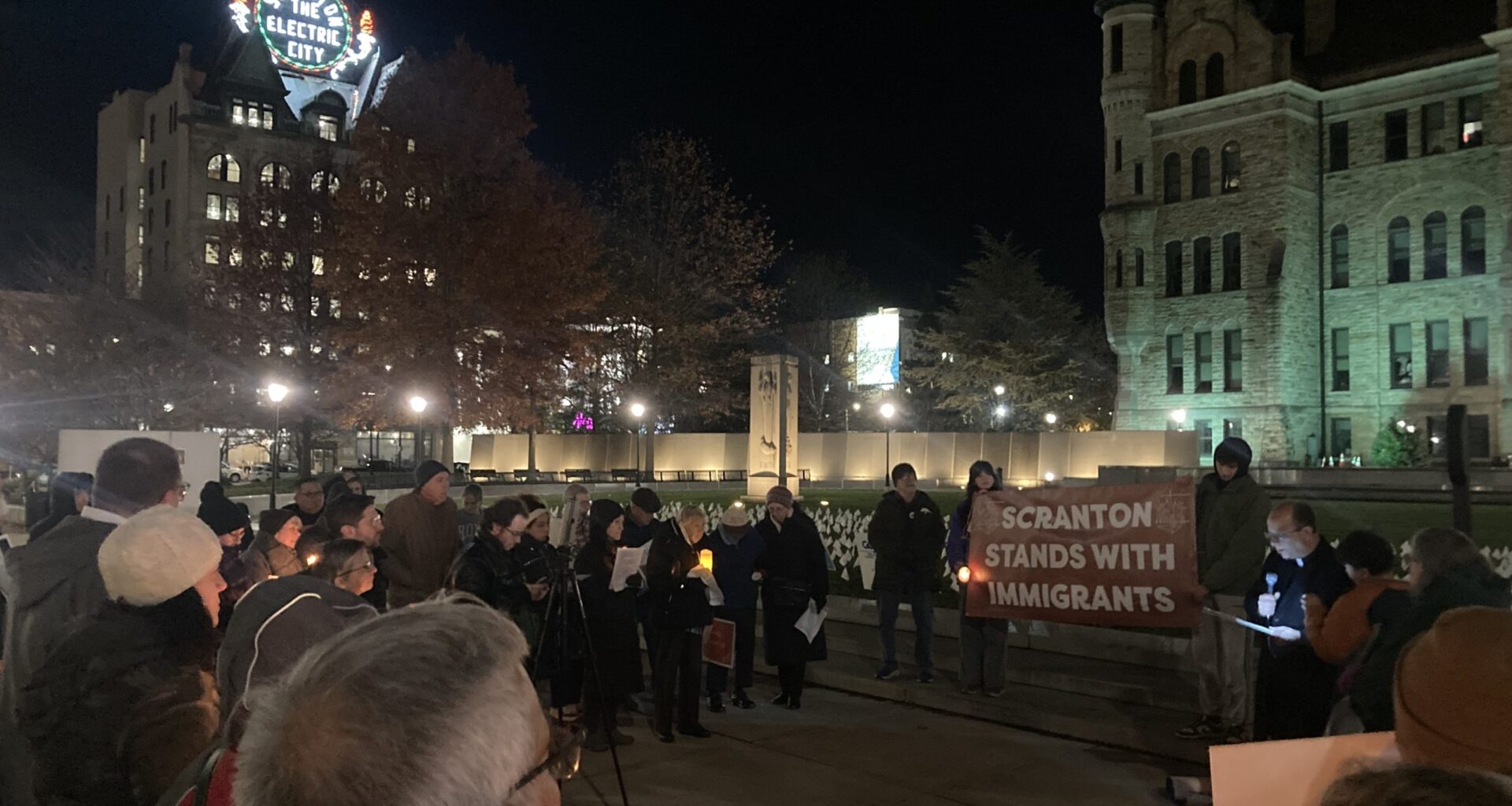
On Nov. 13, the feast day of Mother Cabrini, patron saint of immigrants, dozens of Scrantonians gathered for a special Mass at the University of Scranton, followed by a candlelit procession to Courthouse Square. The demonstrators sought to uphold human dignity and say no to the persecution of vulnerable immigrants in our own community and beyond. The recent statement by the U.S. Conference of Catholic Bishops on behalf of immigrants (strongly endorsed by Scranton’s bishop Joseph Bambera) was read in full. There were roughly 70 similar gatherings across the country.
Many Americans, including many Catholics, are wary of public protest, but the widespread outpouring of grief and solidarity from ordinary Scrantonians after the sudden deportation of our Honduran immigrant neighbor and his daughter confirms a crucial insight of St. Oscar Romero, further corroborated in the recently released apostolic exhortation by Pope Leo XIV, “Dilexi Te.”
According to St. Romero, whose own place and time were marked by intense polarization, the “preference for the poor…is a force for unity.” “Dilexi Te” asks us to put this preference for the poor at the center of the church’s life, unity and mission today. “By her very nature the Church is in solidarity with the poor, the excluded, the marginalized and all those considered the outcast of society…. [I]t is not a matter of a mission reserved only to a few.”
Are all Catholics in Scranton in sync with “Dilexi Te” and the U.S. bishops’ statement? Of course not. Lackawanna County, which includes Scranton, was divided almost down the middle in last year’s election, with 51 percent voting for Democratic nominee Kamala Harris and 48 percent voting for Republican nominee Donald J. Trump. Undoubtedly, some share the view of Tom Homan, the Catholic who serves as President Trump’s “border czar,” that “the Catholic Church is wrong” on immigration.
But with the church’s teaching authority speaking increasingly with one voice on the subject, there is hope of greater unity. In the meantime, as St. Oscar Romero wrote: “Inasmuch as we have not yet achieved this beautiful unity among all within the church, it is only proper to exhort everyone to maintain a calm Christian maturity so that we are not scandalized by the sin within the church, and so that all will do what they can in their Christian lives even though others do not do likewise.”
At the gathering in Courthouse Square in Scranton, demonstrators shared stories of people from our community being detained or deported. One Guatemalan man was detained and separated from his family as he dropped his child off at Scranton’s South Intermediate School. He had attended a talk, in Spanish, by Bishop Menjivar in September in the basement of St. Teresa of Calcutta church, just a couple of weeks before. “La iglesia está con ustedes,” Bishop Menjivar had said then. “La iglesia camina con ustedes.” The church is with you. The church walks with you.
Public demonstration is not the only way Catholics and others in Scranton have been standing with immigrants and refugees living here. Among those gathered in Courthouse Square on Mother Cabrini’s feast day were many who regularly accompany our immigrant and refugee neighbors in a variety of ways. But public witness, especially in a climate of fear and misrepresentation, has its own distinct value.
After the re-enactment of the Way of the Cross in south Scranton in 2023, a headline on the Diocese of Scranton’s website stated, “Hundreds Take Their Faith to the Streets for Good Friday Procession.” On Nov. 13, in Scranton and in scores of other U.S. cities, Catholics took their faith to the streets for our scapegoated and persecuted immigrant neighbors. May we be strengthened by the Spirit of the Lord and continue to stand with them as one.
Related