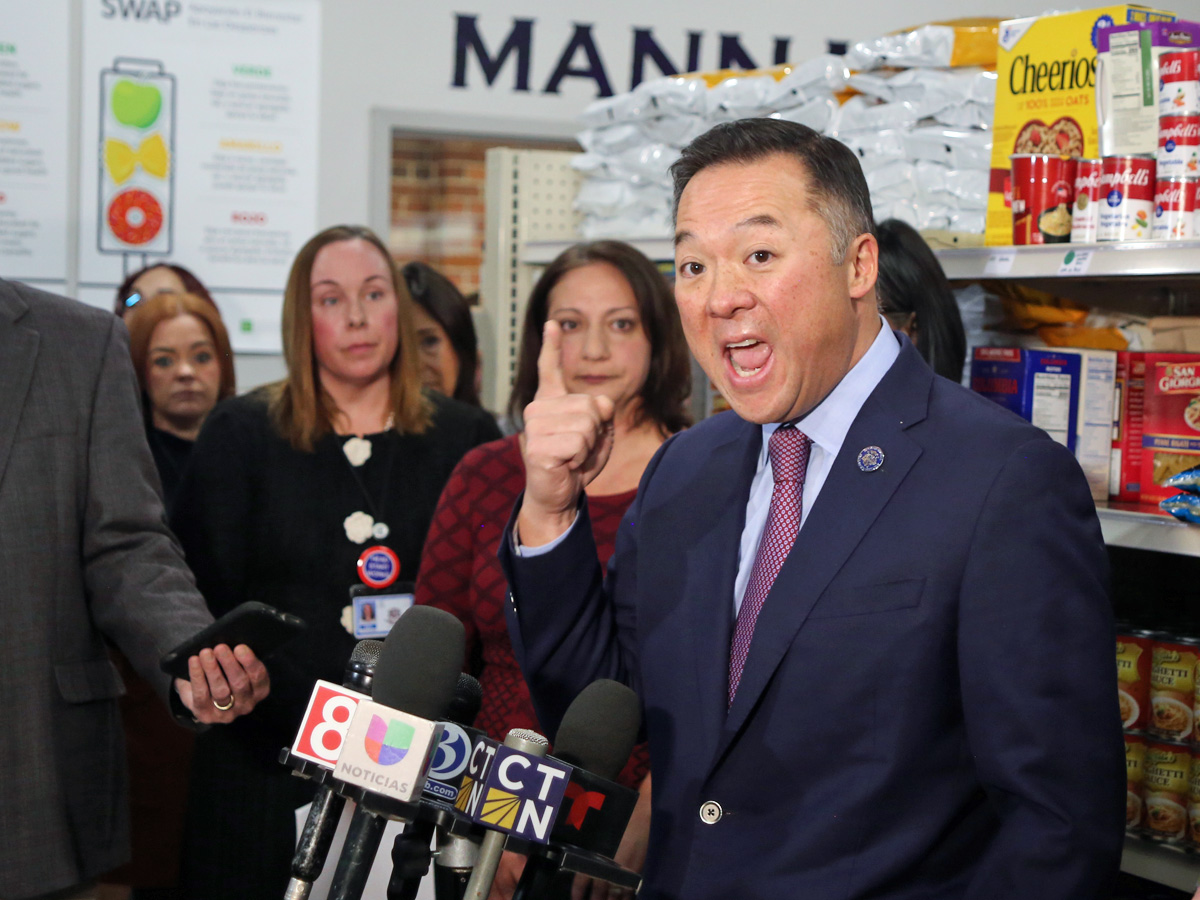
 Attorney General William Tong speaks about the SNAP program at a media briefing Nov. 3, 2025 in Hartford, CT. Credit: Donald Eng / CTNewsJunkie
HARTFORD, CT — Connecticut Attorney General William Tong has joined 21 other attorneys general in filing a lawsuit to stop the federal government from unlawfully cutting off Supplemental Nutrition Assistance Program (SNAP) benefits for thousands of lawful permanent residents, according to a statement from Tong’s office.
Tong and the coalition are seeking to block new guidance from the U.S. Department of Agriculture (USDA) that they said wrongly treats several groups of legal immigrants as ineligible for food assistance, including permanent residents who were granted asylum or admitted as refugees. The attorneys general argue that the guidance contradicts federal law and could impose massive financial penalties on states, and are asking the court to declare the guidance unlawful.
“The Trump Administration cannot help themselves. They are messing with SNAP benefits again,” Tong said. This time they are inventing their own rules to permanently ban legal immigrants — green card holders — from ever receiving food stamps. There is zero basis in the law for this cruel move, and we’re suing to stop them.”
On October 31, USDA issued new guidance to state SNAP agencies describing changes to program eligibility under HR-1, dubbed the “One Big Beautiful Bill.” The new rules narrowed eligibility for certain non-citizen groups, including refugees, asylum recipients, and others admitted under humanitarian protection programs. The USDA memo, however, incorrectly asserted that all individuals who entered the country through these humanitarian pathways would remain permanently ineligible for SNAP, even after obtaining green cards and becoming lawful permanent residents, Tong said.
The coalition of attorneys general emphasized that this position is not mentioned in the bill or in any other federal law. Federal statutes make clear that refugees, asylees, humanitarian parolees, individuals whose deportation has been withheld, and other vulnerable legal immigrants become eligible for SNAP once they obtain their green cards and meet standard program requirements, Tong said. The attorneys general argue that USDA’s memo illegally rewrites those rules and threatens to cut off food assistance for people who are fully eligible under the law.
The attorneys general argue that USDA’s guidance also misapplies the agency’s own regulations. Federal rules give states a 120-day grace period after new guidance is issued to adjust their systems without facing severe financial penalties. USDA is now claiming that this period expired on November 1, just one day after the guidance was released and before states even had a single business day to review it.
The coalition argues that this interpretation is impossible under USDA’s own regulations, which state that the 120-day period cannot begin until new guidance is actually issued. And because the statute also imposes a cost-shifting framework on the SNAP program for states that USDA determines have unacceptable error rates in administering the program, by disregarding its own rules, USDA is exposing states to major financial penalties for errors caused by the agency’s late and inaccurate memo.
States have already begun implementing the statutory changes enacted earlier this year, but USDA’s guidance now forces them to overhaul eligibility systems overnight, Tong said. The attorneys general warn that this will create widespread confusion for families, increase the risk of wrongful benefit terminations, erode public trust, and place states in an untenable situation where they must either violate federal law or accept severe financial liability. The attorneys general are asking the court to vacate the unlawful guidance and block its implementation to ensure that families do not lose critical food assistance.
This lawsuit was led by the attorneys general of New York and Oregon, and also includes Joins the attorneys general of California, Colorado, Delaware, Hawaii, Illinois, Maine, Maryland, Massachusetts, Michigan, Minnesota, Nevada, New Jersey, New Mexico, North Carolina, Rhode Island, Vermont, Washington, Wisconsin, and the District of Columbia.