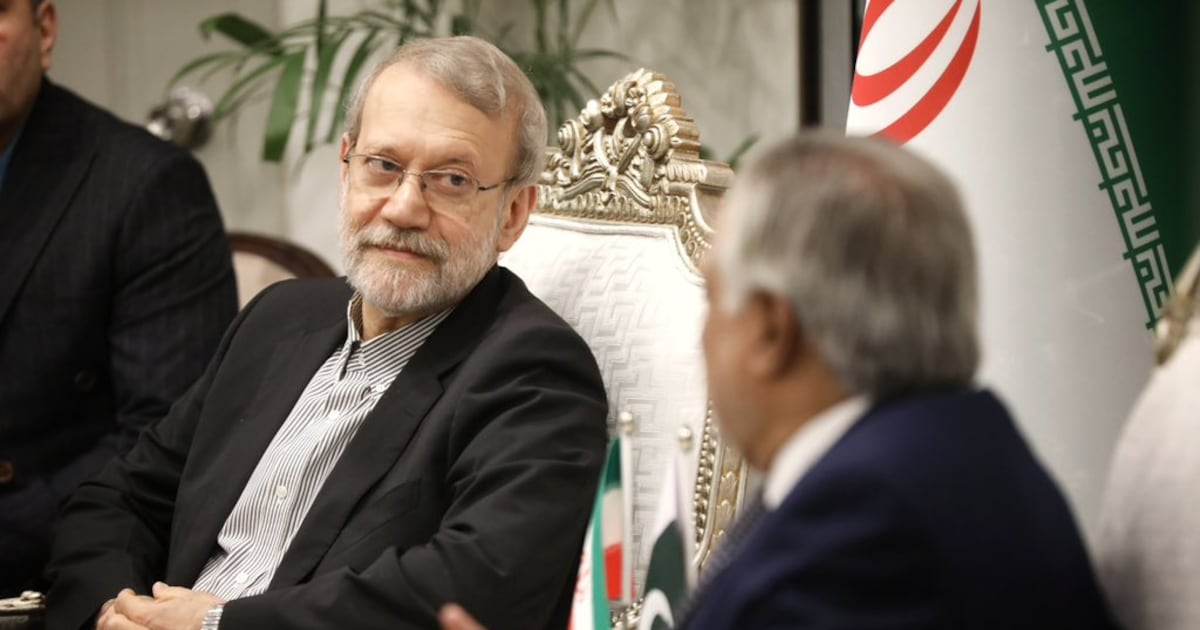
As two Muslim-majority neighbours with historic ties, Iran and Pakistan are no strangers to bilateral visits. Iran’s President Masoud Pezeshkian visited Islamabad back in August, meeting with his counterpart, Asif Ali Zardari. But this week’s visit to Pakistan by Iran’s national security adviser, Ali Larijani, carries special weight.
Mr Larijani occupies a particular place in the Iranian establishment. Much of Iran’s political class has been divided over its international orientation, with reformists and centrists often looking to the West, while many hardliners put their hopes on growing military ties with Russia or China.
A conservative centrist, Mr Larijani is thought to somewhat straddle this divide. He is close to West-facing factions of the Iranian establishment, such as former president Hassan Rouhani, but also sees value in Iran’s ties to Beijing and Moscow. In his few months in the job, he has visited Russia, Belarus and Lebanon, trying to show Iran as defiant following the shocks of its 12-day war with Israel and the US.
His visit to Pakistan, Iran’s only nuclear-armed neighbour, is a part of the same project. While sharing the usual shibboleths about Iranian-Pakistani cultural and historical ties, Mr Larijani has tried to hype up the trip as Iran gaining a powerful ally against Israel. As worries about the resumption of conflict between Iran and Israel heighten, this could be an attempt at deterrence.
Ahead of his trip, Mr Larijani tweeted that Iranians would “never forget that the Pakistani nation stood with us in the 12-day war of the Zionist regime and the US against Iran”. On his arrival in Islamabad, where he was greeted by a deputy national security adviser, he praised his hosts as “an important regional country with a privileged position in terms of regional security influence”.
The Iranian and pro-Tehran media have emphasised Pakistan’s support for Iran against Israel. Lebanon-based Al Mayadeen, close to Iranian views, reported the trip as “a turning point in attempts to change the balance of forces in the region”.
Iran’s ambassador to Pakistan, Reza Amiri-Moghadam, said Iran’s relations with Pakistan were “entering a new strategic phase”.
Mr Larijani’s trip wasn’t all about security. He raised hopes for an upgrade in trade ties. Speaking to Pakistan’s Deputy Prime Minister, Ishaq Dar, he said barriers should be removed so that the mutual trade could triple and reach $10 billion.
Iran’s help to Pakistan, by sending the Iranian Red Crescent following the recent floods there, also came up in meetings with President Zardari who thanked Mr Larijani and asked him to send greetings to Supreme Leader Ayatollah Ali Khamenei. The gas line project connecting the two countries was another topic raised in Mr Larijani’s meetings.
But Israel remains the primary focus. Iran clearly hopes to have the firm support of a major military such as Pakistan if it were to face Israel again.
According to Iranian media, Mr Zardari declared “full solidarity” with Iran following “the Zionist regime’s aggression”. He also thanked Iran for its diplomatic role during the recent Pakistan-India conflict and for its position on the Kashmir dispute. Mr Larijani praised “bravery and success” of the Pakistani army during the four-day conflict in May, even declaring that “Pakistan’s victory is Iran’s victory”.
Although these words signal alignment, regional realities limit Iranian-Pakistani security ties. As India’s government has furthered its security ties with Israel, some might have hoped for Pakistan to, in turn, back Iran. But such hopes ignore the broader picture. Iran and India have also enjoyed ties for decades and neither is likely to tarnish those easily.
Iran has rarely waded into the Indian-Pakistani conflicts. During their four-day war in May, Iran’s Foreign Minister, Abbas Araghchi, made a perfunctory visit to Islamabad, urging restraint on both sides and de-escalation. Iran did not give much meaningful support to Pakistan as it faced Indian attacks.
Regional realities limit Iranian-Pakistani security ties
New Delhi’s ties to Israel have not taken away from the country’s broader tradition of non-aligned diplomacy. It maintains close ties with Russia, having never joined the western sanctions on the country. If Iran hopes to leverage its growing ties with Russia, its geographical proximity to India could be an asset. Just a day before Mr Larijani’s trip, a top Russian transportation official said Moscow was hoping to use Iran as a transit corridor connecting it to India and China. Iran further inserting itself into Pakistan’s potential conflicts with India or Afghanistan goes against Tehran’s interests.
On the other side, Pakistan is in no rush to jump into Iranians arms either. Pakistan’s current government enjoys close ties with the West and US President Donald Trump. Prime Minister Shehbaz Sherif nominated Mr Trump for the Nobel Peace Prize and has reserved special praise for him and his “bold and decisive” role in ending the recent spat with India.
Unlike the previous president, Imran Khan, the current establishment in Islamabad is quite close to the US and is unlikely to join any anti-western alliance with Iran. Pakistan’s tight ties to China are counterbalanced with its cooler stance towards Russia, dating back to Cold War geopolitics. None of this augurs well for Iran counting on Pakistani support.
Pakistan has also never been a serious force against Israel. The country doesn’t recognise Israel and has rejected US calls for it to do so. Pakistani passports, like those from some Arab nations, Iran and Bangladesh, forbid citizens from visiting Israel. The Pakistani public is probably among the most anti-Israel in the region. But none of this translates into Pakistanis putting themselves at the risk of a military conflict with a fellow nuclear power. Aware of how risky this could become, Pakistan hasn’t done much against Israel other than verbal denouncements. And as disclosed by WikiLeaks more than a decade ago, Pakistan’s intelligence services have sometimes even worked with their Israeli counterparts in recent history.
As Iran prepares itself for potential future conflicts with Israel and America, it would be unwise to count on Pakistan for meaningful support. Mr Larijani’s best hope might be to help Pakistan make a case for Iran as it talks to the US. Islamabad could thus be another country on the long list of potential mediators for Iran.
THE BIO
Age: 33
Favourite quote: “If you’re going through hell, keep going” Winston Churchill
Favourite breed of dog: All of them. I can’t possibly pick a favourite.
Favourite place in the UAE: The Stray Dogs Centre in Umm Al Quwain. It sounds predictable, but it honestly is my favourite place to spend time. Surrounded by hundreds of dogs that love you – what could possibly be better than that?
Favourite colour: All the colours that dogs come in