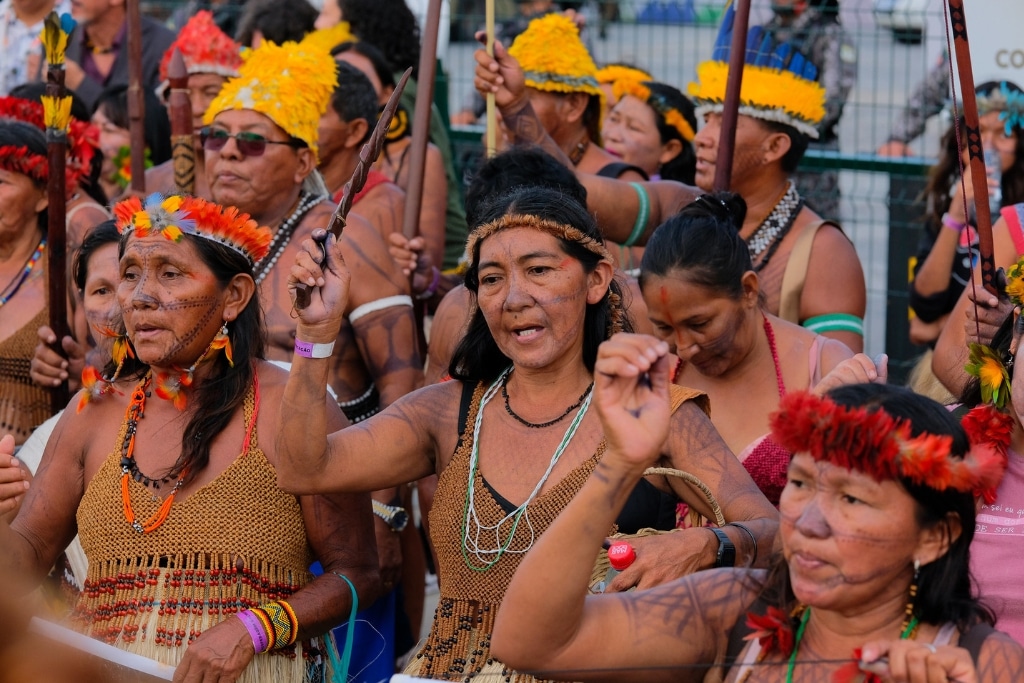
Amid a failure to take concrete steps away from fossil fuels, the adoption of the Gender Action Plan (GAP) at last week’s COP30 climate summit has gone almost unnoticed. The plan, which has been in the works for several years, enhances support for national gender and climate change focal points. The initiative advances gender-responsive budgeting and finance, and promotes the leadership of Indigenous, Afro-descendant, and rural women, among other topics.
—
Women have been historically underrepresented or excluded both in the creation of climate action plans and in their outcomes, which may include training, financing, or, more recently, adaptation mechanisms. Even the official draft text of the Gender Action Plan (GAP), agreed at this month’s COP30 summit in Brazil, took note of the “persistent lack of progress in and the urgent need for improving the representation of women in Party delegations and constituted bodies.”
The agreement’s text sets out 27 actions countries that signed the Paris Agreement are recommended to take. It explicitly recognizes several structurally excluded groups and mandates the development of guidelines to protect and safeguard women environmental defenders, who are at higher risk when they advocate for climate action. It also addresses care work, health, and violence against women through national submissions.
The GAP strengthens coherence across the Rio Conventions, the Intergovernmental Panel on Climate Change (IPCC), and the wider architecture of UN Framework Convention on Climate Change’s (UNFCCC) bodies and processes. While it does not include mandatory, verifiable indicators, it does establish voluntary national reporting through existing mechanisms, including Biennial Transparency Reports.
To some advocates, the lack of mandatory indicators spells lack of commitment. According to the Women and Gender Constituency, which has been working on the plan for several years, the process “continues to fall short of the ambition demanded by frontline communities. Their hopes, solutions, and resistance remind us that incremental progress is not enough. The world needs a transformation rooted in justice.”
Resources for the GAP will be partially furnished by the Green Climate Fund, a UN mechanism created under the Paris Agreement to support developing countries in realizing their national commitments to reduce greenhouse gas emissions. However, as the Women and Gender Constituency states, “continued lack of clarity on access, combined with the chronic underfunding across the Convention, risks leaving the GAP without the means necessary for real implementation.”
Along with pushing for finalization of the GAP, women’s groups were active throughout COP30 in integrating a gender lens into all decisions. 93% of the Nationally Determined Contributions – the national climate plans mandated under the Paris Agreement – submitted in time for COP30 consider Gender Equality and Social Inclusion, up from 40% in 2016. More than 80% of developing countries supported through Climate Promise 2025, a UN system-wide effort helping countries align their national climate pledges with the 1.5C goal, are delivering activities that explicitly address gender equality and social inclusion.
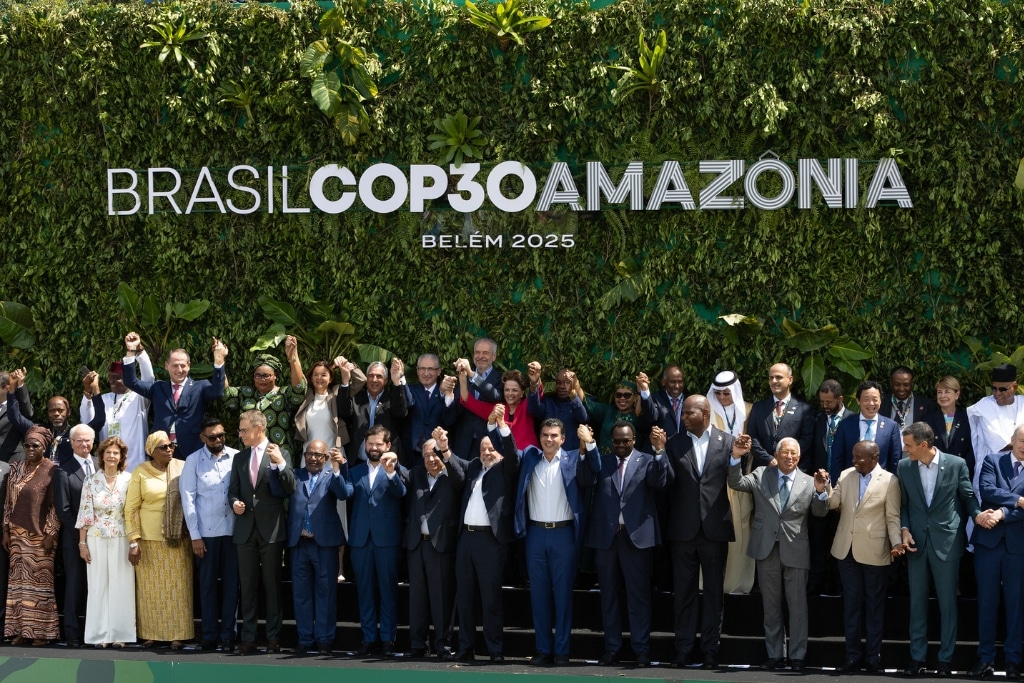
UN Secretary-General António Guterres and Brazil’s President Luiz Inácio Lula da Silva during the Photograph of Heads of Delegation at the Belém Climate Summit. Photo: UN Climate Change/Kiara Worth via Flickr.
Gender advocates emphasized the importance of the fundamental transition away from fossil fuels, which continue to impact women and gender minorities. “A genuine ‘transitioning away’ pathway means clear, quantitative targets to cut fossil fuel production in line with 2030 ambition. No country has yet put those numbers on the table. Without explicit production phase-out targets, we are still sketching around the problem instead of dismantling it,” said Shruti Sharma, Lead for Affordable Energy at the International Institute for Sustainable Development (IISD).
In a statement shared with Earth.Org, Mwanahamisi Singano, Director of Policy at the Women’s Environment & Development Organization, said, “True power is not in the decisions alone, but in how those decisions illuminate our struggle and our strength.”
Featured image: UN Climate Change/Diego Herculano via Flickr.
More on COP30 from Earth.Org (click to view)
News
Explainers
Opinion
Pre-COP30
Our non-profit newsroom provides climate coverage free of charge and advertising. Your one-off or monthly donations play a crucial role in supporting our operations, expanding our reach, and maintaining our editorial independence.
About EO | Mission Statement | Impact & Reach | Write for us