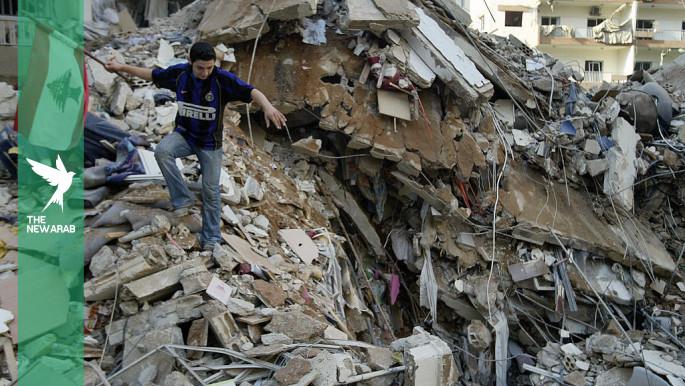
More than 100 civilians were killed by Israel by 1 September 2024, writes Yazan al-Saadi. [GETTY]
Living in Lebanon over the past two years has felt a lot like being Schrödinger’s cat: trapped in a box, beside a bomb that could go off at any moment. It’s a constant state of being both dead and alive.
The official discourse about the recent “Lebanon-Israel conflict” goes something like this: it ‘started’ on 8 October 2023, when Hezbollah ‘attacked’ Israel, which then spiralled into Israel setting off booby-trapped pagers and handheld transceivers to explode on 17/18 September, massive series of Israeli airstrikes on 23 September, and a ground invasion by Israel in south Lebanon by 30 September 2024.
A ceasefire was brokered by 27 November 2024, which has been constantly extended, with the conditions presently remaining ever-tittering towards a violent abyss.
This narrative is simple, digestible.
My reality in Beirut has been starkly more complicated and induces frequent heartburn.
Yes, Hezbollah launched military operations on Israeli forces on 8 October 2023 – in a desperate unplanned act since they were caught off guard by the Hamas-led attack on Israeli military sites and settlements within and along the Gaza enclave the day before. Nevertheless, those “attacks” by Hezbollah focused on Israeli military forces within occupied territories, thus technically a form of self-defence, as dictate the international legal texts, as well as the parameters of an unofficial understanding between Hezbollah and Israel since 2006.
Since that October, Israel unilaterally expanded the scope of the violence and ripped apart the informal agreement it had with Hezbollah, or anyone else for that matter. The Israeli army increasingly unleashed brutal attacks on Lebanese civilians, including incinerating a grandmother and her grandchildren in a car, burning agricultural land, and pointedly assassinating Lebanese journalists, like Reuters’ Issam Abduallah, healthcare workers and first responders, and hitting Beirut at least twice.
More than 100 civilians were killed by Israel by 1 September 2024.
War crimes on repeat
Nevertheless, throughout this period, the official narrative parroted by Western media outlets and political officials focused on the ‘threat of escalation’ or ‘spillover’; when clearly the Rubicon was crossed.
The Israeli war machine had been itching for a fight with Hezbollah and all of Lebanon since 2006. As it embraced a genocidal mindset in Gaza, it primed to outsource and expand that ethos elsewhere.
The pager and walkie-talkie explosions, celebrated and lauded in the West as an “ingenious” tactical act, was really grotesque and terrifying; its ‘brilliance’ on par with that of poisoned a well. Those explosions maimed thousands of non-military personnel, including doctors, the elderly, and children.
I find it one of Israel’s most blatant and obvious war crime that has been brandished so publicly and unashamedly.
But not surprising. Lebanon, after all, is the crime scene in which Israel for decades experimented with and violated the parameters of international law – from the Sabra and Shatila massacres (the second clear act of genocide by Israel, as recognised in international law and the UNGA) to putting bombs in toys.
September 2024 witnessed further and further onslaughts, a full-throttle plunge into the law of the jungle.
Israel launched widespread airstrikes that killed nearly 500 people and then assassinated Hasan Nasrallah and other top Hezbollah officials just days later, after they had already agreed to a ceasefire. The assassination involved the Israeli air force unleashing within mere minutes triple the amount of 4,000-pound bunker busters than what the US used during its ‘active war’ phase of the invasion of Iraq.
The attacks had all been done while Israeli prime minister Benjamin Netanyahu was visiting the United Nations General Assembly in New York, USA.
Then came what the Israelis and their enablers had described as a ‘limited, localised ground operation’, but in reality was a continuation and broadening of the slaughter.
Crawling from the wreckage
October and November were a bloody blur. By the time ‘the ceasefire’ was announced on 27 November 2024, more than a million Lebanese were displaced, a bunch of southern villages along the border were wiped out, residential buildings throughout the country were vaporised and more than 4,000 Lebanese, mostly women and children, were annihilated by Israel.
Despite the battering Hezbollah took from the skies and from within, to its credit, it managed to put up a formidable fight on the ground. But Hezbollah – and Iran lurking behind it – lost that battle.
There are many reasons for this that are worth examining, but first and foremost, it’s clear that whilst they were playing chess, the Israelis and their Western backers were playing rugby.
Over the years Hezbollah had become increasingly vulnerable, partly because they were tainted by their support for the tyrannical Assad regime during the Syrian civil war. Their own failures on the domestic Lebanese front—notably blocking the investigation of the Beirut port explosion of 2020 and aligning side-by-side with the political and commercial elites during the 2019 popular uprising, were also key factors.
Moreover, Hezbollah was operating, and continues to operate, within a divided country when it comes to the questions of Israel, Palestine, and armed resistance. And, as valuable as its links to Iran were, it was also constrained and shaped by the Islamic Republic’s particular security needs.
On the opposite side, the Israelis were virtually all unified and aligned in their intentions for Lebanon.
The phrase, “Lebanon does not want war,” uttered by Hezbollah’s Lebanese opponents and seen on billboards across Beirut and the northern parts of the country, did not really make sense considering that no one within Lebanon had any choice in the matter.
It should be obvious to anyone paying any attention, that the country’s desires have no impact on the box’s walls that surround it, or the bomb ticking away next to it.
War as confusion
Like the ‘ceasefire’ in Gaza, the one in Lebanon has only really shaped media coverage and public discourse, and imposed lopsidedly on non-Israeli forces to stop their defence as Israel continues to shoot indiscriminately.
In fact, since the ceasefire declaration, Israel has killed more than 100 civilians, including recently a school principal. Their attacks on the south and Beka’a have taken place almost daily. Not to mention, Israeli drones have not ceased to hover over Lebanese skies, as the occupation of five key points along the border continues still.
Just days ago, Israel killed five people as it struck Beirut. This included Hezbollah’s no. 2, another red line crossed.
As we mark the 2nd anniversary since the so-called ceasefire, astoundingly, there is a lot of chatter again about the danger of ‘escalation,’ as if things weren’t already dire.
We remain in a state of suspension, always in fear of the bomb next-door, and what future is possible for Lebanon.
The levels of confusion are also high. The Lebanese government is clearly confused as Israel and the US push it to disarm Hezbollah, with the prospect of Lebanese killing Lebanese as the outcome. Hezbollah remains confused with its boisterous rhetoric that is contradicted by its actions, as Israel continues to snipe its people away and render its future precarious. The Lebanese people are confused about how to approach their lives in any other way than just taking it day by day; they are crushed between their need to survive, and the wounds and traumas of these past two years, but also the decades since the civil war.
What disturbing and perplexing times. But ain’t that what war, at its core, is all about?
Yazan Al-Saadi is the International Editor for The New Arab. He is an analyst, writer, editor, and researcher with over 10 years of experience in social research alongside communications and reporting. He also recently published his book, Lebanon Is Burning and Other Dispatches (2025), a collection of political comics.
Join the conversation: @The_NewArab
Have questions or comments? Email us at: editorial-english@alaraby.co.uk
Opinions expressed in this article remain those of the author and do not necessarily represent those of The New Arab, its editorial board or staff.