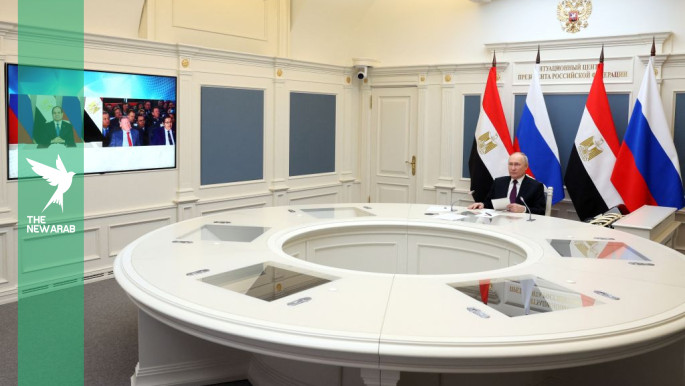
Photograph distributed by the Russian state agency Sputnik, Russia’s President Vladimir Putin takes part in a ceremony to install the reactor pressure vessel for Unit 1 at Egypt’s first nuclear power station in El-Dabaa, on 19 November 2025. [Getty]
For some Egyptians, the images felt like déjà vu. Half a century after the Soviet-backed Aswan High Dam reshaped the Nile and the nation, another Russian-built megaproject is taking shape on the Mediterranean coast. The installation of the pressure vessel at al-Dabaa, the nucleus of Egypt’s first nuclear reactor, has been hailed as a moment of national pride and a promise of energy security.
But the parallels with the past also raise new questions: Lingering Western sanctions against Russia, climate change, and the intricacies of long-term nuclear fuel storage make the finalisation of the project and its sustainable operation after completion challenging, specialists said.
“Engineers from both Egypt and Russia still face a daunting array of technical hurdles,” energy expert Ali Abdelnabi told The New Arab.
“They’re essentially mapping out every potential obstacle that comes with building a nuclear plant of this scale and finding ways to solve them one by one,” he explained.
The pressure vessel, a 330-tonne piece manufactured in Russia and known to be the heart of nuclear reaction, was lowered into the belly of Unit 1 of the al-Dabaa nuclear power plant on November 19.
Watching the lowering of the vessel via video link were Egyptian President Abdel Fattah al-Sisi and Russian President Vladimir Putin. The two leaders hailed the development as a significant step toward making the plant’s first unit fully operational by 2028.
They also considered it a breakthrough in Egypt’s pursuit of energy self-sufficiency and reducing dependence on fossil fuels in a restive global energy market.
Energy security
“The al-Dabaa nuclear plant epitomises a deep-rooted strategic partnership between Cairo and Moscow,” said Amr al-Deeb, director of the Cairo-based International Centre for Geopolitical and Economic Research.
“It not only strengthens that partnership but guarantees its longevity for decades to come,” he told TNA.
Al-Deeb pointed to growing cooperation between Cairo and Moscow across multiple sectors, from energy and defence to trade, which, to him, fosters an increasingly symbiotic relationship.
“Egypt has become one of Russia’s most important strategic partners in the region,” he added, “and Moscow is determined to keep it that way.”
The nuclear power plant in al-Dabaa will deliver a total capacity of 4,800 MW and churn out 37 billion kilowatt-hours of power per hour, which will satisfy 10% of national demand and curtail dependence on natural gas, which powers 81% of generation and exposes Cairo to price gyrations caused by turbulent international economic conditions, especially the war in Ukraine and the genocide in Gaza.
The plant is equipped with modern VVER-1200 reactors (Generation III+). These are considered among the safest in the world, possessing built-in passive safety features that can prevent a meltdown, even if all power is lost and no human action is taken.
It will save Egypt $3 billion annually, an amount that would now go toward fuel imports, according to Egyptian Prime Minister Moutafa Madbouli.
Egypt coughs up $8 billion each year to buy gas from the international market to quench the consumption of its 110-million-strong populace and booming factories.
The Arab country’s dwindling energy production sets off recurrent electricity blackouts, especially during scorching summers.
Growing cooperation
Al-Dabaa, whose construction started in 2022 by Rosatom, is a small detail in the larger picture of growing cooperation between Cairo and Moscow.
It is Egypt’s first nuclear power plant since initial, but unfulfilled, attempts in the 1960s.
Designed, implemented and financed by the Russians, it jogs Egyptians’ memory about major national projects of the past, including the High Dam in Aswan, Egypt’s first attempt to tame the Nile.
Egypt and Russia have been stepping up their cooperation, energised by distinct motivations on both sides.
For Egypt, Russia serves as a vital counterweight in a world long dominated by the US and its Western allies.
Ties between Cairo and Moscow date back decades. They gained real momentum after 2014, when the West turned its back on Egypt following the military’s ouster of Muslim Brotherhood-aligned president Mohamed Morsi.
At that moment of isolation, Russia stepped in, offering arms, investment, and unwavering diplomatic support with no lectures on democracy attached.
Bilateral trade is surging, and Russia is now building a central industrial zone along the Suez Canal that promises thousands of jobs and deeper economic integration.
On the military front, Russian arms provide Egypt with a crucial lifeline, allowing Cairo to diversify its arsenal and bypass the tight restrictions and political strings that often accompany Western weapons.
“These joint projects are clear proof of the deepening strategic partnership between Egypt and Russia,” Egyptian political analyst Mohamed al-Dehi told TNA.
“Russia is under immense international pressure, with Western sanctions tightening by the day, yet Moscow’s unwavering commitment to pushing ahead with the al-Dabaa nuclear plant sends a powerful message that Cairo remains one of its most trusted and valued partners,” he emphasised.
Remaining challenges
Russia provides 85% of the $30 billion needed for the plant’s construction through a $25 billion loan.
Heavy reliance on Russian financing for al-Dabaa has sparked growing unease among some local observers. With Western sanctions on Moscow tightening and no end in sight to the war in Ukraine, these observers fear that Egypt’s flagship nuclear project, and its broader energy independence, can be held hostage to Russia’s deepening international isolation.
Any fresh Western sanctions on Rosatom, they say, can cripple Moscow’s ability to deliver equipment and expertise in the coming period, potentially derailing the entire project in an era already choked by sanctions.
“Those concerns are perfectly valid, but the strong political will shared by both Cairo and Moscow will enable them to overcome any obstacles along the way,” al-Deeb said.
“Western sanctions have so far spared Russia’s nuclear sector,” he continued.
Reliance on Russian financing for al-Dabaa is, meanwhile, widely seen as part of a broader strategic shift where Egypt quietly replaces its old financial dependence on the West with new ties to Russia and China.
This pivot appears to be extending far beyond this nuclear power plant and encompassing expanding trade, military partnerships, and Egypt’s deepening engagement with both powers in forums like BRICS, effectively trading one set of patrons for another.
The plant, constructed in a predominantly Bedouin town located around 300 kilometres from the Egyptian capital Cairo, sits on the Mediterranean coast, around 570 kilometres from the Libyan border.
Its proximity to the Mediterranean, a highly seismically active region, requires its structure to withstand earthquakes of magnitude 7.0 or greater.
Rising Mediterranean Sea levels, projected to climb up to 0.5 metres by 2050, also pose a long-term threat to the coastal site, requiring costly adaptive seawalls.
Egypt faces one of the gravest threats from rising sea levels, as experts warn that saltwater intrusion and permanent flooding could devastate the Nile Delta. This breadbasket accounts for almost 50% of the country’s farmland, and could wipe out entire coastal cities.
For a nation already battling water scarcity and population pressures, the stakes could not be higher, specialists point out.
The installation of the pressure vessel is also raising questions about spent fuel storage.
Russia will store fuel spent in the plant in dry casks for now, but no one has yet solved the question of where to keep this radioactive waste forever.
All these concerns, specialists say, make the completion and operation of the plant a challenging matter for both countries.
“As Egypt pushes forward with this project, it’s walking a very fine line,” Abdelnabi said. “The risks are real, but they’re worth it, especially with the project elevating Egypt’s geopolitical stature across the region.”