
While the US’ AI companies have repeatedly made headlines with historically high valuations, some keen-eyed investors have been making money in China’s AI sector, which has also been on the rise.
Thanks to the success of DeepSeek and other native large language models (LLMs), Grace Tam, chief investment adviser at BNP Paribas (BNPP) Hong Kong, says she had expected the “nourishing policies” for AI and digital consumption that were adopted as part of China’s 15th five-year plan at the plenum on October 20-23.
At the plenum, minister of science and technology Yin Hejun said China had boosted its investment ratio in basic technological research and was looking to expand cross-industry applications of AI by increasing computing power and advanced chip production, while strengthening legal frameworks, ethical standards and international cooperation.
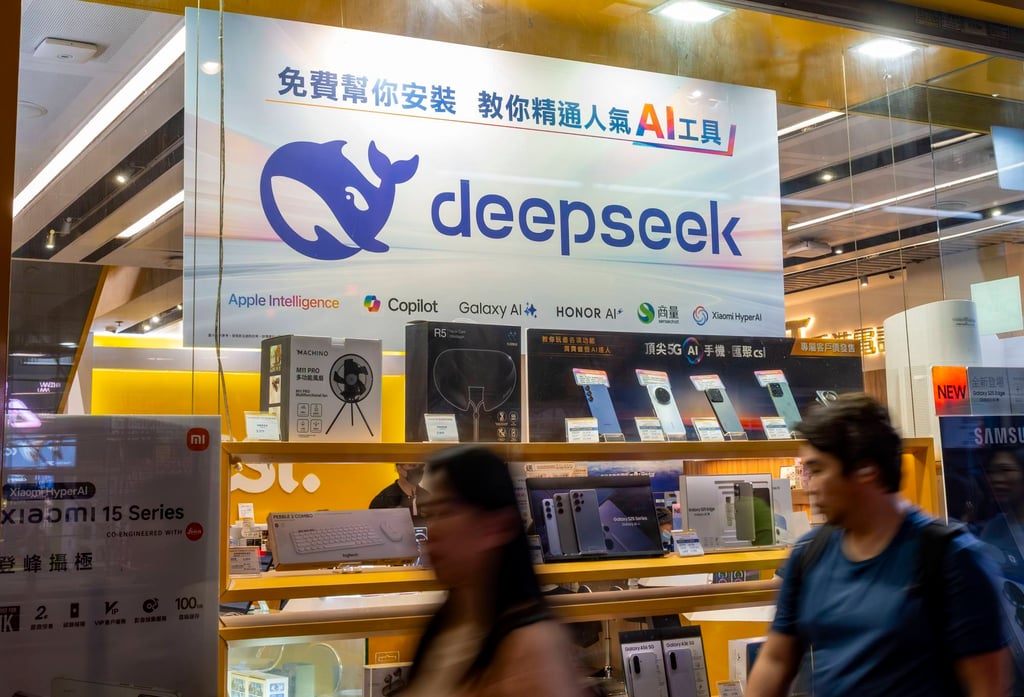
The success of LLMs like DeepSeek has led to the adoption of various digital policies in China’s 15th five-year plan. Photo: Getty Images
“We see robust secular growth opportunities in China’s AI sector,” says Tam, noting that the country’s AI market – already valued at over US$97.5 billion as of mid-2025 – continues to benefit from policy consistency and an ecosystem designed to enable scale. The sector’s ongoing transformation is marked by government coordination, capital strength and global ambition. “The goals are to enrich digital consumption, support research and development, incubate innovative companies, and ensure balanced supply and demand,” she says.
She notes that China’s State Council has introduced an AI+ Action Plan and an AI+ International Cooperation Initiative to accelerate the integration of artificial intelligence into the nation’s economy and society.

Jeanne Lim, BeingAI. Photo: Handout
But Tam believes that investors should be looking beyond LLMs to sectors where China may have advantages over the US, such as in the manufacturing of real-world appliances using sophisticated integration with AI.
“AI-native devices such as AI smartphones, AI robots, wearable devices, desktop 3D printers, AI household appliances, network-connected vehicles, digital education, AI healthcare, digital entertainment and e-commerce are the areas with opportunities,” she says.
Tam believes that China’s AI companies are still priced “somewhat reasonably” compared with the US’ large tech companies and their multi-trillion dollar valuations, which some experts are calling a bubble. Nevertheless, Tam recommends investors enter the space with caution.

Grace Tam, BNPP Hong Kong. Photo: Handout
“The most important indicators are whether earnings growth is good enough to sustain the rally, and whether there are any innovative products or services that surprise the market,” she advises. “Overall, we always recommend that investors have a diversified multi-asset portfolio to weather all kinds of market scenarios. A portfolio approach through funds, ETFs and structured products with underlying investments in a basket of China AI stocks that potentially limit downside risk and capture upside potential, or are tailored with better entry levels for AI stocks.”
Jeanne Lim, founder of BeingAI, former CEO of Hanson Robotics and co-creator of Sophia, the world’s first “robot citizen”, is an AI founder and angel investor with over two decades of experience in tech. She believes that China’s AI sector is positioned for sustained long-term growth, driven by its status as a national strategic priority.
“China’s AI plan channels capital into six priority domains including science and technology, industrial development, consumption quality, people’s well-being, governance capacity and global cooperation,” Lim notes. “Compelling opportunities are stratified across the entire AI technology stack.”
While significant amounts of capital are flowing into the foundational layers of computing such as domestic chips, cloud infrastructure and model development, Lim also sees particularly strong potential in the application layer.
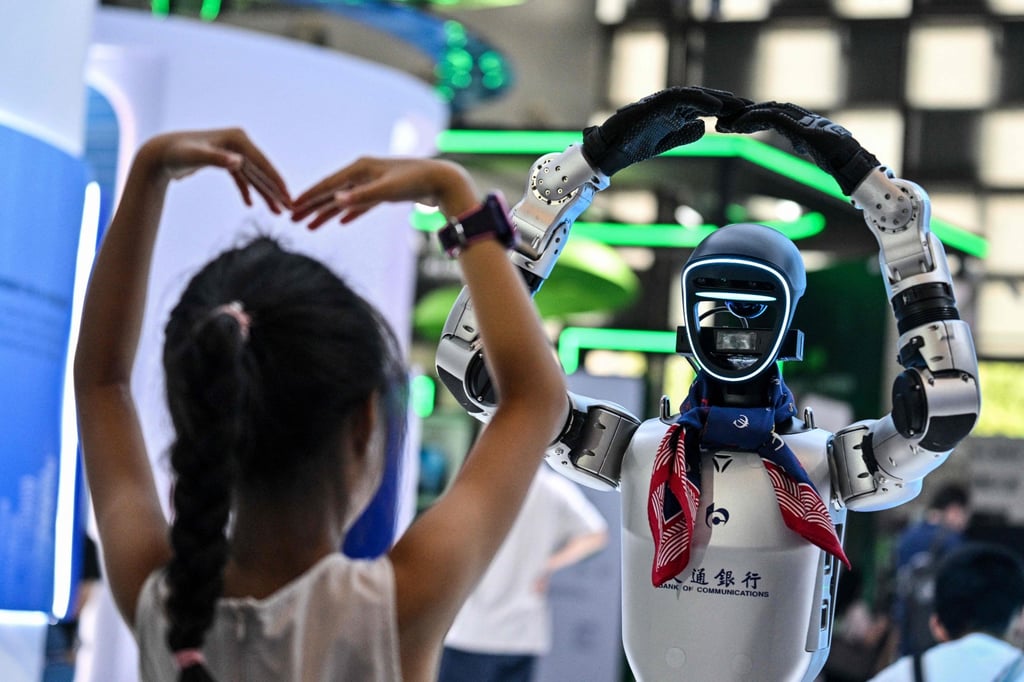
A girl plays with a robot during the World Artificial Intelligence Conference at the Shanghai World Expo and Convention Center in Shanghai, in July. Photo: AFP
“As AI adoption accelerates,” Lim says, “companies that successfully integrate AI to solve real-world problems in key sectors such as automating workflows in manufacturing, personalising diagnostics in healthcare, or optimising logistics are poised for exponential growth. Their potential to scale and generate recurring revenue offers significant upside multiples, especially as they move beyond initial subsidised phases to proven, profitable business models.”
Lim believes valuations in America’s AI industry are excessively inflated and she draws parallels with the dot-com bubble of the late 90s, due to the “seemingly unstoppable surge of capital” chasing the latest AI themes “before there is clear proof of sustainable use cases and return on investment”.
The most important indicators are earnings growth … and whether any innovative products or services surprise the market
A critical difference in China is the central role of the state, with valuation drivers closely linked to a company’s utility in achieving national goals. According to Lim, this means traditional adoption curves can be accelerated by government policy.
Her advice for wealth professionals is to construct a resilient, multilayered portfolio that balances growth and risk across China’s AI value chain, incorporating companies and projects through core, growth and tactical allocations.
“This includes foundation-layer companies in cloud, data centres and semiconductors,” Lim suggests. “These benefit from broad-based adoption and strong policy support.
“Next are established leaders in verticals like healthcare, finance and advanced manufacturing, which are using AI to achieve dominant market positions and make significant efficiency gains.
“Finally, [look for] pure-play AI start-ups or venture funds focused on breakthrough areas like foundational models or robotics.”
To manage risk, investors should ensure that overall their portfolios lean towards sectors aligned with national priorities such as industrial AI and domestic hardware, while underweighting politically sensitive areas like consumer data or content platforms.
“Diversification across the AI stack helps mitigate technological and geopolitical shocks, while maintaining disciplined portfolio management,” Lim says. “Dollar-cost average core holdings and profit-taking triggers during speculative surges can reduce market volatility and create opportunities to reinvest during corrections.”