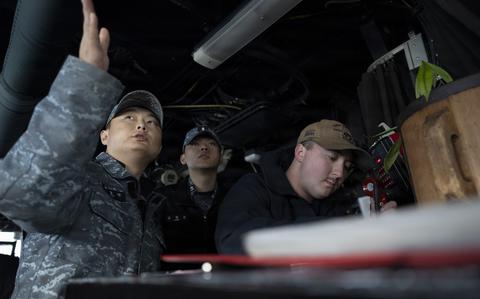
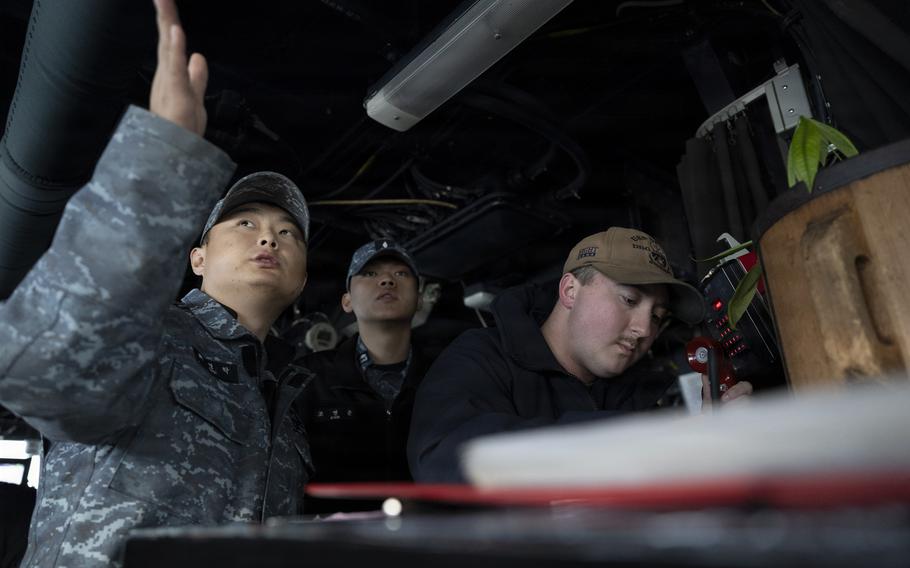
U.S. and South Koean navy sailors discuss maneuvers aboard the USS Dewey during the Maritime Counter Special Operations Exercise in South Korea, Nov. 18, 2025. (Oscar Diaz/U.S. Navy)
CAMP HUMPHREYS, South Korea — North Korea’s government media on Friday denounced the year’s U.S. military activity in the region as “gravely threatening” to “strategic stability” on the Korean Peninsula.
A series of exercises on and off the peninsula encroaches upon North Korea’s “sphere of security,” according to an unsigned commentary published on the Korean Central News Agency website.
“We have already made it clear that all threats encroaching upon our sphere of security will become direct targets of the [Democratic People’s Republic of Korea] and be managed in a necessary way,” the KCNA commentary states, referring to the country by its formal name.
U.S. Forces Korea responded that military exercises by the U.S. and South Korea “ensure the readiness necessary to meet the expectations of those we lead and those we are sworn to protect,” according to email Friday from USFK spokesman David Kim.
“Our training events are transparent and focused on deterrence, defense, and the maintenance of peace and stability on the Korean Peninsula and across the region,” Kim said. “We maintain a strictly defensive posture, and our exercises are designed to prevent conflict, not provoke it.”
KCNA lists a series of “reckless military moves” this year, most recently an anti-submarine and counter special operations drill with South Korea.
The four-day Maritime Counter Special Operations Forces Exercise involved the guided missile destroyer USS Dewey, an MH-60R Seahawk helicopter, two U.S. AH-060E Apache helicopters and one U.S. P-8A Poseidon surveillance aircraft, according to a U.S. Navy news release Nov. 21. The exercise took place Nov. 17 to 21 in Pyeongtaek and offshore, according to the Navy.
“Our routine and long-planned defensive training exercises are essential to ensure we meet our mission: to defend the homelands and uphold our ironclad commitment to [South Korea],” Kim said.
The South Korea Joint Chiefs of Staff in a text message to Stars and Stripes on Friday said the nation’s military “conducted an annual defensive exercise for the stability on the Korean Peninsula and the region, and we will continue this effort.”
KCNA also referenced a U.S. Air Force consolidation this year of F-16 Fighting Falcons from Misawa Air Base, Japan, and Kunsan Air Base, South Korea, into two “super squadrons” at Osan Air Base, 48 miles south of the border between North and South.
The super squadron initiative is a yearlong “force-optimization test designed to see if a larger, consolidated squadron can generate more combat power and operate more efficiently,” according to an Air Force news release in August.
KCNA said the Air Force “is running amuck” by creating “two ‘super-powerful wings’ ” at Osan.
“It is an irrefutable fact that it is aimed at deterring the DPRK and regional countries by force and securing air superiority in contingency,” the commentary states.
The commentary also criticized the U.S. for military exercises and arms buildups in Japan and Guam “targeting independent sovereign states in the region.”
South Korea for the first time sent its own domestically designed and built submarine and other assets to Guam for a biennial Silent Shark exercise starting Nov. 18, according to the Korea JooAng Daily on Nov. 17.