I had no idea that an exact replica of Daniel Chester French’s studio was built, did you? French (1850-1931) built his summer home and workspace, Chesterwood, beginning in 1898. The studio was completed first and the house in 1901. He gave his young assistant, Henry Augustus Lukeman (1872-1935), the architectural plans for the studio, and his replica was completed in 1900.
After Lukeman, it became the studio of his nephew-by-marriage, renowned stained glass artist Frederick Ludwig Leuchs. Today, Leuchs’ daughters, and Lukeman’s great-nieces, Paula Leuchs McNay and Catherine Leuchs Bohrman, are restoring the studio. When asked why they would undertake the difficult task of restoration, McNay said, “to continue supporting the arts in Stockbridge and to preserve history.”
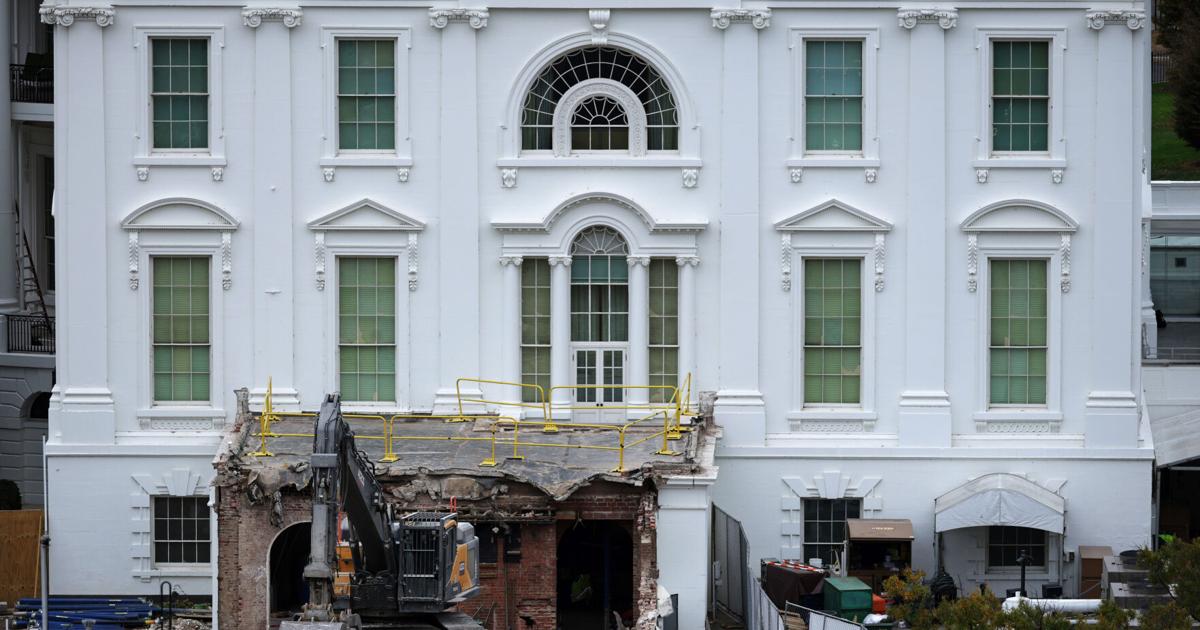
Buildings are the repositories of our history. We take a loved one, stand outside a house and say “that is where I was born,” and our story begins. Commentator Michael Steele recently told a similar story while he was a panelist on “Real Time with Bill Maher.” Steele recounted being taken by his father to stand outside the White House and how he first heard the story of our country. When Steele shared that on air, Maher responded: “It is just a building.”
Yes, to some, it is just an old building. To others, when a building is torn down it leaves a rent in the fabric of our history.
The White House was built between 1798 and 1801. Our second president, John Adams, was the first to live there. Our third president, Thomas Jefferson, completed the people’s house in 1801, designing and adding the two final touches: the East and West colonnades.
George Washington, our first president, never lived in the White House, but he selected its location, the architect and the design. Through that design, its modest size and simple dignity, the form of government it symbolized could be explained.
An old building, a small historic object and a sepia photograph are all imbued with something that informs and amplifies a time, a place and a story. We in Berkshire County must have felt that way, because we have saved so much. Along our main streets and backroads, the interspersing of our historic structures is not just the springboard for telling our history; it is also the basis of the appearance and the character of our area.
In 2009, Jim Shulman, an avid collector and Berkshire Eagle columnist, wrote and asked what we could do to preserve the William Russell Allen House on East Street. Could the historic house be converted into a museum to literally hold the images and objects of Berkshire past, which inspired and informed Shulman’s stories of Pittsfield? With $200,000 amassed through the generosity of the Mass Division of Asset Management and Maintenance, the Berkshire Bank Foundation, a generous private donor and Soldier On, we stabilized the 1886 house. With that amount, we could stabilize WRA but could go no further.
This year, Pittsfield Historical Commission Chairman John Dickson requested I write a letter of support for Preservation Massachusetts to place WRA on its Most Endangered Historic Resources’ 2025 list. Never count a good man out: What I started in 2009, John Dickson might finish in 2025.
Another day, another email: Kripalu Center for Yoga wrote to me about the restoration of the 134-year-old gatehouse at Shadow Brook. It’s yet another property that underscores what we stand to lose if we don’t preserve notable buildings and landmarks: not just history but the regional economic benefits bolstered by that history in the tourism and hospitality sectors.
With enthusiasm, I wrote a grant that could be used to apply to private foundations and for government grants. Jennifer Joyce, Kripalu director of gifts and gratitude wrote: “What you’ve created for us is absolutely stunning. You’ve captured not just what we need to raise funds, but the very heart and soul of why this matters.”
Our history is the underpinning of our communal identity and our economy. It facilitates telling our story and, by extension, America’s story.
There seem to be cycles and fads in what we humans value. This might be a time when many prefer tearing down and building new, espousing that new is better.
So, right now it might be more difficult to preserve even as it is more important to fight for the balance between current needs and the relics of the past. Think for a moment of all the empty buildings in Berkshire County. We need housing, but do we need to build all of it anew? Maybe we need to achieve that balance by rehabilitating extant buildings for new purposes.
I miss the East Wing, and I would miss the Shadow Brook gatehouse, the William Russell Allen House and the relationship between the extant buildings at Ventfort Hall and the Morgan estate.
When we turn the page on the last day of 2025, our country will be entering its the year of its 250th birthday. From coast to coast, folks will be telling our story. In New England, we will be able to point to our earliest buildings. From Salem Street in Boston to Main Street in Stockbridge, we can stand and point at the North Church or the Mission House and say, “That is where our country was born,” and so our story begins.