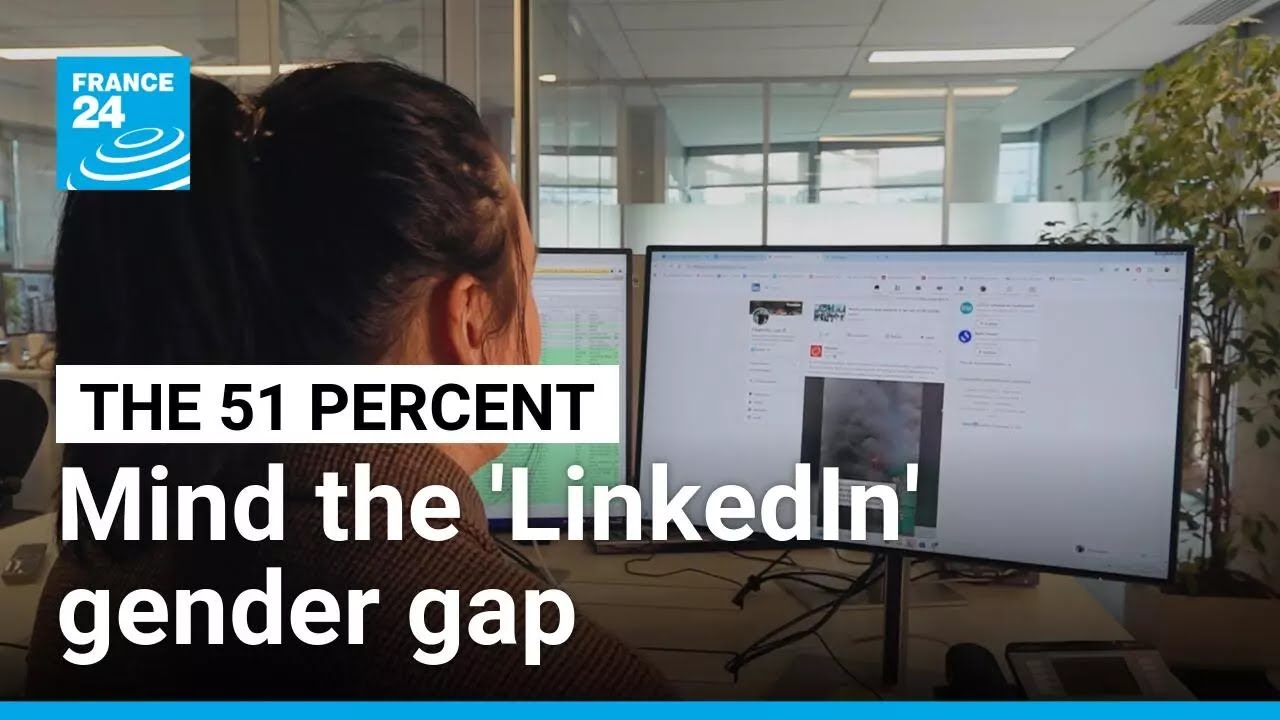
Mind the ‘LinkedIn’ gender gap • FRANCE 24 English
[Music] Hello, I’m Annette Young and welcome to the 51enter show about women reshaping our world. Coming up, LinkedIn, the social media platform with which professionals connect and network, has landed itself in hot water after a surprising experiment, revealed signs of biased against women. Also, competition is woven into nearly every part of our lives. But do we actually need it at work or even in our daily routines? I’ll be talking shortly to author Retica Bhhatra, who’s written a book entitled Uncompete: Rejecting Competition to Unblock Success. And the countdown is on for French female astronaut Sophie Adeno, who’s taking off the International Space Station in the coming months. But first and Italian MPs have voted unanimously to introduce the crime of femicide, the murder of a woman motivated by gender as a distinct law to be punished with a life sentence. The draft bill follows national outrage after the brutal killing of a 22year-old woman by her former boyfriend in 2023. Introduced by Prime Minister Georgio Maloney, the bill drew rare cross party support. Both MPs from the hardright government and the opposition backing the measure with many wearing red ribbons or red jackets in tribute to victims of feverside. Now it’s seen as one of the few remaining reliable social media platforms. But LinkedIn, where professionals connect to network, has now come under fire after a surprising new experiment exposed potential bias. Some women say that by changing their profile to appear as a man or using stereotypically malcoded business language meant that they were getting dramatically more visibility. A claim LinkedIn has denied. Charlotte Lamb has more. On the world’s largest online professional network, a growing trend. Women taking part in an informal experiment, changing their profile gender, pronouns, even rewriting their biographies to sound, as they put it, more like a man. According to some, engagement has skyrocketed. Alex is an author and climate activist. like many, LinkedIn is essential to her career. I basically changed my profile uh my gender and and posted on it um like one day after um and my my views increased by uh 724%. I was a bit shocked. The experiment was co-started by entrepreneur Cindy Gallup. We weren’t testing gender specifically on LinkedIn, but we were testing visibility and alongside two male colleagues, we posted identical content on LinkedIn. I reached 6% of my followers with this post. Our male colleagues, Steven and Matt, reached 51% and a staggering 143% respectively. It did not sound like me. Um, social worker Megan Cornish, who works with tech companies, was the first to take part. She asked AI to rewrite her whole profile to sound more quote malecoded and then blogged about it. I recycled some old posts that hadn’t been doing very well in that style. And every day I saw an increase in reach and I was going to do it for a full month, but by the end of the week I was like, I’m too mad. I have to share this. And the stories keep coming. One man even saw engagement drop when he switched his name from Daniel to Daniela. LinkedIn told France 24 its algorithms do not use gender as a ranking signal, saying changing gender on your profile does not affect how content appears in search or feed. But some experts say it’s not necessarily explicit discrimination. It could be something more subtle. I recognized that there was potentially some plausible proxy bias going on um when it comes to the the feed algorithm. And what I mean by proxy bias is that the algorithm isn’t saying do you know what if you’re female then then you know reduce your your reach. It’s saying that the reach is based on things like topics, language, career. The experiment’s founders have launched a campaign urging the social media platform to increase transparency. Their hope to move closer to a world where women won’t have to rewrite themselves in any space to be heard. And talking of the workplace, one element which is interwoven into the very fabric of our working lives is the notion of competition. But do we really need to compete at work or indeed in all parts of our daily lives? What if in truth competition does more harm than good and actually stops us from reaching our true potential? Retica Multra is the founder of Canandor, a global inclusion strategy firm, but she’s also the author of Uncompete: Rejecting Competition to Unblock Success. And she joins me now from Seattle. Retica, thank you so much for joining us. You grew up in Singapore. You’ve worked as a business journalist and also in the corporate world in general. The idea of advising people to not compete is such a counterintuitive move. So, what made you decide to write a book about it? Great question, Annette. And actually it was all my experiences in the business world and specifically in advising corporations and leaders on how to create a more genderbalanced, a more inclusive workplace, one where you know folks really wanted to work and felt like they belonged. And what I often came back to was this belief that if you know for example women were rising in the workplace then somehow men were losing out and it felt very zero sum hierarchical all the time like there was this invisible competition and yet this idea of it’s a competition if women get ahead men are losing out. This idea and this narrative kept coming up again and again and I really wanted to address it which I try and do in this new book. The chapter titles say everything, Ruchica, you know, competition is the thief of joy, redefine success on our own terms and so on. But are we sort of not hardwired to compete? Is it not part of human nature to begin with? That’s a great myth which I really enjoy tackling in this book. We’re actually not hardwired to compete. In fact, data shows that one of the reasons we as humans have prospered for so long is we’re actually very very good at collaborating with each other, we always have been from our hunter gatherer days all the way till where we are right now. Unfortunately, modern society and especially modern workplaces have created a culture of uh you know competing with each other stack ranking. There can only be one woman in the seauite. There can only be uh you know one promotion so you got to fight it out with your colleagues and suddenly a a friend someone who you collaborated with earlier on your team becomes a rival. And so actually that’s you know that’s a myth. I I would say that what makes us great as humans is that we’re very good at collaboration. So why not get better if we change the workplace norms? What you’re talking about is the need to collaborate versus compete. How do we actually do that? Collaboration is so important in the workplace. Opting out of competition is a choice and and opting for collaboration is also a choice. So some of the ways that I recommend it, for example, are creating a promotion system that isn’t zero sum, that isn’t about one person getting promoted at the cost of everyone else. There’s evidence that even in our political system, especially here in the United States, there would be a lot less political division if we did not pit two sides against each other and it was zero sum, winner take all. There can only be one president. the loser sort of slinks home with a tail between their legs. I would love to in the workplace especially see more leaders talk about uh pro collaboration in promotion, talent development conversations. Tell me of a time that you collaborated with your team member or uh projects should be rewarded based on what the team did rather than there was this one standout individual which I will say is a very masculine style of uh of being in the workplace where only one individual uh gets rewarded or only one individual wins the prize and I think we really need a reframe right now. Reika Mahalra, it’s been a pleasure speaking to you. Thank you so much. Thank you, Annette. And the countdown is on for French female astronaut Sophie Adeno, who will depart for the International Space Station in less than 3 months. The 43year-old already has a very impressive CV and now she will be taking it to even greater heights. As Eliza Herbert reports, astronaut Sophie Adno is preparing to take a giant leap. In 2026, she will fulfill her lifelong dream of space travel and become the second French woman to reach orbit. It’s the realization of the dream I had as a little girl who was inspired by all these space adventures since the first French astronauts. two one ignition. Adno and three colleagues will blast off aboard the SpaceX Falcon 9 in midFebruary. The 43year-old will then spend 6 months at the International Space Station, floating 400 km above Earth, a feat that requires rigorous training. In 2022, the aeronautical engineer was chosen from more than 22,000 applicants to take part in the European Space Ay’s new class of career astronauts. Since then, she has pushed her body to its limits through physical tests like survival training, high-speed spins, pool tests, and parabolic flights to simulate weightlessness. She was the first French woman to become a helicopter test pilot, then the second French female astronaut after Claudia and Yuri. From Tulus on Monday, she addressed France’s National Center for Space Studies to express what it means to represent her country. And it’s important because we’re taking a piece of France into space. And it’s a great source of pride to represent all the work done by the National Center for Space Studies who’ve been working on this space adventure since 1982. Worldwide, less than 90 women have traveled into space compared to more than 560 men. Adno’s advice to young girls who are interested in science and aeronautics is to always aim for the sky. And that’s it for this edition. So until our next show, bye for now.
LinkedIn, the social media platform with which professionals connect and network, has found itself in hot water after a surprising experiment revealed signs of bias against women. Also competition is woven into nearly every part of our lives; but do we really need it at work or even in our daily routines? Annette Young talks to author, Ruchika Malhotra, whose latest book is entitled “Uncompete: Rejecting Competition to Unlock Success”. Plus the countdown is on for French female astronaut, Sophie Adenot, who will be heading to the International Space Station in the coming months.
#linkedin #gendergap #adenot
Read more about this story in our article: https://f24.my/BaU2.y
🔔 Subscribe to France 24 now: https://f24.my/YTen
🔴 LIVE – Watch FRANCE 24 English 24/7 here: https://f24.my/YTliveEN
🌍 Read the latest International News and Top Stories: https://www.france24.com/en/
Like us on Facebook: https://f24.my/FBen
Follow us on X: https://f24.my/Xen
Bluesky: https://f24.my/BSen and Threads: https://f24.my/THen
Browse the news in pictures on Instagram: https://f24.my/IGen
Discover our TikTok videos: https://f24.my/TKen
Get the latest top stories on Telegram: https://f24.my/TGen
1 comment
I managed a division and told my team is that we are not in competition with each other but with the other divisions. My team rocked!
Comments are closed.