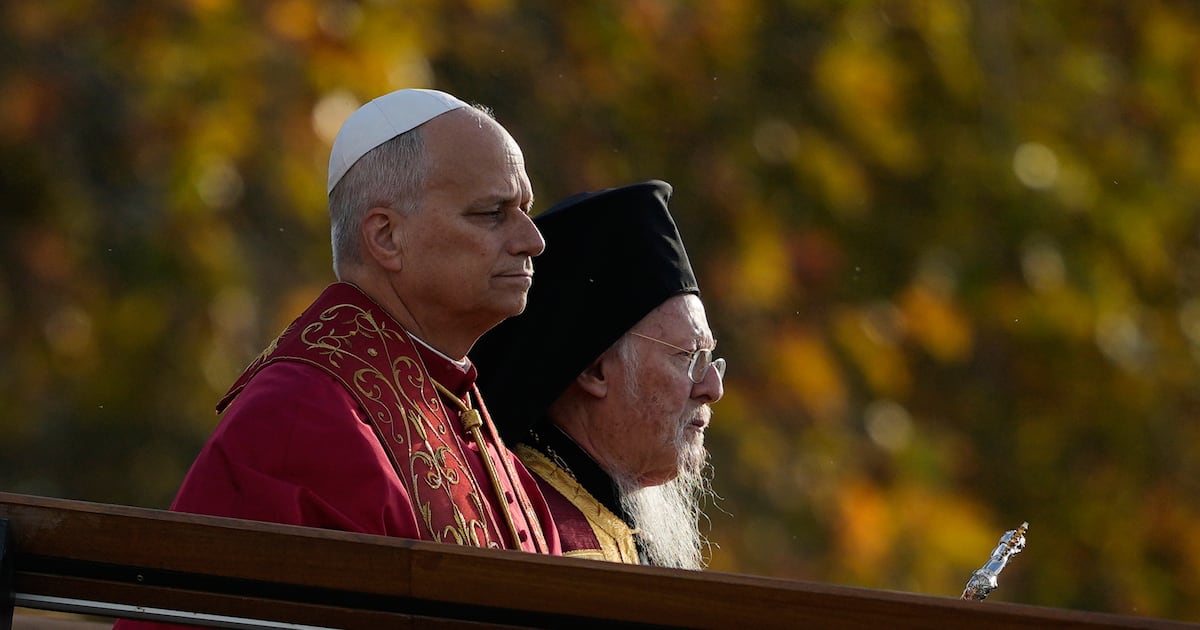
Pope Leo XIV condemned the use of religion to justify conflict and extremism as he prayed alongside the spiritual leader of the world’s Orthodox Christians in a show of unity between denominations.
“We must strongly reject the use of religion for justifying war, violence or any form of fundamentalism or fanaticism,” Pope Leo said in a prayer session on the shores of Turkey’s Lake Iznik, in the town of the same name. “Instead, the paths to follow are those of fraternal encounter, dialogue and co-operation.”
The leader of the world’s Catholics stood alongside Bartholomew I, spiritual leader of the world’s Orthodox Christians, as they celebrated 1,700 years since one of early Christianity’s most important gatherings, which took place in Iznik in 325AD.
The two leaders were joined by other dignitaries on a wooden platform above the ruins of the Basilica of St Neophytos, a local holy man, and the group prayed in Greek, Arabic and English after a choir sang hymns in English, French, Greek, Latin and Turkish.
The American Pope was on the second day of his four-day tour of Turkey, during which he has been delivering messages about the importance of unity between Christians and among humanity as a whole. He has refrained from referring to specific conflicts and has spoken in general terms about the need for peace, while calling for an embrace of diverse cultures and faiths.
“Today, the whole of humanity afflicted by violence and conflict is crying out for reconciliation,” Pope Leo, 70, said in Iznik, which is also known as Nicaea. “The desire for full communion among all believers in Jesus Christ is always accompanied by the search for fraternity among all human beings.”
The leader of the world’s 1.6 billion Catholics will spend Saturday and Sunday in Istanbul, before travelling to Lebanon for the second leg of his first overseas trip since his election in May.
The meeting in Iznik of the Pope and Bartholomew I, a Turkish citizen whose full title is the Ecumenical Patriarch of Constantinople, celebrated a key event in the early development of Christian belief.
In 325AD, Roman Emperor Constantine I convened hundreds of bishops in Iznik to resolve disputes within Christianity, in a gathering known as the first Council of Nicaea.
Its most significant outcome was the Nicene Creed – a proclamation that Jesus is equal to God the Father. In a slightly modified form, it is still recited in church services around the world, across most denominations.
The Basilica of St Neophytos was destroyed by an earthquake in the year 740 and submerged under the waters of Lake Iznik, before re-emerging in recent years when water levels receded. The basilica is widely believed to be on the site of an earlier church that hosted the Council of Nicaea.
At the site, Bartholomew I, who lives in Istanbul, called for an end to “the scandal of the divisions that unfortunately still exist” and said such differences should be replaced with “the desire for unity for which the Lord Jesus prayed and gave his life”.
The Catholic and Orthodox Churches split over doctrinal differences in 1054, in what is known as the Great Schism. Since then, the churches have been making attempts to repair ties, especially since a 1964 meeting between Pope Paul VI and Ecumenical Patriarch Athenagoras I in Jerusalem.
Today, most of the world’s hundreds of millions of Orthodox Christians live in Russia, Eastern Europe and Middle Eastern and North African countries, including Egypt, Syria and Lebanon.
Some nationalists and Islamist groups in Turkey have opposed the Pope’s visit, especially his excursion to Iznik, which they see as an attempted incursion on Turkish soil and proselytism.
Earlier in the day, a small protest by members of the conservative Islamist New Welfare Party took place in the town amid a heavy police presence. The group accused the Pope of trying to establish a “Vatican-like Greek Orthodox state” according to a statement read out by a member of the demonstration. They dispersed peacefully soon afterwards, the Associated Press reported.
Not all of Iznik’s citizens feel similarly. Earlier this week, resident Emine Sen, 55, told The National that people of different religions should respect each other’s beliefs.
“I don’t really approve when discrimination occurs,” she said. “Because everyone has their own beliefs, and both sides should welcome this.”
EA Sports FC 24