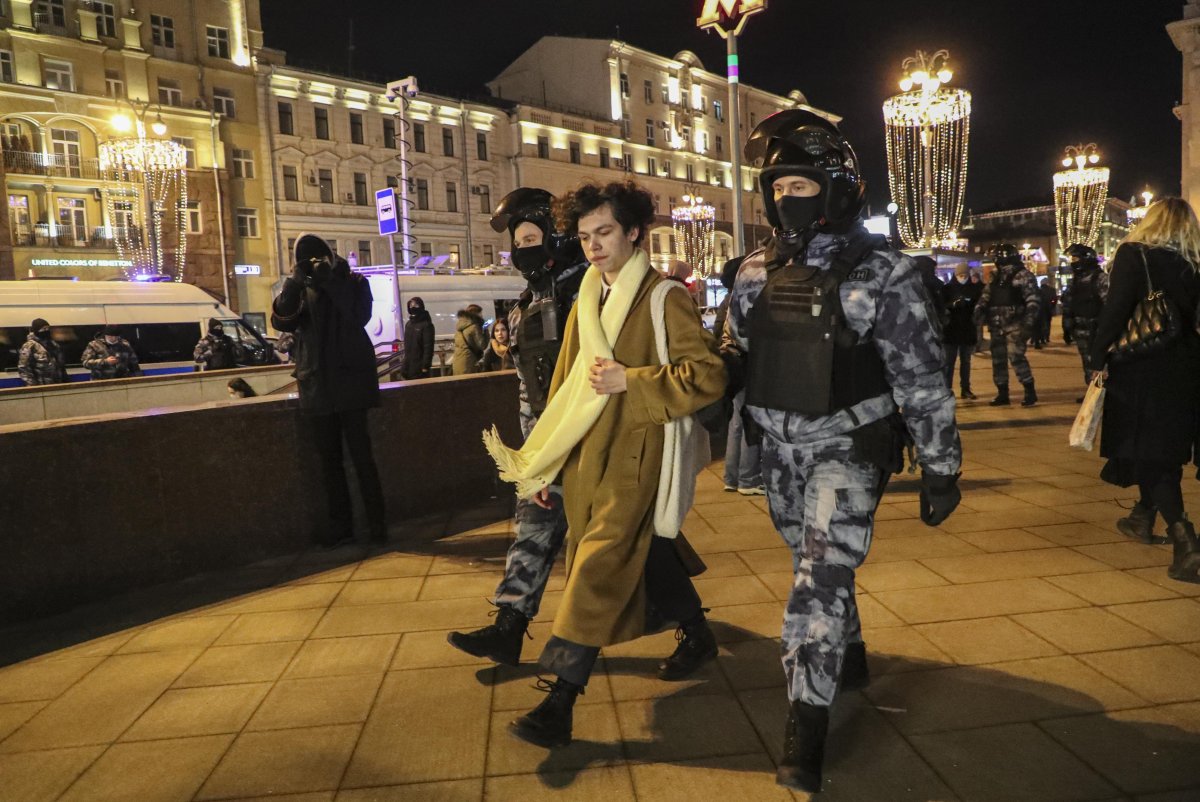
Russian police detain a protester during a rally in Moscow on Feb. 25, 202, against the entry of Russian troops into Ukraine. Russia has designated Human Rights Watch as an “undesirable” foreign organization,” the nation’s Ministry of Justice announced Friday. File Photo by Maxim Shipenkov/EPA
Nov. 28 (UPI) — Russia has designated Human Rights Watch as an “undesirable” foreign organization,” the nation’s Ministry of Justice announced Friday.
This decision means the Human Rights Watch, which was founded in 1978, is banned from operating in Russia. HRW is in 78 nastions.
“Designating rights groups undesirable is brazen and cynical,” Philippe Bolopion, executive director at Human Rights Watch, said in a news release. “It only redoubles our determination to document the Russian authorities’ human rights violations and war crimes, and ensure that those responsible are held accountable.”
HRW has documented human rights violations in Russia and the military committing war crimes in Ukraine.
“For over three decades, Human Rights Watch’s work on post-Soviet Russia has pressed the government to uphold human rights and freedoms,” Philippe Bolopion, executive director at Human Rights Watch, said. “Our work hasn’t changed, but what’s changed, dramatically, is the government’s full-throttled embrace of dictatorial policies, its staggering rise in repression, and the scope of the war crimes its forces are committing in Ukraine.”
In 2015, Russia introduced the “undesirable” law to silence independent media, opposition groups and foreign organizations. That includes the Moscow Times.
Russian authorities have designated at least 280 organizations as “undesirable.” Courts have issued administrative and criminal sentences, including in absentia, against several hudred people, HRW said.
“Undesirable” organizations the Prosecutor’s Office says undermines Russia’s security, defense, or constitutional order, are banned in Russia.
Individuals who continue to engage with these organizations, in Russia or abroad, may face administrative and criminal penalties, including a maximum six-year prison sentence. The authorities interpret “engagement” widely and arbitrarily, HRW said.
The organization leaders risk up to six years, according to Russian law.
The Prosecutor General’s Office banned Human Rights Watch on Nov. 10.
In 2021, Andrei Pivovarov, a political activist, was sentenced for four years for social media posts, which the authorities said promoted Open Russia, a political opposition movement designated “undesirable.” Russian authorities released and expelled him from the country in 2024.
In May 2025, a Moscow court sentenced rigory Melkonyants, a prominent Russian rights defender and election monitor, to five years in prison after authorities wrongly equated the Russian election monitoring group Golos with the European Network of Election Monitoring Organizations, designated “undesirable” in 2021.
During the initial full-scale invasion of Ukraine by Russia in Feburary 2022, Human Rights Watch was among several international organizations and non-government organizations with offices shut down in the nation.
Ssix weeks after the invasion of Ukraine, Russian authorities revoked the registration for the Human Rights Watch Moscow office, which had operated in Russia since 1992.
Human Rights Watch started working on Russia in 1978, during the Soviet era.
The UN High Commissioner for Human Rights, a rapporteur for the Organization for Security and Cooperation in Europe and the Venice Commission, an advisory body to the Council of Europe have criticized the legislation.