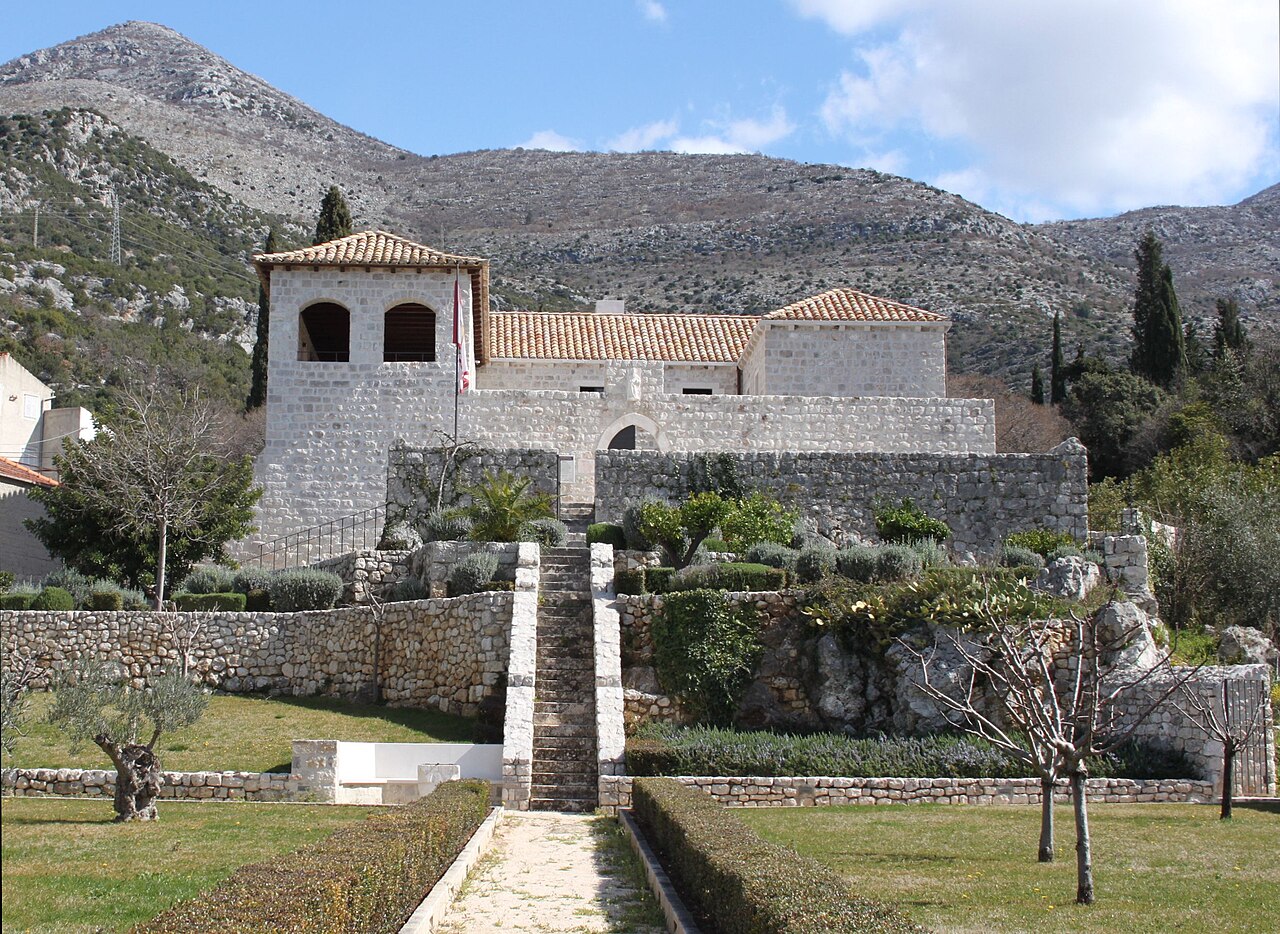
November the 29th, 2025 – There’s a beautiful Croatian palace in southern Dalmatia that has been historically dealt a difficult hand, it was destroyed by an earthquake, attacked by pirates and razed to the ground twice. Despite all that, you can still visit it to this day.
As Putni kofer writes, Dalmatia is full of historic, magnificent stone buildings, they’re often just a few steps from the sea and reached through a beautifully landscaped, green garden. They’re also often a sight that you can catch a glimpse of from the corner of your eye from the main road. If you’re travelling down to Dubrovnik by car from the direction of Pelješac, you’ll pass through the Dubrovnik Littoral, a municipality where roadside signs will invite you to stop and explore one of the region’s greatest attractions: the Rector’s Palace in Slano. Trust us when we tell you – it’s worth making a stop.
classic dubrovnik style
The Rector’s Palace in Slano seems unobtrusive at first, letting its namesake from Dubrovnik’s Old Town be the star of that name, but when you approach it, you will soon realise that every single stone of this meticulously restored palace can tell incredible stories. Entering the Rector’s Palace in Slano is the equivalent of entering a long and rich past, which was proud, but anything but simple.
Unlike the monumental Rector’s Palace further south in the actual city of Dubrovnik, this Croatian palace was built more modestly, but with the same recognisable style of Dubrovnik’s late Gothic and Renaissance. It boasts a harmonious stone facade, windows with stone arches, an inner courtyard and simple but elegant stone decorations. At every step, it is evident that the building was functional, but certainly representative enough to reflect the power and strength of the former Dubrovnik Republic (Ragusa) in its peripheral areas.
a journey of over 600 years back in time
Today, Slano is a small tourist town, located in a gorgeous bay that the powerful Dubrovnik Republic set its sights on over 600 years ago. It was right there that it constructed that this duke’s palace was built. Slano developed into an important trading port under the Dubrovnik Republic, with two shipyards, a salt warehouse, salt, livestock and grain markets. This Croatian palace was at the very heart of that development, and that’s why it was often hit by turbulence and troubled times.
To begin with, let’s explain how and when it was built in the first place. The area of what is now called the Dubrovnik Littoral (Primorje) was once called Terre Nuove, the new land, in documents when it was being developed. After the Dubrovnik Republic expanded westward during the mid-14th century and purchased Ston and the Pelješac peninsula, in 1399 it was the turn of the Littoral, which it purchased from the Bosnian king Stjepan Ostoja. It’s also known precisely how much he received for this valuable stretch of land: a house in Dubrovnik worth 500 ducats, the title of honorary nobleman and a tenth of the land in the sold Littoral.
This land was immediately designated for the construction of a stunning palace for the duke, which was erected in 1447. According to the Slano tourist board, it was constructed by craftsmen who had already proven their skills in the construction of the Dubrovnik monastery. “The duke in Slano was elected for three months. His task was to consolidate and enforce the authority of the Dubrovnik Republic. The duke governed the Dubrovnik littoral, judged and imposed punishments, and collected fees and taxes,” documents reveal.
this croatian palace was a victim of earthquakes, fire and pirates…
This beautiful Croatian palace’s first function was a defensive and administrative one, but over time it changed, and with it, the palace’s surroundings and appearance also did. The structure was often attacked by pirates and outlaws throughout the 16th and 17th centuries, it fell victim to the strong earthquake of 1667, and was burned down twice: once in 1806, and once again much later during the Homeland War.
“The Rector’s Palace in Slano shared the turbulent political history of the former Dubrovnik Republic, and all this was accompanied by architectural reconstructions, mostly caused by earthquakes, especially the great earthquake of 1667 that devastated Dubrovnik and the surrounding areas. In 1806, it suffered again during the Montenegrin aggression when it was burned down. It suffered that same fate again much later in various attacks during the Homeland War, more specifically in 1991,” states the website of the Society of Friends of Dubrovnik Antiquities, the body which currently manages the palace.
Back in 2017, this Croatian palace was fully renovated, opened to the public, and once again transformed into the centre of cultural life, a guardian of heritage, and a favourite tourist attraction. It can be visited every day except Sundays for a small ticket fee of just two euros.
Subscribe to our newsletter
the fields marked with * are required