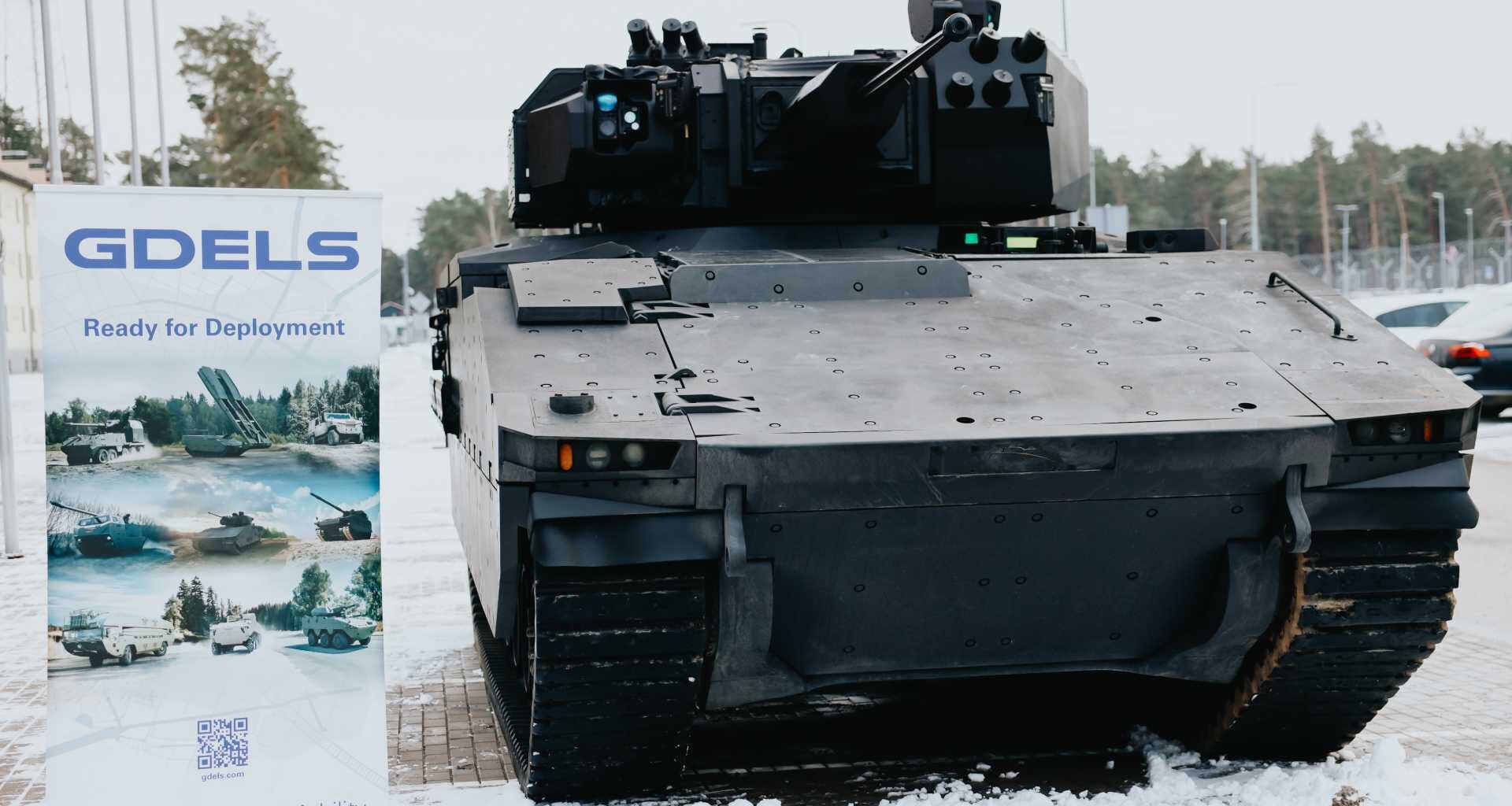
Latvia confirmed that the first ASCOD Hunter infantry fighting vehicles will arrive in the first half of 2026, ahead of full fleet deliveries in 2027.
On November 27, 2025, Latvian Defence Minister Andris Sprūds confirmed that the first ASCOD Hunter infantry fighting vehicles will be delivered in the first half of 2026, enabling preliminary unit integration and training ahead of full fleet deliveries in 2027. The announcement follows the signing of a letter of intent with Spain and Austria that formalizes the cooperation within the ASCOD program and establishes a shared user group for upgrades, sustainment, and interoperability. Latvia’s procurement plan covers a total of 84 Hunter IFVs, split between two battalions, with at least 30 percent of the program designated for Latvian industry through licensed assembly and sustainment work.
Follow Army Recognition on Google News at this link
Latvian soldiers from the Mechanized Infantry Brigade selected the name Hunter, which the Ministry notes is linked to Latvian mythology where the hunter symbolizes skill, adaptation, connection to the environment and survival in demanding conditions. (Picture source: Latvian MoD)
On the same day, the country officially signed a letter of intent with Spain and Austria on the cooperation and integration in the ASCOD program during a multinational meeting held at the Ādaži military base. The meeting included delegations from Latvia, Spain, Austria, and the United Kingdom, presentations from GDELS-Santa Bárbara Sistemas, and capability demonstrations of the ASCOD Hunter and Pizarro vehicles. It is directly linked to Latvia’s procurement of 84 ASCOD-based Hunter IFVs, the national decision to restructure mechanized infantry capabilities, and the effort to place this modernization inside a broader European cooperation framework. Latvia’s inclusion in the ASCOD user group creates a structured partnership mechanism that will shape technical alignment, training approaches, future upgrades, and interoperability within NATO. The meeting at Ādaži gathered Defence Minister Andris Sprūds, Brigadier General Georgs Kerlins, and representatives from allied nations, all participating in the establishment of the ASCOD user group, intended to coordinate work on tracked armored platforms used across Europe.
Minister Sprūds stated that cooperation on such systems strengthens mobility, protection, and resilience for Latvia’s land forces, and highlighted the intention to include additional allies in the future. During the session, GDELS-Santa Bárbara Sistemas presented the ASCOD Hunter IFV developed specifically for Latvia, and all delegations observed mobility and firing capability demonstrations of both the Hunter and the Pizarro. Latvia’s Ministry of Defence later emphasized publicly that the letter of intent represents a step toward deeper cooperation and stronger European defense integration, complementing national modernization goals, and that the full fleet of 84 vehicles will significantly reinforce national combat capabilities. The user group framework will support coordination in areas such as sustainment, maintenance practices, updates to electronic systems, and long-term platform evolution aligned with broader NATO requirements. Latvia’s decision to adopt the ASCOD 2 followed an evaluation process that included the ASCOD 2, the CV90, the K21, and the Otokar Tulpar, as the country sought a successor to its aging fleet of British CVR(T)s that had been purchased second-hand and delivered between 2015 and early 2020, with several of those vehicles later provided to Ukraine.
After this evaluation, Latvia selected the ASCOD 2 in November 2024, and, in January 2025, signed a contract with GDELS-Santa Bárbara Sistemas for 42 vehicles at a cost of €373 million, including a logistics support package. In June 2025, the Latvian Cabinet approved purchasing an additional 42 IFVs for €387 million to accelerate the rearmament of a second battalion and meet NATO capability targets more rapidly. This expansion raised the total procurement to 84 vehicles and included a requirement that at least 30 percent of the program involve Latvian industry. Local assembly work would be carried out under license, strengthening national industrial capacity for sustainment. According to national planning, Latvia will begin receiving the fleet in 2027, although political statements note that the first Hunter IFVs will enter service earlier for training and introductory integration. These steps link Latvia’s modernization efforts to a wider regional context in which NATO states seek greater interoperability and unified approaches to armored capabilities.
The Hunter is a localized configuration of the ASCOD 2 tracked platform designed to meet Latvia’s mechanized infantry requirements, offering a combination of cross-country mobility, modular protection, and digital integration compatible with NATO command and control systems. The Hunter IFV is equipped with an MTU 8V199 series diesel engine capable of producing up to 1,100 hp, a Renk HSWL 256B transmission, and rubber tracks supplied by Soucy. Its hull structure is built according to NATO STANAG 4569 levels, incorporating scalable ballistic and mine protection, and features such as spall liners, energy-absorbing floors, and blast-attenuating seating to mitigate mine and improvised explosive device effects. Internally, the vehicle accommodates a crew of three and eight fully equipped infantry soldiers, and its open electronic architecture supports future sensors, communication systems, and potentially unmanned system control interfaces. Latvian soldiers from the Mechanized Infantry Brigade selected the name Hunter, which the Ministry notes is linked to Latvian mythology where the hunter symbolizes skill, adaptation, connection to the environment and survival in demanding conditions, making it a key asset for mechanized infantry operations, with a top speed of 70 km/h. Latvia’s decision to adopt a named national variant mirrors earlier approaches in Austria and Spain and helps position the Hunter as a dedicated national configuration within a shared European framework.
A major component of the ASCOD Hunter is the Israeli UT30 Mk2 turret from Elbit Systems, already used by numerous armies and selected under a contract valued at approximately $100 million, with local industrial participation included in the production plan. The UT30 Mk2 turret is dual-axis stabilized and supports firing on the move at stationary and moving targets, and is equipped with a 30 mm Mk44 Bushmaster II chain gun, a coaxial 7.62 mm machine gun, and integrated interfaces for anti-tank guided missiles such as the Spike LR2. The turret’s design includes independent pedestals for the turret mechanism, the gunner sight, and the commander panoramic sight, combined with thermal imaging, laser rangefinding, and automatic target tracking, all intended to increase hit probability in varied conditions. The turret also incorporates several ballistic protection options up to STANAG 4569 Level 4, smoke grenade launchers, and laser warning systems, and certain configurations can include the Iron Fist active protection system. The UT30 Mk2 is designed to remain fully overhead, preserving internal space and retaining the vehicle’s armor integrity without hull penetration.
Latvia’s integration within the ASCOD user group also reflects the broader development path of the ASCOD 2 platform, which has evolved from a tracked armored vehicle developed jointly by Austrian and Spanish companies into a modular platform. Variants such as the Pizarro in Spain and the Ulan in Austria demonstrate the platform’s adaptability, and the British Ajax family, which is based on ASCOD 2 components, represents the most extensive derivative program despite its technical challenges and continued restrictions on operating hours. Artillery systems such as the Donar and the more recent Nemesis self-propelled howitzer combine the ASCOD 2 chassis with advanced 155 mm artillery modules, while several engineering, command, and support variants demonstrate the platform’s flexibility within national fleets. For Latvia, the relevance of these developments lies in the potential for future upgrades, cross compatibility with other user states, and access to a shared base of technical evolution. By participating in the user group, Latvia positions itself to benefit from cooperative planning on sustainment, modernization cycles, and the integration of new technologies, ensuring that the ASCOD Hunter remains part of a larger, continuously updated armored vehicle family.
Written by Jérôme Brahy
Jérôme Brahy is a defense analyst and documentalist at Army Recognition. He specializes in naval modernization, aviation, drones, armored vehicles, and artillery, with a focus on strategic developments in the United States, China, Ukraine, Russia, Türkiye, and Belgium. His analyses go beyond the facts, providing context, identifying key actors, and explaining why defense news matters on a global scale.