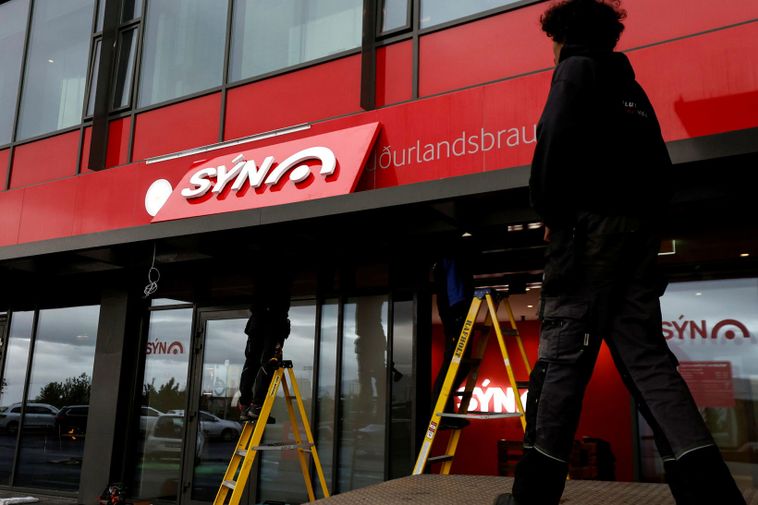

It is getting increasingly difficult for media companies to compete with state-run media on the advertising market.
mbl.is/Eggert Jóhannesson
As of December 1,
Síminn
/
Sýn
will stop broadcasting evening news on weekends and public holidays. Evening news will therefore only air on weekdays. News services on
Bylgjan
radio and the website Vísir.is will remain unchanged.
The decision was announced yesterday by
Sýn
.
The company notes that maintaining a dedicated evening news
programme
and fulfilling an important public-service role is an immense challenge in the current operating and competitive environment. After nearly 40 continuous years of broadcasting evening news, these changes are now being implemented.
“The company will continue to monitor the development of the media landscape closely and assess what operational model is sustainable in the long term. This measure supports
Sýn’s
operational goals but does not change the profit forecast for 2025. It is yet another step in adapting operations to the steadily deteriorating conditions facing privately run media in Iceland,” the announcement states.
Government has shown little interest
“Holding a leading role in Icelandic news coverage since 1986,
Sýn’s
newsroom has provided the public with free and independent journalism. It is clear to all that the operating environment for privately owned media in Iceland is, as things stand, unsustainable. Private media operate at a significant competitive disadvantage compared with the state broadcaster RÚV, foreign streaming services and social media platforms,” says
Herdís
Dröfn
Fjeldsted
, CEO of
Sýn
.
“So far, the government has shown little interest in adopting the comprehensive measures that have repeatedly been called for.
Sýn
is trying to safeguard strong and independent TV journalism. Without realistic action from the government and parliament, the conditions for running television news could collapse entirely in the near future.”
‘Perhaps not surprising’
Grímur
Grímsson, MP for
Viðreisn
, and
Ingibjörg
Isaksen, parliamentary group chair for the Progressive Party
—both members of
Al
þingi’s
Judicial and Educational Affairs Committee
—say it is important to support privately run media given their fragile situation.
“These are, of course, unfortunate developments, that news output is being reduced in this way,” Gr
ímsson told mbl.is. “It seems the operating environment for private media is extremely challenging at the moment, and in that sense this perhaps shouldn’t come as a surprise.”
Various measures could be explored to support private media, he says, though he does not believe increasing direct state funding is the right approach.
Warnings about the minister’s approach
Ingibjörg
Isaksen reiterates the importance of strong, editorially independent media capable of in-depth reporting and counteracting the information disorder now prevalent.
She notes that the Progressive Party has
criticised
the culture and media minister’s proposed legislation to reduce maximum media subsidies
—legislation introduced last spring.
“We in the Progressive Party warned against this strategy of cutting support to larger outlets in order to lift up smaller ones. We preferred to keep the current ratio unchanged and instead provide additional, targeted support for smaller media, as we have precedent for from the previous term,” she says.
However, doing so would require accelerating the minister’s planned comprehensive review of the Icelandic media landscape.
Discussion about R
ÚV needed
Grímsson says that discussion about the role and status of RÚV should take place alongside debate on how to fund private media and whether they would benefit from reduced allocations to the state broadcaster.
He adds that it is also worth considering whether the current household levy (
nefskattur
)
—through which R
ÚV has been funded for decades
—is still the right model.
“Many people dislike the levy, others are neutral. It’s worth asking whether this is the right system, but first we need to clarify what we want R
ÚV to be on this market. What is the broadcaster’s role? Should it operate two radio stations and one TV channel? What do we want RÚV to do?”
Only then, he says, can decisions be made on the appropriate method of funding.