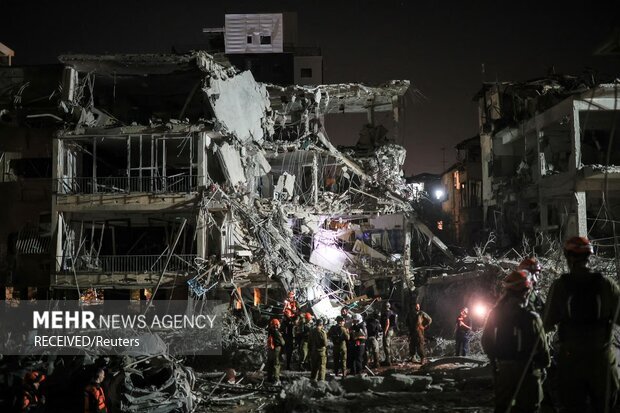
The 12-day war was one of the greatest defeats experienced by the Zionist regime in its fabricated history. According to the Leader of the Islamic Revolution Ayatollah Seyyed Ali Khamenei, this aggression was the result of a 20-year Israeli plan to confront Iran, which ended in complete failure. The real statistics on damages have never been fully published due to severe media censorship in the occupied territories, but reviewing admissions from Israeli officials and media indicates that the Tel Aviv regime suffered enormous economic, military, and social losses. These statistics represent only a small portion of the actual dimensions of the crisis but clearly illustrate why Tel Aviv wanted a ceasefire after 12 days.
Israeli officials admit failure
One of the most prominent statements came from Major General Giora Eiland, former Chairman of Israel’s security council. In an interview with Israeli media, he stated that Israel’s interests were in ending the war and accepting a ceasefire; continuing the war was not in its favor.
These remarks directly reflect the acknowledgment of failure in achieving strategic objectives. According to Eiland, the costs of continuing the war, including economic damages and international pressures, outweighed the potential gains.
Former Israeli prime minister Ehud Olmert also commented on the 12-day war, saying that Iranian missiles caused extensive damage to Israeli cities, and Iran does not intend to coexist peacefully with Israel. This explicit admission indicates that the regime’s 20-year plan to confront Iran failed.
Israeli media analysts also publicly expressed their concerns. A reporter from Channel 12 stated: “We could not defeat Iran, and we will pay the price for this in the future.” Yossi Yehoshua, a military analyst for Yedioth Ahronoth, emphasized that Israel, with all its resources, could not achieve victory over Iran. Channel 12 reported that Iran has still not used long-range weapons or heavy missiles, and the Ma’ariv newspaper acknowledged that Iran emerged from the war stronger than before.
Financial and economic damages
According to Israel’s Tax Authority, 41,651 damage claims were registered since the beginning of the war with Iran:
32,975 claims related to building damages
4,119 claims related to vehicles
4,456 claims related to equipment and property
It is estimated that thousands of damaged buildings remain unregistered. Shlomo Maoz, an economic analyst for Ma’ariv, wrote that Israel’s 12-day military operation cost approximately $16 billion, and the regime’s GDP was impacted by a similar amount.
Disruption of daily economic activities caused losses of around $1.5 billion and paralyzed sectors including high-tech, transportation, tourism, restaurants, and industries. Airport closures and flight suspensions also exerted additional pressure on the economy. Even assuming half of the damages are compensated in the future, losses of around $8 billion would remain, equivalent to 1.3% of Israel’s GDP.
Military and defense costs
Israel’s average daily military expenditure was $725 million, totaling $8.7 billion over 12 days. This figure included airstrikes, F-35 fighter operations, and the use of various munitions. Activating advanced missile defense systems, including Iron Dome, Arrow, and David’s Sling, cost $10-200 million daily. Each interceptor missile cost between $700,000 and $4 million, bringing total defense and military expenditures over 12 days to an estimated $12.2 billion.
Damages from Iranian attacks
Iranian missile attacks caused approximately $3 billion in direct infrastructure damages. Key targets included Haifa oil refinery, Weizmann Institute, and military buildings in Tel Aviv. Israel’s Tax Authority initially estimated damages at $1.3 billion, expected to exceed $1.5 billion—twice the direct damages from previous Iran’s retaliatory attacks. More than 18,000 people were forced to evacuate their homes, with emergency accommodation costs estimated at $500 million. Reconstruction of infrastructure and homes will require several years and tens of billions of dollars.
Macro-cconomic consequences
Following this failed war, Israel’s budget deficit increased to 6% of GDP, and defense spending reached 20-30 billion shekels. The Bank of Israel reduced the projected economic growth for 2025 to 3.5% and estimated the war costs at 1% of GDP (around $5.9 billion). The regime’s credit rating was also affected, with warnings issued by Standard & Poor’s and Fitch. The United States spent around $1-1.2 billion defending Israel, mainly using THAAD systems, but after failing to achieve initial objectives, refrained from further escalation.
Conclusion
The 12-day war between Israel and Iran was one of the most costly and failed periods in the Zionist regime’s history. Statistics and official statements indicate that Israel’s economic costs were reported between $12 and $20 billion, but comprehensive estimates suggest $40 billion.
The main costs included:
Direct military costs: $12.2 billion
Economic disruption and business closures: $21.4 billion
Damages from Iranian attacks: $4.5 billion
Evacuation and reconstruction costs: $2 billion
Even considering official Israeli statistics, these figures illustrate severe economic, military, and social pressures on Israel. Long-term consequences—including budget deficits, reduced economic growth, damage to tourism, emigration of specialists, and declining investor confidence—remain. Ultimately, the 12-day war proved that Israel’s 20-year plan to confront Iran failed, forcing Tel Aviv to seek a ceasefire to prevent further losses and economic collapse. This account, based on admissions from Israelis themselves and their media sources, provides a clear picture of the real dimensions of defeat and damage, showing that despite all claims and rhetoric, the Zionist regime was almost paralyzed under the pressure of the Islamic Republic of Iran.
MNA/6671353