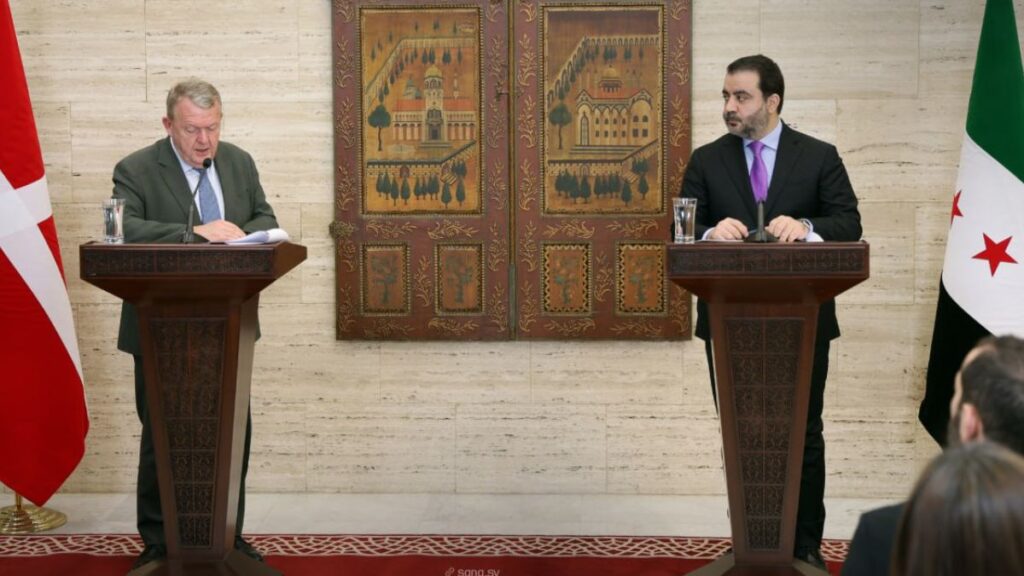
Syrian Foreign Minister Asaad al-Shibani met his Danish counterpart, Lars Løkke Rasmussen, on Saturday, 29 November, to discuss bilateral relations, diplomatic representation and the issue of Syrian refugees.
Al-Shibani received Rasmussen at Tishreen Palace in Damascus, where the two ministers later held a joint press conference to present the outcomes of their talks.
This is the first visit by a Danish foreign minister to Damascus in 15 years, with Rasmussen expressing hope that Denmark will be able to reopen its embassy in the Syrian capital soon.
Al-Shibani said Denmark had become a key partner for Syria, praising Copenhagen’s positions in the UN Security Council and its support for Syria’s unity and sovereign national decision.
He added that the talks touched on mechanisms to handle practical issues that would facilitate the return of Syrian refugees, noting that Syria is keen on the return of all its sons without exception and that its doors are open to everyone.
According to al-Shibani, the discussions also addressed the launch of a Syrian-Danish Business Council that would oversee economic relations between the two countries.
The Syrian minister renewed his call for the Danish private sector, especially leading companies in renewable energy, to invest in Syria.
He considered that these investment invitations come “within our vision for the new Syria, which adopts an open economy based on international partnership and good governance.”
For his part, Danish Foreign Minister Lars Løkke Rasmussen expressed his country’s readiness to engage with Damascus in joint work and to move from partnership to full support, saying, “Our assistance to the Syrian people has been financial, and we are ready to increase this assistance.”
Rasmussen affirmed his support for Syria’s recovery, state-building and all aspects that would help move the country toward a better future. He pointed out that some Danish companies are interested in coming to Syria and finding opportunities in their fields of work, expressing hope that sanctions on Syria will be lifted to allow these companies to operate.
The Danish foreign minister said there are “one or two million Syrians” who wish to return to their country, adding that this is one of the issues being discussed with the Syrian government.
Syrian refugees in Denmark
After the fall of the former Syrian regime on 8 December 2024 and Bashar al-Assad’s flight to Moscow, several host countries for Syrian refugees began to consider their voluntary return to Syrian territory.
On 14 December 2024, the Danish authorities announced a financial grant of about 27,000 euros for each Syrian refugee who chooses to return voluntarily to Syria.
Under this decision, adults who decide to return to Syria receive 200,000 Danish kroner, the equivalent of 26,818 euros, while each child receives 50,000 kroner, around 6,700 euros.
The German newspaper BILD quoted Denmark’s Social Democratic Minister for Integration, Kaare Dybvad Bek, as saying that since 2015, more than 5,100 Syrians have left Denmark, including nearly 600 Syrians with legal residence who have been voluntarily returned from Denmark to Syria since 2019 with financial support as part of the Return Act.
Around 45,000 migrants and descendants of Syrian origin live in Denmark, including about 28,000 adults and 17,000 children, as of 1 January this year.
If all Syrians were to leave at once and take the return support, the Danish authorities would have to pay about 865 million euros, roughly 751 million euros for adults and about 114 million euros for children.