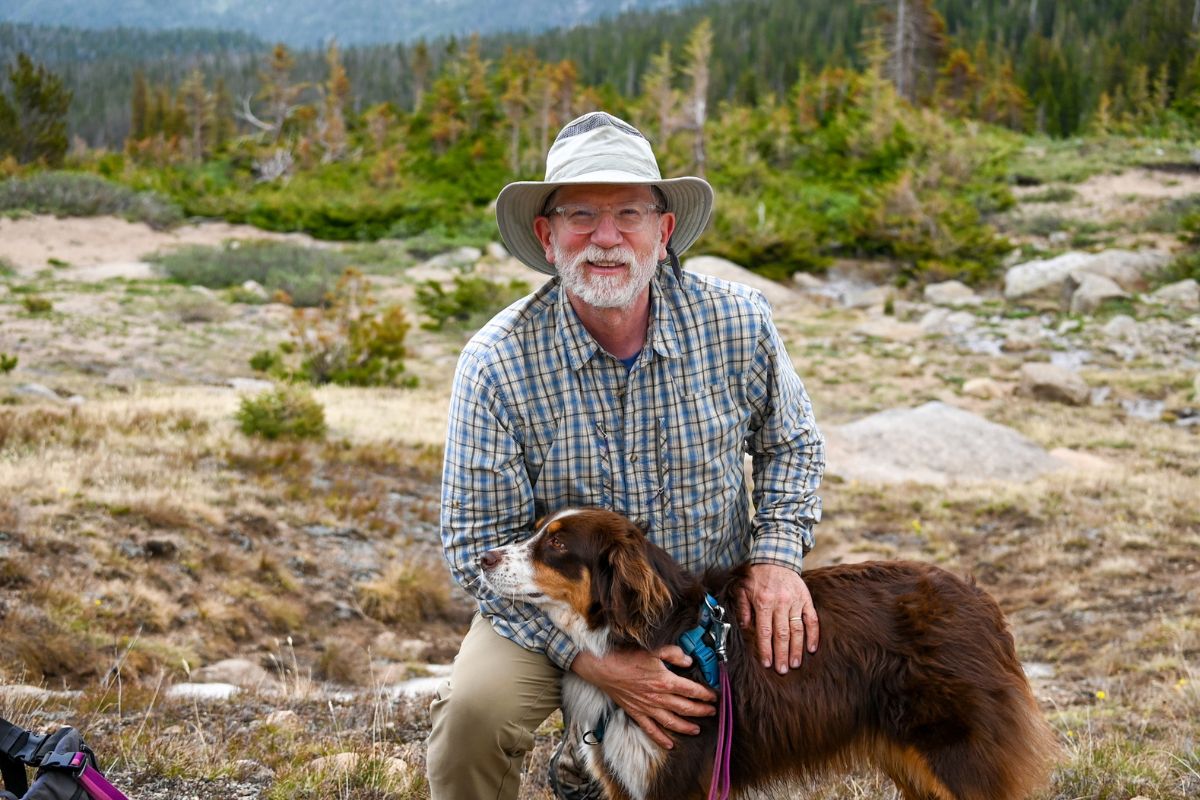
Mark Easter is the author of the award-winning popular science book “The Blue Plate: A Food Lover’s Guide to Climate Chaos,” which explores the question: “Can we eat our way out of the climate crisis?” Easter is an ecologist and greenhouse gas accountant who has researched the carbon emissions from food, forestry, and fiber in academia and private industry for nearly three decades. He is a long-time resident of Fort Collins, where he loves to read, work in his garden, cook, hike, backcountry ski, and spend time with his wife and their Australian Shepherd, Bonny.
SunLit: Tell us this book’s backstory – what’s it about and what inspired you to write it?
Mark Easter: I am an ecologist and a greenhouse gas accountant, and I worked for nearly three decades at Colorado State University in a research team that studied food — more precisely, the climate emissions from growing, harvesting, shipping, processing, and cooking food, and dealing with the leftovers.
The science of food and carbon emissions feels incredibly urgent, partly because food may be the most personal daily connection we have to the climate crisis — but also because the food system is responsible for about a third of the dangerous human-caused climate emissions we create today. And the usual culprits (coal, natural gas, oil) play only bit parts in those emissions.
UNDERWRITTEN BY
Each week, The Colorado Sun and Colorado Humanities & Center For The Book feature an excerpt from a Colorado book and an interview with the author. Explore the SunLit archives at coloradosun.com/sunlit.
The vast majority of the emissions come from uncountable trillions of invisible microbes in the guts of animals, in the soil, in the depths of landfills and irrigation reservoirs, and in the veritable lakes full of manure that hold the waste from cattle at nearly every dairy in the western world. There are compelling, urgent stories behind those emissions that were not being told but which lay at the center of the steps, writ large, that society must take to address the climate crisis. I felt that scientists needed to share these stories with the public, which are our stakeholders, not just about the emissions themselves, but what can, and already is, being done to reduce them.
SunLit: Place the excerpt you selected in context. How does it fit into the book as a whole and why did you select it?
Where to find it:

SunLit present new excerpts from some of the best Colorado authors that not only spin engaging narratives but also illuminate who we are as a community. Read more.
Easter: While I was researching the book, I was simultaneously researching some of my family history. I was astonished to learn that my great-grandmother Neva Heilman owned a farm on the Colorado Eastern Plains, south of Yuma. Neva remains an enigma in our family. She was taciturn. She rarely smiled. She never spoke about her life other than to arrange for the most direct present needs — obtaining groceries, preparing and occasionally sharing meals, sewing clothing and bedding.
After researching her story more I learned that her farm was in an area that was among the hardest hit during the Dust Bowl. She lost the land to a tax sale in 1935 during one of the worst periods of the Great Depression. I went to visit the land she once owned and learned there why the farm had failed and what her role likely was in degrading the soil to the point of failure. I was confronted with how my family was complicit in a crisis of degraded soil that is also one of the greatest sources of greenhouse gas emissions that science has identified in the world today.
It strikes me that nearly every family in the world has farmers or ranchers like my great-grandmother somewhere in their ancestry that played a similar role. We all share this common history. Learning Neva’s story added texture and depth to her life that now has my family thinking differently about her.
SunLit: What influences and/or experiences informed the project before you sat down to write?
Easter: When the science that contributed to understanding the climate crisis was first developing, we scientists basically failed to communicate effectively what climate change was, why it was happening, what the consequences likely would be, and what we could do about it. We spoke with the public using the same language and jargon we used in workshops and seminars and scientific papers. There were no recognizable stories told.
Few people outside of our scientific disciplines had a clue what the hell we were saying. We had to take stock of that failure and try to re-learn how to write for the public. I’ve appreciated good science writing my entire reading life, and in writing “The Blue Plate” I’ve come to appreciate even more the skill and craft that the best of them brought to the page, authors like Barbara Kingsolver, Barry Lopez, Carl Sagan, Rachel Carson, and so many others.
SunLit: What did the process of writing this book add to your knowledge and understanding of your craft and/or the subject matter?
Easter: “The Blue Plate” is a journal of discovery for me, and I was astonished to find so many connections to my daily life. I was truly astonished to learn about the biogenic methane emissions from dams, reservoirs, and hydroelectric systems. I was a little devastated to learn the troubling back story about how carbon-rich mangrove forests are clearcut throughout the tropics to create ponds to raise farmed shrimp, and the absolutely enormous carbon emissions that come from that process. Farmed shrimp is off the menu for me now.
SunLit: What were the biggest challenges you faced in writing this book?
Easter: I was working as a full time, grant-funded research scientist when I wrote the book. I also love to backpack and ski and fish in the Rocky Mountain backcountry. Finding time to write competed with all of those other things. But the project had grabbed me by the neck and wouldn’t stop shaking me. I found the time and somehow managed to pull it off. Difficult as it was, I loved every minute of it.
SunLit: What do you want readers to take from this book?
Easter: There are so many things one can feel inadequate about in our lives today, whether it is the choices available to us, or our personal inability to act on matters that mean something to us and our families. This is especially true where the climate crisis and environmental loss are involved. But food doesn’t have to be one of those things. Good, low-carbon choices that are economical, delicious, and nutritious are available to us and ready to fill our plates.
SunLit: What is the most interesting science fact that you came across in writing “The Blue Plate”?
Easter: It blew my mind to learn that there is more carbon in the soil than there is in the atmosphere, or in all of the plants in the forests and grasslands and crops in the world, or in the carbon dioxide dissolved into the top few meters of water in the oceans. Greenhouse gas accountants are just that — accountants. We love to add things up and know how much of things like carbon and nitrogen are in different “pools” in the earth system, and how they move between those “pools” like the soil, the atmosphere, and the ocean.
Discovering that there is more carbon as organic matter in the soil than there is carbon in the greenhouse gases like carbon dioxide in the atmosphere helped make it clear to me how critically important soils are in our daily lives, and the role they must play in creating a safer climate future.
SunLit: Tell us about your next project.
Easter: I am taking a break from writing to hopefully pay back some of the time deficit I accumulated with my wife and family and my dog. I’m trying to devote more time to being outside with them in this beautiful, mysterious world that we love to no end.
A few more quick items
Currently on your nightstand for recreational reading: “In the Soup: Poems” by John Calderazzo. “The Wild Dark” by Craig Childs. “Tents in the Clouds: The First Women’s Himalayan Expedition” by Monica Jackson and Elizabeth Stark, with Foreword by Arlene Blum.
First book you remember really making an impression on you as a kid: “Where the Wild Things Are,” by Maurice Sendak, and “The Wolfling,” by Sterling North.
Best writing advice you’ve ever received: My writing mentor, John Calderazzo, taught me that it doesn’t matter how good the writing is if there is not a story at the center of it. I believe he was spot on.
Favorite fictional literary character: Daniel Waterhouse, in Neal Stephenson’s three book series titled “The Baroque Cycle.”
Literary guilty pleasure (title or genre): Stories about soldiers, marines, and sailors during World War II.
Digital, print or audio – favorite medium to consume literature: Print is my first choice, with audio playing a close second if the voice actor reading the book is good.
One book you’ve read multiple times: “PrairyErth” by William Least Heat Moon.
Other than writing utensils, one thing you must have within reach when you write: My bookshelf so that I can consult the writing of other authors I respect and admire.
Best antidote for writer’s block: I sit down at my computer, open whatever project I am working on to the troublesome spot, and I type out the words, “What is keeping me from writing right now?” Then I try to answer my question there on the page, working through whatever is holding me back. It nearly always helps me get going again.
An interview to provide a relevant perspective, edited for clarity and not fully fact-checked.