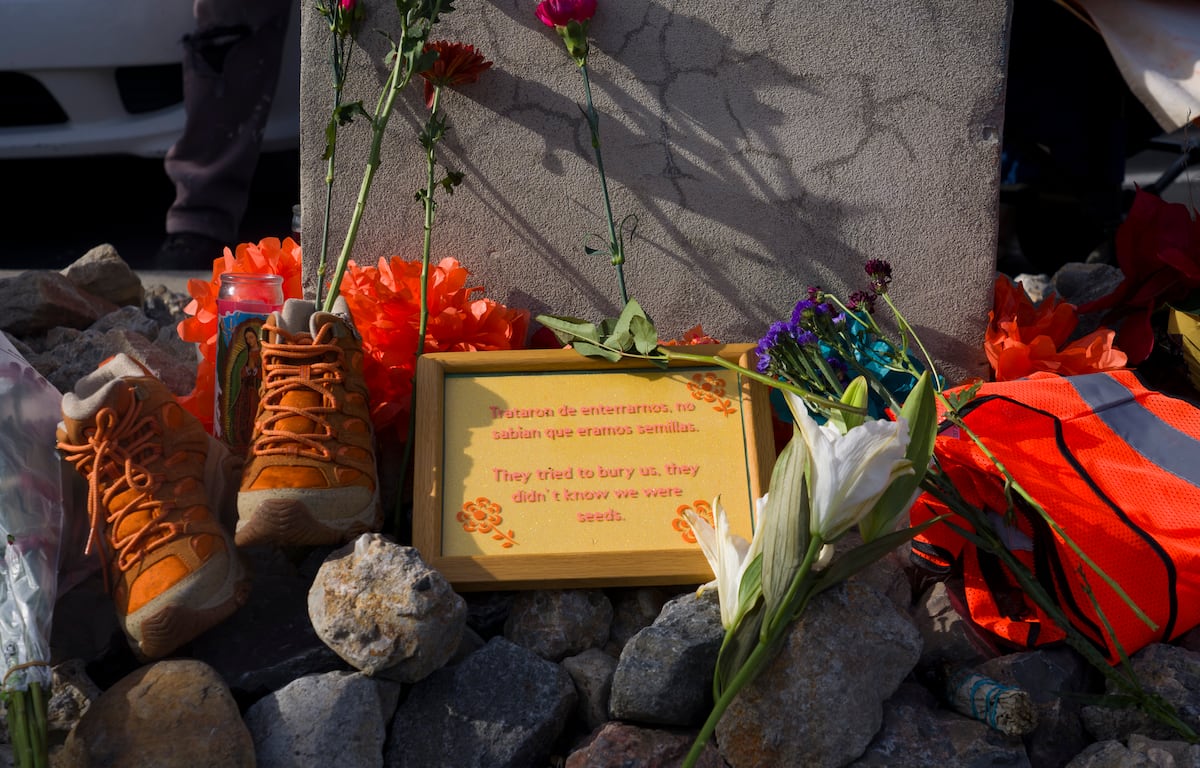
José Hernández, an El Salvadorian immigrant killed by Salt Lake City police last month, was a known as a “very amigable” — friendly — man, and a talented craftsman, landscaper, roofer and painter, immigrant rights activist Brianna Puga said at a vigil for Hernández Saturday.
“José was an individual that would carry himself with a lot of warmth, a lot of generosity,” Puga said. “He would always be making jokes.”
Puga was one of about 40 people who gathered in Salt Lake City Saturday at the intersection of 2100 South and 300 West where Hernández was fatally shot Oct. 29. The vigil was held just outside the parking lot of the Home Depot, where Hernández, along with other day laborers, often looked for work, and was organized by the Utah immigrant rights nonprofit Comunidades Unidas.
“This is a ritual to be in collective space with one another,” Puga, the immigrant rights lead for the organization, told the crowd. “A moment of truth, of love, of reflection, and to make it clear that to his community, his life mattered. His dignity mattered. His presence mattered.”
As Puga and others spoke over the course of nearly two hours Saturday, some members of the crowd held a large banner that read “immigrant rights = human rights” and another that read “El pueblo salva al pueblo,” meaning “The people save the people.” Others held smaller posters that read “Stop the violence against our neighbors” and “Justice for Jose,” with a drawing of Hernández.
(Bethany Baker | The Salt Lake Tribune) People gather for a vigil for José Hernández, a man killed by the Salt Lake City police department, in Salt Lake City on Saturday, Nov. 29, 2025.
But what justice may look like in this case is still an open question, Comunidades Unidas executive director Dominique Byrd said in an interview following the vigil.
“I think once we see the results of the investigation [into the police shooting], that will determine really what we hope to see from our city,” Byrd said. “If they rule it’s an excessive use of force, great. That’s a great first step in the right direction. We just don’t feel that anybody should be calling for medical help and should end up being shot in the intersection.”
According to 911 calls and body camera footage released by SLCPD earlier this month, officers initially responded to a call on the day of the shooting from a man who said, with few details, that his friend had just been “attacked in the middle of the street.”
When officers arrived, according to body camera footage, one officer told another that he saw Hernández in the parking lot of the Chevron across the street from Home Depot with his hand up to two other men “like he’s looking to fight them.”
In a news release, the department said witnesses to the events prior to the officers’ arrival indicated “some sort of altercation had occurred,” though it was unclear from the body camera footage if Hernández had been involved in any sort of fight prior to law enforcement’s arrival.
Once they arrived, officers separated the men, and spoke to the two men who had been with Hernández, as well as other bystanders, who said they saw Hernández collapse and called for medical attention. Police asked Hernández if he needed medical attention, which he declined, though he told police that the two men he had been with “wanted to beat [him] up,” and then stopped responding to officers’ questions.
After being initially questioned by police, Hernández began to pick up landscaping rocks and put them in his pockets, which one officer noticed and told him to put back. Hernández, according to the body camera footage, refused to comply and stood up to walk away.
“He’s got a rock in his hand like a weapon,” one officer said, and then both officers drew their guns.
Hernández then began walking away as officers told him to drop the rock and one officer switched from his firearm to a stun gun as Hernández motioned as if he were going to throw the rock before starting to run from police. He ran across 300 West before turning and throwing the rock at one of the officers, who then fired at Hernández.
Hernández died later that day at a hospital.
The incident was traumatic for those in the area and members of Hernández’s community, several speakers said at Saturday’s vigil.
(Bethany Baker | The Salt Lake Tribune) Sheccid Sosa Reyna speaks during the vigil for José Hernández, a man killed by the Salt Lake City police department, in Salt Lake City on Saturday, Nov. 29, 2025.
Sheccid Sosa Reyna, a 22-year-old Home Depot employee, said she did not directly witness the shooting but was shaken by it, and that, as a lot attendant, she sees the day laborers at the store every day.
“It really angers me that after this happened, everything went back to normal,” she said. “It just really didn’t sit right with me working the rest of that shift knowing that someone died who was just part of a community that’s trying to do better for [themselves].”
Sosa Reyna added that the day laborers she sees every day are “willing to be out here in the hot and the cold, rain, snow — they’re out here, standing out here, looking for an opportunity, just like everybody else.”
Several of the speakers also addressed the fear that many of the day laborers, even those in the country legally, have of police and Immigration and Customs Enforcement. While they await the results of the investigation into the shooting, Byrd said, she thinks one initial step toward justice for Hernández would be for local law enforcement not to work with ICE.
Currently, several law enforcement agencies in the state have signed varying agreements with ICE — known as 257(g) agreements — which give local officers immigration enforcement powers. The SLCPD does not have a 257(g) agreement with the federal government, though some agencies, even without agreements, will sometimes notify federal law enforcement if they encounter people with outstanding warrants.
“I think our cities need to step up and not collaborate with federal enforcement efforts … whether it’s through a 257(g) agreement or whether it’s through informal collaborations.” Byrd said in an interview. “For our residents here to feel safe, we can’t have collaborations with ICE. I think that’s something for me, for the organization, that’s a huge step toward justice. We need our local officials to stand by our community.”
Following remarks from Byrd and others, the crowd laid out flowers on a memorial for Hernández, lit candles and closed with the song “Amor Eterno.”
It includes the lyrics, “Pues siempre estoy pensando en el ayer, prefiero estar dormida que despierta / De tanto que me duele que no estés / Como quisiera, ay, que tú vivieras” — “I’m always thinking about yesterday, I’d rather be asleep than awake / It hurts me so much that you are not here / How I would like, oh, that you lived.”