
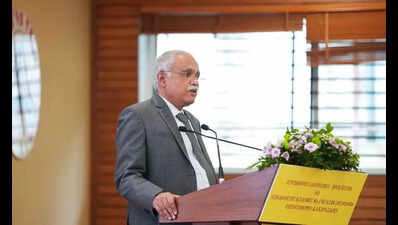
Bengaluru: As Artificial Intelligence (AI) and emerging technologies reshape the judiciary, Justice CM Joshi of the Karnataka high court cautioned that while these tools can streamline processes, human oversight and data accuracy remain crucial to ensuring justice is not compromised.”AI may be the future of courtroom efficiency, but it cannot replace judicial reasoning,” he said, highlighting the need for cautious adoption of technology in Indian courts. Speaking at a session on ‘Improving quality of adjudication: emerging and future technologies,’ Justice Joshi outlined the ways AI is being used and the safeguards required. He stressed that while AI can assist with transcription, translation, case analysis, and drafting, human verification is essential to prevent errors. Similarly, he emphasised that AI outputs depend entirely on the quality and correctness of input data, warning that incorrect data could lead to flawed results. “Certification and verification remain essential — AI cannot replace cross-checking or validation of documents.”He noted that AI can speed up workflow and reduce routine tasks, but judicial reasoning and final judgments must remain with human judges. He cautioned against over-reliance, pointing out that AI may generate hallucinations or incorrect interpretations if patterns are misread. To prevent misuse, he said AI systems operate within defined legal and procedural boundaries. The judge also stressed the need for a gradual approach, recommending AI use for document abridgement, transcription, and plain-language searches. While courts undergo a cultural shift to accept digital evidence, replicated judgments, and AI-assisted documents, legal gaps, including questions on certified copies and primary versus secondary evidence, must be carefully addressed.He added: “AI outputs are suggestions, not decisions. Emerging technologies are imperfect but good enough to remove routine grunt work. Unless we start trying them responsibly, we cannot fully benefit from their potential.”