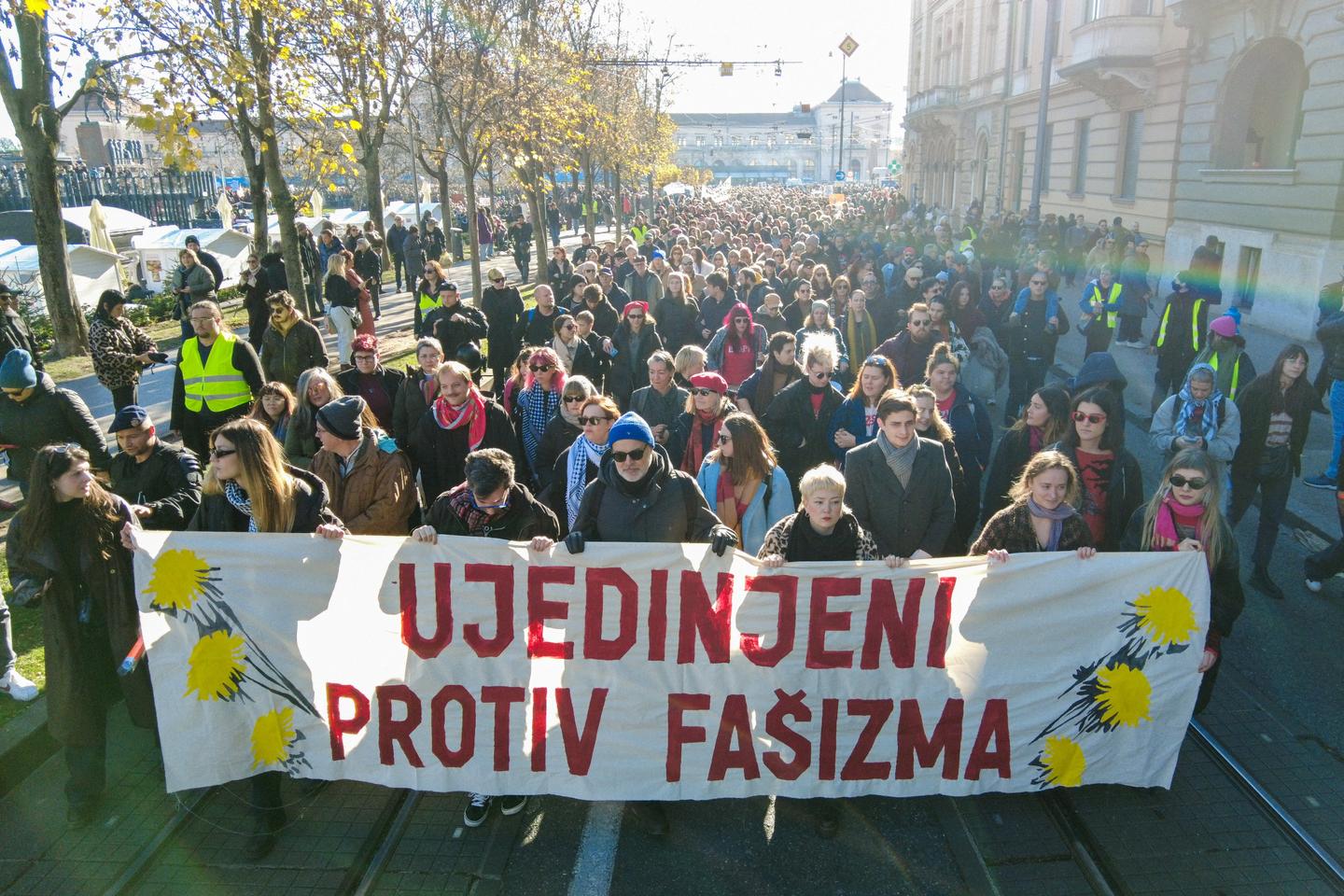
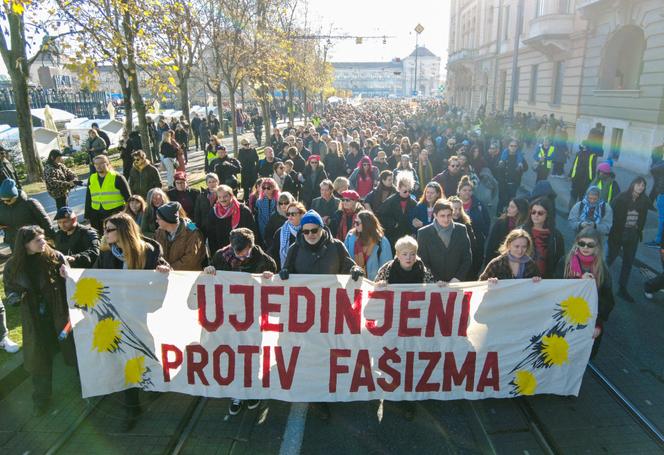
 People carry a banner reading: ‘United Against Fascism’ during a protest against what they say is the rising use of far-right symbols and rhetoric, in Zagreb, Croatia, November 30, 2025. ANTONIO BRONIC / REUTERS
Several thousand people rallied in Croatia’s capital Zagreb on Sunday, November 30, in an anti-fascist march protesting the rise of World War II revisionism and far-right views in the country.
In recent months, Croatia has been seeing right-wing nationalists increasingly trying to impose their agenda, with subsequent incidents targeting the ethnic Serb minority and the use in public of the country’s World War II pro-Nazi regime salute. In early November, masked men disrupted a Serb cultural event in Croatia’s second largest city of Split, replicating the Ustasha salute.
Relations with ethnic Serbs remain fragile since Croatia’s 1990s war with Belgrade-backed rebel Serbs who opposed its independence.
Hundreds of thousands gathered in Zagreb at a July concert of ultra-nationalist singer Marko Perkovic Thompson. One of Thompson’s most popular songs starts with the Ustasha salute and his fans are often adorned with affiliated symbols.
In days that followed the concert, two MPs made the salute from the parliamentary podium, while in October the assembly hosted a round table that downplayed the number of Croatia’s WWII death camp victims.’
‘We are all anti-fascists’
“Fascists are no longer ashamed, nor do they hide,” organizers of Sunday’s march said in a statement calling for resistance to “violence, historical revisionism and intimidation.”
“We currently have a problem with widespread revival of Ustasha ideology,” said protester Kristijan Kralj, an electrical engineering student. The Ustasha organization persecuted and killed hundreds of thousands of Serbs, Jews, Roma and anti-fascist Croats. Although their Independent State of Croatia (NDH) was a Nazi puppet state, their modern sympathizers see them as the nation’s founding fathers.
Partner service
Learn French with Gymglish
Thanks to a daily lesson, an original story and a personalized correction, in 15 minutes per day.
Try for free
Help us improve Le Monde in English
Dear reader,
We’d love to hear your thoughts on Le Monde in English! Take this quick survey to help us improve it for you.
Take the survey
New
Le Monde’s app
Get the most out of your experience: download the app to enjoy Le Monde in English anywhere, anytime
Download
Dado Gazda arrived from Bjelovar, some 85 kilometers east of Zagreb, to “support all these people in their fight against far right.” “The time has come to say what is bothering us, why we are worried about our country,” he told AFP.
Chanting “We are all anti-fascists,” the marchers walked through central Zagreb on a sunny and cold day to the city’s main square, carrying in front a giant banner that read “United against Fascism.” Similar marches were held in three other Croatian towns – Rijeka, Pula and Zadar – all on the Adriatic coast.