On the one hand, it looks as if the “Dmitriev–Witkoff pact” as a path to “peace through business” is working. Putin’s emissary has put forward a number of business projects which he considers exceptionally attractive for the American side.
On the other hand, we see no practical steps at all, nor even any public reaction from potential American partner companies. There are simply no such interested companies.
In the time that has passed since the first business-format meeting at the beginning of April this year, and as of now, there is not a single officially launched project between Russia and the United States that would be implemented following Dmitriev’s statements over the past year.
Dmitriev’s failure
The reason is simple. Having familiarised themselves with the “unique proposals”, business circles, as well as the key American departments – Energy and Treasury – concluded that there was no project justification, no commercial appeal and, in a number of cases, complete unreality.
It is enough to recall the proposal for a Trump–Putin tunnel under the Bering Strait. Despite US interest in developing deposits of rare earth metals (REMs) in order to rid itself of dependence on China, what the Russians are offering is attracting no interest.
American oil companies, at a time when the Trump administration is lifting restrictions on the development of hydrocarbon deposits on US territory, see no point in implementing large-scale projects in Russia.
All the more so in the conditions of Putin-omics, with its dominance of the security apparatus and lack of rule of law, the losses already incurred by Americans in Russia, and the fact that the Kremlin warns it will “select” candidates for doing business in Putin’s Mordor – deciding whom to admit and whom to show the door.
As they say in Washington, American business circles speak of Dmitriev with contempt. Someone with an SVR ID is not regarded as a businessman; he is described as a “manager of stolen money” – a reference to the Russian Direct Investment Fund he heads.
Dmitriev’s initial self-positioning in the US as a Russian entrepreneur with a strong American education and practical experience who seeks to restore relations between Russia and the US on the basis of business pragmatism has suffered serious erosion and, after Alaska, a de facto fiasco.
Dmitriev is not held in high esteem in the circles around the Kremlin either; he is considered an “upstart from Kyiv”. It cannot be ruled out that he may be replaced by a more powerful figure from among the “Petersburg” group.
There is talk of a heavyweight from Putin’s inner circle – the head of the oil company Rosneft, Igor Sechin, who is also executive secretary of the presidential commission on the strategy for the development of the fuel and energy complex and environmental security.
Indirect confirmation of this is the transfer of the promising Tomtor rare earth deposit in the Arctic zone of the Sakha Republic into Rosneft’s ownership. The specifics of developing REM deposits are entirely different from oil field development.
Thus, the Kremlin has decided to extend the extraction activity of Russia’s leading oil company to another mining sector, due to the special trust the Kremlin ruler places in Sechin. For the time being, the Kremlin is keeping Sechin’s REM card in its pocket. And there is no guarantee it will be used as a trump for Trump.
Sechin’s China track
On 25–26 November, Beijing hosted the 7th China–Russia Energy Business Forum, held under a clumsy, Soviet-bureaucratic style theme: “Strengthening the high-level China–Russia strategic alignment and consistently consolidating comprehensive co-operation and partnership in the energy sphere”. This is an annual forum, which the head of Rosneft has personally attended for the past three years, delivering keynote speeches.
This year Sechin’s speech contained a number of points that attract attention. The speaker noted that China had saved 20 billion US dollars by buying oil from Russia since 2022, i.e. since the start of Russia’s full-scale invasion of Ukraine.
It is obvious that this saving for China means foregone Russian revenue as a result of the discounts Russian companies have been forced to grant Chinese oil buyers under Western sanctions.
The head of Rosneft complained that, like China, Russia had been under growing external pressure for many years, the main aim of which was to squeeze Russia out of the global market. He immediately proposed a way out: “Russia has a unique resource base and is ready to use it to supply China. Thanks to Russian energy resources, the PRC will achieve its strategic goals.”
It has long been clear that in recent years Russia has rapidly transformed into a raw-material appendage of the Middle Kingdom. But such an explicit statement of the Kremlin’s readiness to accept a permanent vassal-raw-material status for Putin’s Russia vis-à-vis its Chinese suzerain is being voiced almost for the first time.
This approach fits into the formula voiced by the Chinese host of the forum, Vice-Premier of the State Council of the PRC and member of the Standing Committee of the Politburo of the CPC Central Committee, Ding Xuexiang – to strengthen co-operation along the entire production chain, to ensure the safe and stable functioning of cross-border energy corridors, and uninterrupted trade in energy resources.
It is clear that in the Chinese Communist Party, which has designated the “reunification of Taiwan” as a strategic objective, there is a clear understanding that Western sanctions would deprive the country of the bulk of seaborne energy supplies, creating a threat to the stable functioning of the economy. In this context, Russia is to play the role of a reliable resource rear.
Sechin also added that the combination of Russian resources and the Chinese technological platform reliably ensures the stable development of both economies. He painted the future of the West in gloomy colours under such a combination of Russian and Chinese efforts: deprived of access to Russia’s resource base and China’s component base, Western opponents might lose their technological and economic agency.
It is obvious that such statements by Sechin were prepared by the Kremlin precisely in order to assure Xi of the inviolability of the “no-limits comprehensive strategic partnership” between Russia and China, against the background of the Trump administration’s attempts to “pull Russia away from China”.
It is no coincidence that these theses were voiced not by Deputy Prime Minister Aleksandr Novak, who also took part in the forum, but by the head of Russia’s largest oil company (which now also controls a giant, promising REM deposit), a person from among those closest to the Kremlin ruler.
In turn, Russia’s energy vassalage fits fully into the implementation of the strategic directives on building a powerful energy state, as defined at the recent 4th Plenum of the 20th Central Committee of the Chinese Communist Party.
Trump: on course for American capitulation
Thus, the Kremlin’s course towards energy vassalage to China not only lies in the mainstream of Putin’s “pivot to the East” strategy, proclaimed more than ten years ago, but also answers the question of whether the United States is capable of tearing Russia away from China. Clearly it is no longer capable, because the Russian economy is being incorporated into the Chinese one according to an algorithm and at a pace determined not in Moscow, but in Beijing.
Nonetheless, Trump, with Sisyphus-like persistence, is trying to re-recruit Putin to his side. A bet has been placed in haste, in the hope of bringing this plan to success over the next few months.
As reported on 25 November, Trump officially confirmed that he had accepted Xi’s invitation to visit China in April 2026. The intention of the occupant of the White House is to arrive in Beijing with a trump card up his sleeve – Russia on the side of the United States. To achieve this, he believes it is enough “to sell Ukraine” to Putin.
It is no accident he used this particular expression when, in talking to journalists, he justified Witkoff’s negotiating game in favour of Russia. To this end, Zelenskyy is subjected to furious pressure and blackmail. His position has been sharply weakened by the mafia-style corrupt dealings of his closest entourage and a collapse in public trust.
But Xi also wants to meet Trump not empty-handed. “Taiwan is ours” is not just a CCP propaganda slogan. Admittedly, it is unlikely that the PLA will carry out a successful blitzkrieg in the time remaining before a Trump–Xi summit, but Beijing is already creating a powerful projection of threat both to Taiwan and to Japan. And this is not only Putin-style animated films in which Chinese missiles hit targets in Taiwan and the Japanese islands, including in Okinawa Prefecture, where US bases are located. It is also an aggressive propaganda attack on Japan’s Prime Minister Sanae Takaichi, accusations against Tokyo of “undermining the post-war international order” with threats to use force against Japan, and a diplomatic demarche at the UN. Here Xi is acting just like Putin – supposedly “taking back what is ours”, unlawfully taken by the West under US leadership at a time of Chinese weakness.
At the same time, honeyed words are addressed to America in the context of the Second World War – “China and the United States fought shoulder to shoulder against fascism and militarism”. Xi’s hint to Trump becomes clear: if you sell Ukraine to Russia, you must not object to the reunification of the island with mainland China.
And we see that the extraordinarily talkative “big dealer from Manhattan”, who is also President of the United States, not only remains silent on the situation in East Asia, but posts on social media that US–China relations are “extremely strong”.
Ukraine – Europe’s citadel
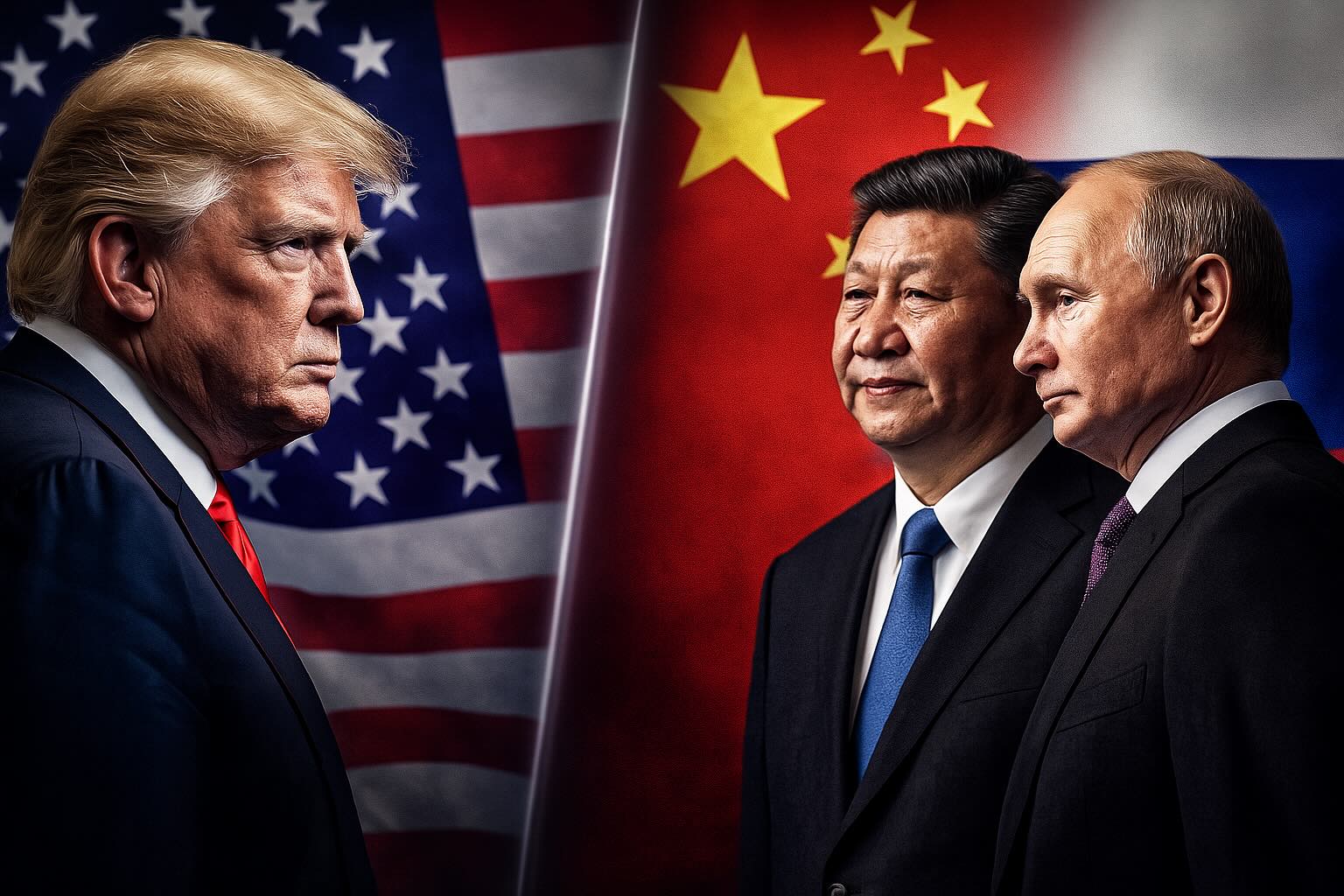
If all the pieces are put together, a game for four hands – Beijing’s and Moscow’s – becomes visible. This game aims to keep Trump trapped by his own whims and illusions: the laurels of global peacemaker, Nobel laureate, the man who brings “many trillions of dollars” to America, the one who “pulls” Russia away from China.
Putin wants to restore a status quo ante in relations with the United States, so as to reduce the imbalance he himself has created in favour of China, while at the same time maintaining Beijing’s support for the future.
Xi intends to “reunify Taiwan” without resistance from the United States and to preserve the status quo in trade and economic relations, with a positive balance for the Middle Kingdom.
It should be noted that this game by Beijing and Moscow is being facilitated in Europe, and not so much by the Kremlin’s Trojan horses, Orbán or Fico, as by those who, in the style of NATO Secretary-General Mark Rutte, seek to flatter Trump.
In Beijing and Moscow, they clearly believe that the erasure of Ukraine and Taiwan from the political map of the world should be the price the West pays for “peace in the whole world” and a further comfortable, carefree life with fragrant coffee and croissants in the morning, warmth at home from unlimited Russian gas, and Chinese smartphones in their pockets.
From Washington it looks different, but in Trump’s model of world order, as in property development, some buildings can be demolished in order to put up another Trump Tower and collect a Nobel Prize.
All three players, in one way or another, distrust one another. It could not be otherwise; they are predators. But two of them are intent on removing the third from the global arena and making Europe easy prey.
Recall Xi’s words to Putin as he took his leave after visiting Moscow in March 2023: “Right now, there are changes, the likes of which we haven’t seen for 100 years. When we are together, we drive these changes.”
For the moment, however, they have not succeeded in overcoming the European citadel called “Ukraine”. They failed in 2014, they failed in 2022, and so now they are trying to do it in another way – acting from the transatlantic, western rear of Europe.
Instead of compelling the aggressor to peace – to capitulation under the name of a “peace agreement” – they are trying to bend the Ukrainian leadership, mistakenly taking it for the whole of Ukraine.
Yet Ukraine is holding the line. In fact, it is the United States under Trump’s leadership that has capitulated.
Will Europe withstand the blow without Ukraine? This is doubtful, judging by the behaviour of Brussels’ “Euro-indecisive”.
Despite the splits Putin is doing between Beijing and Washington, it is Xi, not Trump, who holds the leash around his neck. That is why Sechin was sent to Beijing to confirm the unchanged vassal status of the Kremlin vis-à-vis the Middle Kingdom.
Ukraine’s leadership should harbour no illusions, not only about Trump but also about China’s “peace-making”, as China is profiting handsomely from the war in Europe, helping Russia “achieve the goals of the special military operation”, while preparing itself to “reunify” Taiwan and to help with Ukraine’s post-war reconstruction, regardless of the status of its existence.
Post Views: 1,145