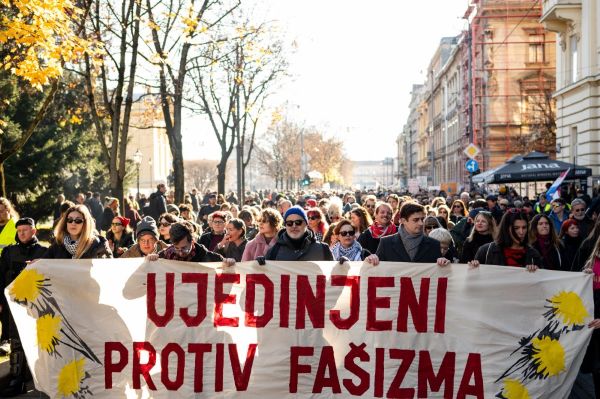
On Sunday, thousands of people participated in protest marches across Croatia, voicing their concerns about the growing influence of far-right groups in the country. The events, organised under the banner “United Against Fascism,” took place in four major cities, including the capital, Zagreb. Participants expressed their solidarity by chanting, “We are all antifascists!” while advocating for an active response to perceived attempts by right-wing factions to instil fear and suppress dissent.
During the protests, demonstrators called upon governmental authorities to take definitive action against hard-right groups that frequently employ pro-fascist symbols associated with Croatia’s World War II regime. This regime oversaw concentration camps in which tens of thousands of ethnic Serbs, Jews, Roma, and antifascist Croats lost their lives. A declaration made at the event emphasised a firm stance against considering national minorities as provocations. It condemned any form of patriotism that relies on the darkest chapters of the nation’s history.
Growing apprehension regarding social cohesion has emerged following recent extremist incidents in November, which targeted ethnic Serb cultural gatherings in Zagreb and Split. These events have raised fears of potential ethnic violence reminiscent of the conflicts stemming from the Serb-Croat war between 1991 and 1995. Additionally, extremist groups have directed hostility toward liberal organisations, politicians, and foreign workers in Croatia, often invoking the Nazi-era slogan “For the homeland — Ready!” commonly associated with the Ustasha regime from World War II.
Journalist Maja Sever addressed attendees at the Zagreb rally, stating, “The current situation is very dangerous. Your presence today demonstrates a commitment to not remaining silent; we will advocate for a democratic society.”
In contrast, counter-demonstrations were reported in Rijeka and Zadar, where groups of young men clad in black engaged in acts of hostility, including verbal assaults and the launching of firecrackers and red paint at the protesters. Iva Davorija, an organiser for the Zadar march, described these events, noting that participants threw smoke bombs and threatened violence while shouting the slogan above.
The political landscape in Croatia has shifted to the right since the governing conservatives, led by Prime Minister Andrej Plenkovic, formed a coalition with the far-right Homeland Movement (Domovinski pokret – DP, an ECR member) after the parliamentary elections last year. This coalition has resulted in the exclusion of an ethnic Serb party from government representation for the first time in years.
The situation reached a notable climax in July with a mass concert by the far-right singer Marko Perkovic, known as Thompson, whose use of World War II-era slogans has caused significant controversy. Despite facing bans in several European cities, he remains immensely popular in Croatia.
Prime Minister Plenkovic has rejected claims that he has overlooked the rise of far-right extremism and neo-fascist rhetoric, asserting that leftist opponents are exaggerating the issue and exacerbating societal divisions. It is important to note that Croatia was part of Communist-run Yugoslavia after World War II. Still, the federation disintegrated amid a series of nationalist conflicts in the 1990s, during which more than 10,000 individuals lost their lives. Croatia joined the European Union in 2013, following its NATO accession four years earlier.
This article used information from The Associated Press.