Replacing the closure of coal-fired units 2 and 3 in 2027\n1000MW class, targeted for operation in December 2029
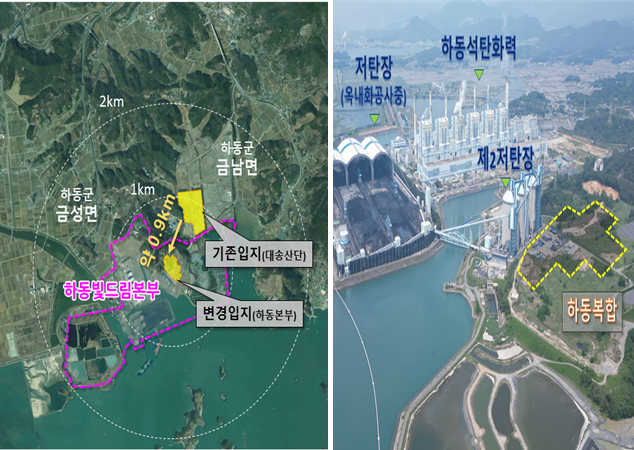 사진 확대
사진 확대 The site of Hadong LNG combined power plant./ Rep. Seo Cheon-ho’s office/
The construction of an LNG (liquefied natural gas) complex power plant, which will cost 1.38 trillion won in Hadong, Gyeongsangnam-do, will begin in earnest. As it has been confirmed as an eco-friendly power infrastructure to replace Hadong Thermal Power Plant Units 2 and 3, which are scheduled to be closed in 2027, it is expected that the structural transformation of the local energy industry will accelerate.
Hadong-gun announced on the 1st that the Electricity Commission recently approved the construction plan of Korea Southern Power Co.’s “Hadong LNG Complex Power Plant.” It is a project to replace existing coal-fired facilities that are undergoing phased shutdown in accordance with the government’s 10th basic plan for electricity supply.
Korea Southern Power will invest a total of 1.38 trillion won in 76,000 square meters of idle land at the Hadong Bit Dream Headquarters (formerly Hadong Thermal Power Plant) to build a 1,000MW LNG power plant. It is the same scale as the existing coal units 2 and 3 and aims to operate commercially in December 2029 after environmental impact assessment.
Hadong Thermal Power Plant is scheduled to be closed sequentially starting with Unit 1 in 2026 and until Unit 6, so the new LNG power plant is expected to play a key role in stabilizing the local power supply and maintaining the industrial base.
Hadong-gun expects to revitalize the local economy, inflow of population, and create jobs during the construction and operation period by attracting LNG power plants. In particular, about 93.6 billion won in subsidies is expected to be invested in the region over 33 years, which is expected to have a significant effect on supplementing local finances.
Hadong-gun is also implementing a strategy to transform into a sustainable energy hub in the post-coal region, such as preparing for a 700MW pumping power plant in Okjong-myeon and promoting the designation of a “Just Transition Special District.”
The construction of the LNG power plant was initially aimed at attracting the Daesong Industrial Complex, but it was on the verge of collapse due to the suspension of the industrial complex development plan in July last year. Since then, the situation has changed rapidly as Korea Southern Power Co. reviewed its location in the Seoul metropolitan area, but Hadong-gun has turned to the site of a current thermal power plant in the rural development zone, drawing approval from the Electricity Commission.
Hadong-gun and Seo Cheon-ho have continued various activities, including the operation of TFs, holding resident briefing sessions, consultations between the Ministry of Industry and the Ministry of Climate, Energy, and Environment, and participation in working groups in Gyeongnam. From December to September last year, the Coal Power Transition Council presided over by the Vice Minister of Industry continuously requested Hadong to be attracted, and on the 17th, it signed a win-win agreement with Korea Southern Power Co.
As Hadong’s energy industry transition is on track after decarburization, significant changes are expected in the future in the power and industrial structure of the western part of Gyeongnam.