Debt, humanitarian aid, and collective solidarity
None of them have worked regularly since October 2023, when Israel revoked the permits allowing Palestinians to work in Israeli territory. Renting a home, buying food, and paying bills are immense challenges without a stable income.
Debt, humanitarian aid, and collective solidarity are all that remain.
Remaining resistant against adversity
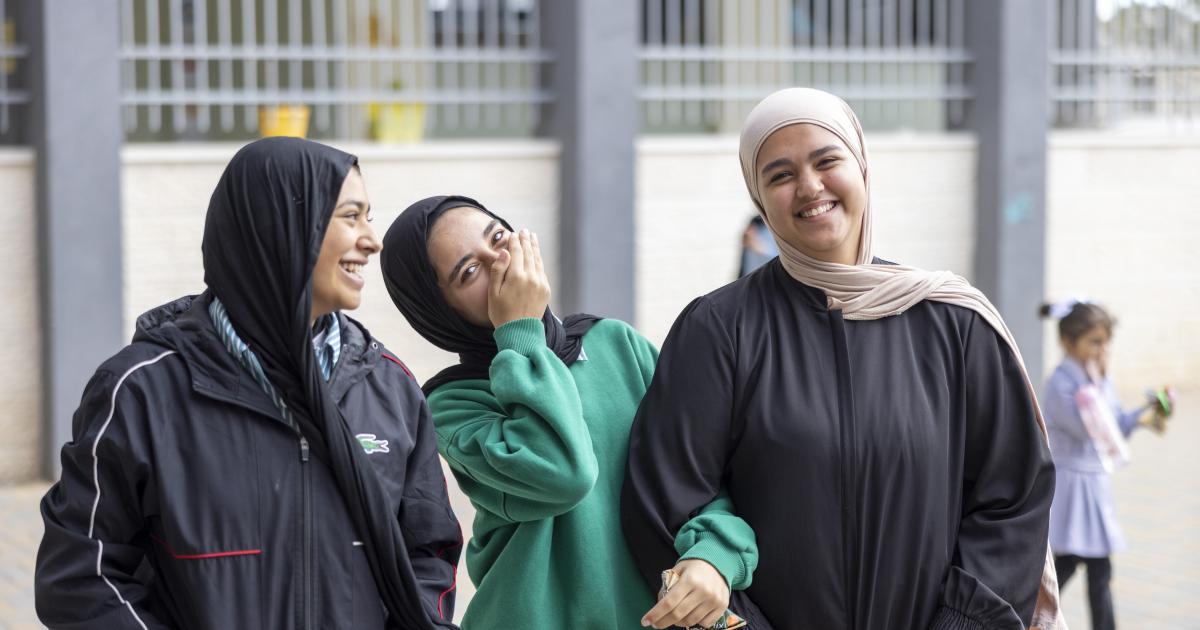
We meet these women at a centre offering psychosocial support to children and caregivers, funded by the EU and operated by UNICEF and local Palestinian organisations. They are well-dressed, wearing make-up, and meticulously groomed. ‘Taking care of ourselves is, in its own way, an act of resistance against adversity’, a Palestinian journalist in Gaza once said.
‘They want us to be silent and unkempt, depressed and weak. But we will be beautiful, empowered and dignified.’
Her words echo in this small room, where these women share their anger, sadness, and frustration.
War evokes fear
‘We live with our families in single rooms, all together, crammed in’, one woman says. ‘There are 6 of us in 1 room. These rooms are meant for students, not families.’
‘Are you all mothers?’, we ask.
‘Yes’, they reply.
‘And how are your sons and daughters?’
A heavy silence follows. Then, 1 woman speaks up.
‘Not well. It took months to bring even a little normality back to our home.’
‘To escape the camp, we ran to a car, but gunfire erupted all around us. We stayed inside the car, crouched down, praying we wouldn’t die’, she continues. ‘Now, my daughters are afraid of getting into a car, any car.’
In the Occupied Palestinian Territories, there are children who fear getting into cars because they were trapped inside while violence raged around them.
‘My boys have become aggressive’, another woman says. ‘Instead of talking, they raise their hands in anger. They are full of rage.’
The headmaster of a boys’ school we visited in the morning told us the same thing: the boys expelled from the camp arrived at school with nothing – no books, no pens, no uniform – full of anger and unable to concentrate.
How could it be any different?
When pictures speak louder than words
Many of them have witnessed family members being killed, been detained in their homes, threatened by soldiers, and endured sleepless nights filled with the sounds of drones and gunfire. They’ve hidden under beds, covering their ears to block out the gunshots, and fled in chaos, leaving everything behind.
Drawings on the school walls are the expression of what children see, some of them are very normal, but others are far from what a child under 10 should be drawing. One would expect mostly happy scenes, certainly not images of bombings or arrests.
Learning recovery and support activities
With the closure of 3 schools operated by UNRWA, 1,200 children from the Jenin camp alone were left without education. They had to enrol in government schools mid-year, wherever space was available. Many were forced to change schools again and again. ‘My son refused to go to the third school’, a young woman with tired eyes tells me, holding her daughter. ‘He cried and said he couldn’t bear to lose more friends.’
The EU is channelling €6 million towards UNICEF. This funding will help provide all children who are unable to follow their education – due to the worsening context in the occupied West Bank, including East Jerusalem, with learning recovery and support activities, such as remedial and catch-up classes and distribution of school kits.
Meanwhile children forcibly displaced from the camps struggled to adapt to ever-changing, unfamiliar environments, government schools fared no better. Due to Israeli military operations, schools in Jenin closed for an average of 100 days in the first semester. Remote learning was attempted, but approximately half the students lacked the technology to participate. They fell further behind.
Israel’s withholding of tax revenues owed to the Palestinian Authority has also crippled schools. Teachers receive only half their salaries, and schools operate just 3 in-person days a week.
These Palestinian women say little, but their silence speaks volumes.
Repeatedly being forced to close schools for security reasons is tantamount to crippling generations of young Palestinians inside and outside the camp, for whom education is the most powerful tool to follow their dreams and break the cycle of poverty.
‘We want nothing different from what you all want for your children’, says a Palestinian woman who has been silent until now. ‘We want them to be happy and safe. We want them to study and pursue their dreams.’
‘Is this what you call childhood? Is it normal for an 11-year-old to wet the bed from nightmares? To dream every night that they will be killed?’ she continues.