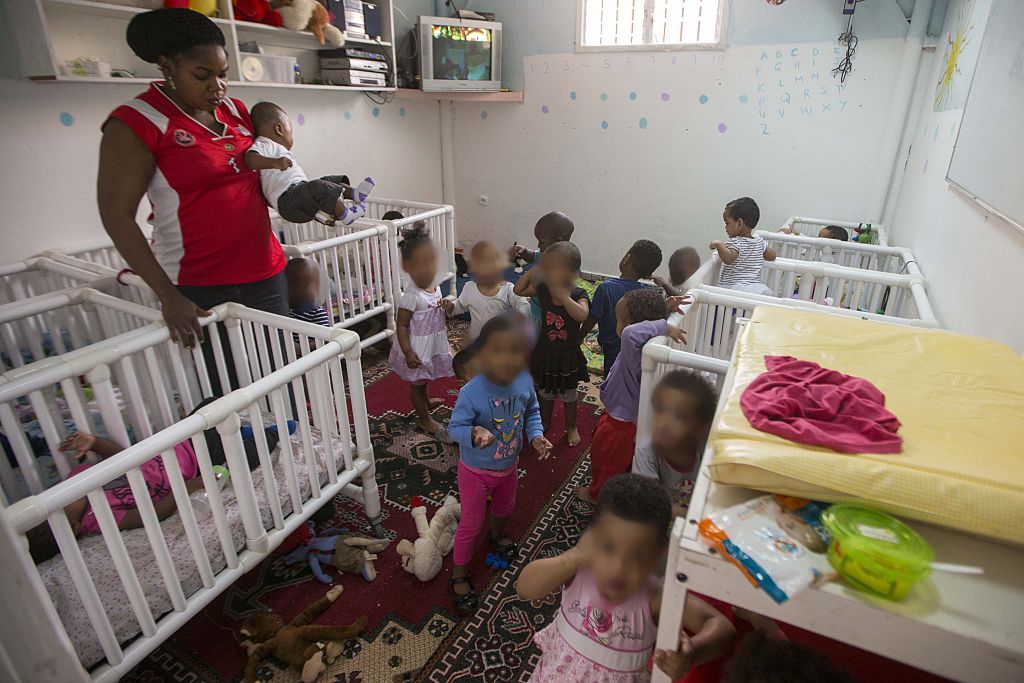
Five infant deaths within two months in Tel Aviv’s pirate daycare facilities, mainly serving the migrant community, caused enough of a public outcry in Israel in 2015 that it spurred a government decision to act. The deaths, which came after back-to-back reports by the Israeli State Comptroller in 2013 and 2014 warning that these facilities were endangering children’s lives, created mounting pressure on the government to act.
These unlicensed and unregulated childcare centers, commonly referred to as “baby warehouses” for their overcrowding and minimal oversight, were at the time the only childcare solution for Tel Aviv’s population of undocumented migrant workers and asylum seekers while they worked. The city of Tel Aviv, home to many migrants, watched a growing crisis unfold in its southern neighborhoods and pushed for a solution.
The 2015 decision allocated $9.15 million over five years, split among government ministries and funneled through local municipalities to Unitaf, a nonprofit organization chosen to operate the facilities. This was renewed in 2021, but the funding is due to expire at the end of this month, plunging hundreds of children — and their parents — into uncertainty.
The initial government decision was explicitly temporary, an emergency solution to an acute problem. Lacking significant political will, the government wouldn’t commit long-term to serving a population it officially wanted to discourage from remaining in the country. “There was no vision for long-term planning,” Yael Geula, executive director of Unitaf, told eJP.
Today, Unitaf serves approximately 600 children ages 0-3 across Israel — roughly 20% of the estimated 4,000-6,000 children in that age range without legal status. But a significant portion of asylum seeker and migrant worker toddlers continue to spend their early years in unsupervised frameworks, mainly in cities where Unitaf doesn’t operate.
Unitaf’s facilities operate according to accepted Israeli standards in supervised daycare centers, with staff — most of whom lack legal status themselves — receiving pedagogical training and accompaniment by social workers. The daycares feature professional supervision, pedagogy and social and community support. Parents pay tuition lower than private facilities, and the state, together with some philanthropic funding, covers the remaining operational costs.
For the hundreds of children attending the supervised frameworks, the intervention is lifesaving. Families credit Unitaf with closing significant developmental gaps for their children.
No one knows exactly how many toddlers need services, due to their lack of legal status. They only appear on the government’s radar when their parents register them for municipal kindergarten at age three, when the country’s compulsory education law applies regardless of legal status.
While for much of the past two decades the community lived concentrated in Tel Aviv, migrant workers and asylum seekers are now scattered throughout the country, making it harder to keep track of them and oversee the situation with pirate nurseries.
“They are invisible, and even the authorities don’t really know about them, unless something extreme happens,” Geula said. “Specifically in infancy, which is known to be so important for development, the toddlers are not entitled to anything. Neglect at this stage has many ramifications.”
The consequences of that neglect extend far beyond early childhood. Children without status who don’t receive proper education arrive at special education frameworks at much higher rates than average. In adolescence, dropping out and slipping into crime are common. Recently, the “SSQ” gang made headlines in Israel, sowing chaos in south Tel Aviv, with members who are of middle school age.
“Everything starts in infancy, in the question of whether the parents put the toddler in a place where they can go to work calmly, or whether they don’t know what they’ll get when they return from work,” Geula said.
In recent years, funding transfers have been incomplete, posing operational challenges for Unitaf. Last September, reports emerged that the Public Guardian and Ministry of Economy had delayed their 2025 budget transfers, threatening the organization’s operations. As of early November 2025, Unitaf had received only about two-thirds of the committed funds for 2022-2025.
The funding instability has already forced cuts. A planned therapeutic playroom remains closed. Social work students completing their required practical training at Unitaf facilities were dismissed because the organization couldn’t pay for supervision. Services helping parents navigate healthcare and social services for their children have been scaled back.
Unitaf was missing $762,000 in government funding for 2025, creating cash flow problems. The Association for Civil Rights penned an appeal to the relevant government ministries, stating that “the foot-dragging in fulfilling their legal obligation severely harms the children, their families, and the daycare staff.”
In response, MK Naama Lazimi, of the Democrats party, who serves as chair of the Knesset Youth Committee, summoned representatives from five government ministries — Education, Welfare, Labor, Economy, and Finance — to explain funding delays and commit to the program’s future.
At the Nov. 18 meeting, which Lazimi described as “the most absurd in the Knesset,” each government ministry claimed that another was responsible. Adding to the confusion, the Labor Ministry currently operates under an acting minister and the Finance Ministry has no director general.
The second committee meeting, which was held last Tuesday, concluded with a resolution to close the immediate funding gap and ministry officials promising to work together. Lazimi also vowed to push for recommitment to funding for another cycle when the current decision expires. “Our goal in this discussion is to create stability in creating a funding stream for this,” Geula told the committee. “[Unitaf] saves lives. This needs to be long-term.”
In the absence of Unitaf frameworks, she said, people will be forced to use the pirate nurseries, the so-called “baby warehouses.”
“During COVID, and during the war, when we weren’t allowed to open, the pirate nurseries were the first to open,” Geula told the committee. “Today, there are still many pirate nurseries all over the country.”
Eynat Benita, representing the central Israeli city of Rehovot, put the issue in stark terms: “These children are now in the backyard of Israeli society. But in five years, they will be in the front yard. Thanks to the government funding for daycare frameworks and early interventions, we see the closing of developmental gaps.”
The administrative challenges compound another crisis Unitaf faces: the post-Oct. 7 philanthropic landscape. As eJewishPhilanthropy has previously reported, Israeli nonprofits are navigating an increasingly competitive field for donor support, with resources flowing heavily toward war-related causes. Organizations like Unitaf, which rely on philanthropic support to close funding gaps as part of the original arrangement with the government funding structure, find themselves competing for attention in an environment where marginalized issues face particularly steep odds.
“Everyone wants to give to trauma and soldiers,” Geula said. “We understand that. But we can’t rely on philanthropy as the central factor anymore.”
Larry Tobin, director of the Shapiro Foundation, which has supported Unitaf since 2018, confirmed the foundation’s ongoing engagement when contacted about the funding crisis. “Unlike in the U.S., Israel does not have birthright citizenship. Israel does not have a legal responsibility to serve their needs as babies, but there is plenty of data to suggest that play-based learning, early intervention and literacy will lead to better long-term outcomes and reduce the costs of education and healthcare to Israel,” he said. “There’s a separate ethical question about what responsibility Israel has to children born in Israel to parents with legitimate asylum claims that have been pending for nearly two decades. The question is even more acute since Oct. 7[, 2023], as a majority have shown immense loyalty to Israel and the Jewish people of late.”