Gov. Gavin Newsom has signed several bills this fall to curb the Trump administration’s aggressive immigrant enforcement.
From mandates that require schools to notify parents about immigration enforcement activities on their campuses to face mask bans and identification display requirements for law enforcement, the bills aim to protect immigrant students and communities across the state.
Whether the laws have any teeth depends on the federal government’s willingness to follow them and the state’s determination to enforce them.
Ashton Desmangles, a 14-year-old freshman at El Cerrito High School, said the laws are well-intentioned but appear mostly symbolic.
“It’s a solution to an issue that we don’t have power to fix,” Desmangles said. “The federal government’s not going to abide by it, because the Trump administration doesn’t care what bills we pass here in California.”
Here’s a roundup of the new legislation:
Senate Bill 98, co-sponsored by state Sen. Jesse Arreguín, who represents west Contra Costa County, mandates that school administrators notify families and students when federal agents conduct immigration operations on any school or college campus. Assembly Bill 49, drafted by Assemblymember Al Muratsuchi, prohibits federal immigration agents from entering nonpublic areas of schools without a judicial warrant or court order.
Senate Bill 805 requires plainclothes law enforcement officers to visibly display identification that includes their agency and either a badge number or name when performing enforcement duties.
Senate Bill 627, authored by Arreguín and state Sen. Scott Wiener, prohibits federal and local law enforcement officers from wearing face masks while performing their duties. The law applies to local and federal officers but exempts California Highway Patrol officers. It was primarily aimed at Immigration and Customs Enforcement agents wearing masks that make them unidentifiable. Violations are punishable as an infraction or misdemeanor. Officers who commit assault, battery, false imprisonment or false arrest while masked face civil penalties of at least $10,000.
“No one wants masked officers roaming their communities and kidnapping people with impunity,” Wiener said in a statement after the bill’s signing.
But the Department of Homeland Security responded on X that its agents would defy the law, saying, “To be clear: We will NOT comply with Gavin Newsom’s unconstitutional mask ban.”
Immigrants are worried
According to the most recent U.S. Census, more than a third of Richmond’s residents are foreign-born, and half of all households speak a language other than English.
Karen Hernandez, a Richmond resident and daughter of immigrant parents from Durango, Mexico, said the new laws provide some comfort but may not address deeper fears in the immigrant community.
“It’s great because a lot of parents are very worried,” Hernandez said. “It’s very concerning for the parents to send the kids to school. It’s good that they passed this because it makes them feel safe and keeps immigration from going into schools.”
Hernandez has heard from families in her community who have kept children home from school due to fears about immigration enforcement.
“If the president’s not following the rules and the federal government is not following the rules, then the community is still going to be scared about it,” Hernandez said.
WCCUSD added protections
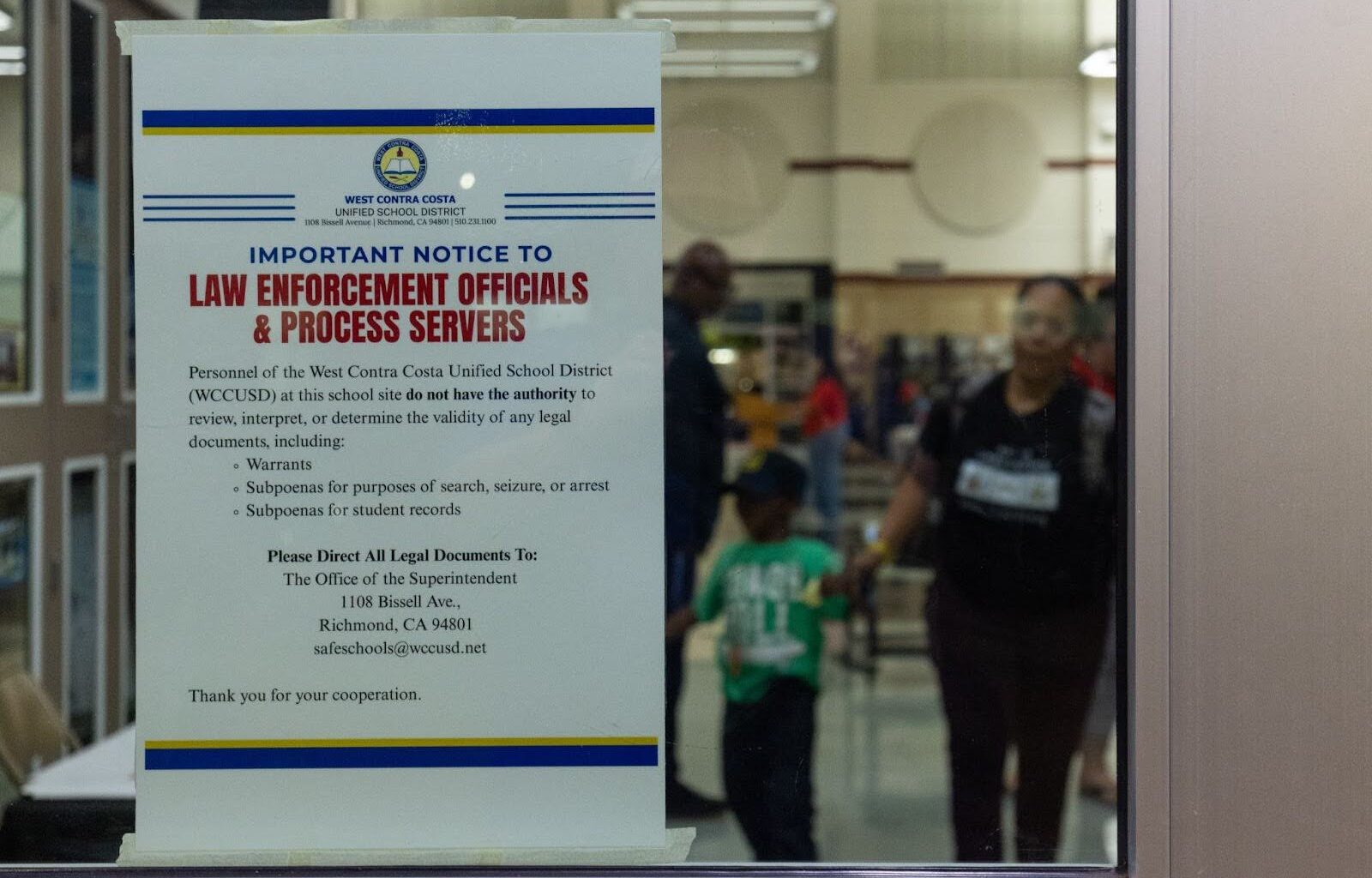
SB 98 builds on existing protections adopted by the West Contra Costa Unified School District last December, by declaring every school site a safe place for all students and their families, prohibiting immigration agents from entering any school or school grounds, and prohibiting district employees from inquiring about students’ immigration status.
WCCUSD did not respond to a request for comment, but did post a video on YouTube of Superintendent Cheryl Cotton addressing concerns within the community.
“Our schools are safe, welcoming spaces for every child, regardless of immigration status,” Cotton said. “WCCUSD’s commitment to maintaining inclusive learning environments is grounded in our anti-racism policy and our district immigration policy, both of which affirm that we will protect and support every member of our community.”
The U.S. Constitution dictates that federal law takes precedence over state law, casting legal uncertainty on whether California can enforce legislation aimed at federal immigration officials.
Bill Essayli, the acting U.S. attorney for the Central District of California, posted on X, “California’s law to ‘unmask’ federal agents is unconstitutional, as the state lacks jurisdiction to interfere with federal law enforcement.”
As for the laws’ effects on local police, Richmond Police Department Public Information Officer Lt. Donald Patchin said, “The passage of the recent assembly and Senate bills has essentially had little to no impact on our operations, as we do not participate in immigration enforcement.”
For families like Hernandez’s, the anxiety is constant. Her mother has been in Mexico for nearly two years, having been barred from returning to the U.S. for 10 years. Her father, who has legal residency, travels between the U.S. and Mexico to be with both his wife and his children in California.
“It’s every day,” Hernandez said when asked how often she worries about her family. “It’s something that you’re always worried about. It’s hard not to focus on it because it’s happening to my community. There are a lot of families that disappear, and we don’t know where they are.”
Hernandez emphasized that her community is often misunderstood. “Our community is just here to work,” she said. “They’re not here to do danger. We’re not all dangerous. We’re just here to work and to provide for our family.”