
It would be unwise for Ukrainians to attack Russian ships in the Baltic Sea, as it could lead to a major environmental disaster, said Minister of Foreign Affairs Margus Tsahkna (Eesti 200).
Two days ago, Ukrainian sea drones attacked two empty sanctioned Russian oil tankers near the Turkish coast in the Black Sea. Sources told Ukrainian media that they could have transported oil worth $70 million and circumvented sanctions. They were sailing to Russia’s Novorossiysk port to pick up cargo.
Tsahkna was asked on ERR’s Vikerraadio on Monday if Estonia had warned Ukraine against carrying out similar attacks in the Baltic Sea.
“About 60-plus percent of Russia’s gas and oil exports pass through the Gulf of Finland, and that is an enormous volume, especially in a corridor only about six nautical miles wide. We have not said ‘don’t come here,’ but it would be wise not to, because it really could escalate the situation in the Baltic Sea,” the minister said in response.
“But let’s be honest: Ukraine has the right to destroy military and strategic targets even on Russian territory. International waters are a bit of a different matter, but Turkey was quite vocal when those two oil tankers were attacked — specifically because it happened in Turkish economic waters, not even fully in international waters,” Tsahkna said.
Raimond Kaljulaid, a member of the Riigikogu National Defense Committee, who was also a guest on Monday’s “Välistund” show, said it was a “small miracle” that an incident with mass casualties or environmental damage has occurred in Europe so far. He said this is thanks to the effective work of intelligence services.
“At the end of the day, since the country [Ukraine] is fighting for its survival, and this is an existential struggle for them, they too may at some point conclude that if they do something like this, it will likely lead to statements being made in Europe—saying they are very gravely concerned that such an incident has occurred—and perhaps even condemnation. But just as those statements have not stopped Russia, they may eventually no longer deter Ukraine either, if they judge that it would not lead to a complete collapse in support,” the MP said.
No black-and-white answer
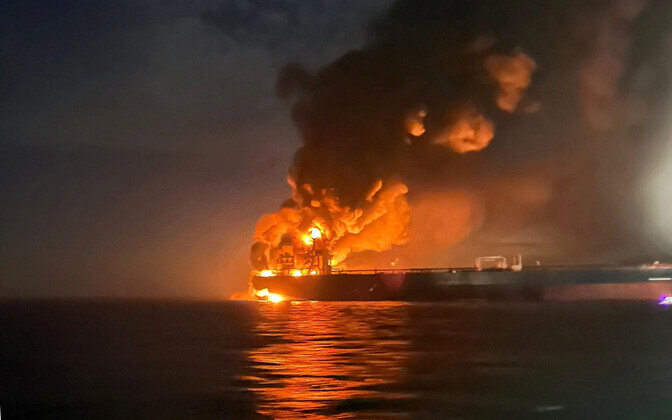 A tanker on fire off the coast of Turkey after being attacked by a Ukrainian drone. Source: SCANPIX/Turkish Directorate General for Maritime Affairs/Handout via REUTERS
According to legal experts, such attacks may not be lawful but the answer is not entirely black and white.
Professor Veli-Pekka Tynkkynen of the University of Helsinki told Finnish broadcaster Yle that such attacks are clearly not legal in the conventional sense. Attacking tankers violates the principle of free passage in international waters.
“But when considered in the context of war, Ukraine is trying to take measures that serve its objectives,” Tynkkynen said. He added that compared to the illegal acts Russia has committed at sea, Ukraine’s drone attacks are minor — and Ukraine has the right to defend itself.
Alexander Lott, a research professor at the Norwegian Center for the Law of the Sea and a lecturer at the University of Tartu, also said that the answer is not black and white.
“From the standpoint of international law, it must be remembered that attacks are only lawful when directed at military targets, not civilian ones. The key question is whether commercial ships sailing under the flag of a neutral state can be considered military targets,” Lott said.
He also pointed out that during the war, Russia has indiscriminately attacked civilian targets in Ukraine and elsewhere.
 Alexander Lott. Source: Priit Mürk/ERR
“Among other things, Russian naval forces attacked the cargo ship Helt, which was owned by an Estonian company, and it sank,” Lott recalled.
He said that while maritime law requires states to protect the marine environment, the situation is different in naval warfare, and it is possible to carry out military operations in international waters.
However, states disagree on whether such attacks may be directed at commercial ships of neutral countries. Some countries argue that objects supporting military action may also be targeted, but Europe generally does not consider this to be lawful.
Furthermore, any assessment must consider the extent of environmental damage. International agreements ban the use of warfare methods that cause extensive and long-term environmental harm. The Ukrainian targets in this case were vessels without cargo.
“This is quite a complex case, and unfortunately, there is no black-and-white answer,” Lott concluded.
Shadow fleet vessels also operate in the Baltic Sea. Both experts said that attacks on them cannot be ruled out in these waters either. Lott said Estonia must first and foremost be prepared to deal with the environmental damage.
This article was updated to add comments from Veli-Pekka Tynkkynen and Alexander Lott.
—
Follow ERR News on Facebook and Twitter and never miss an update!