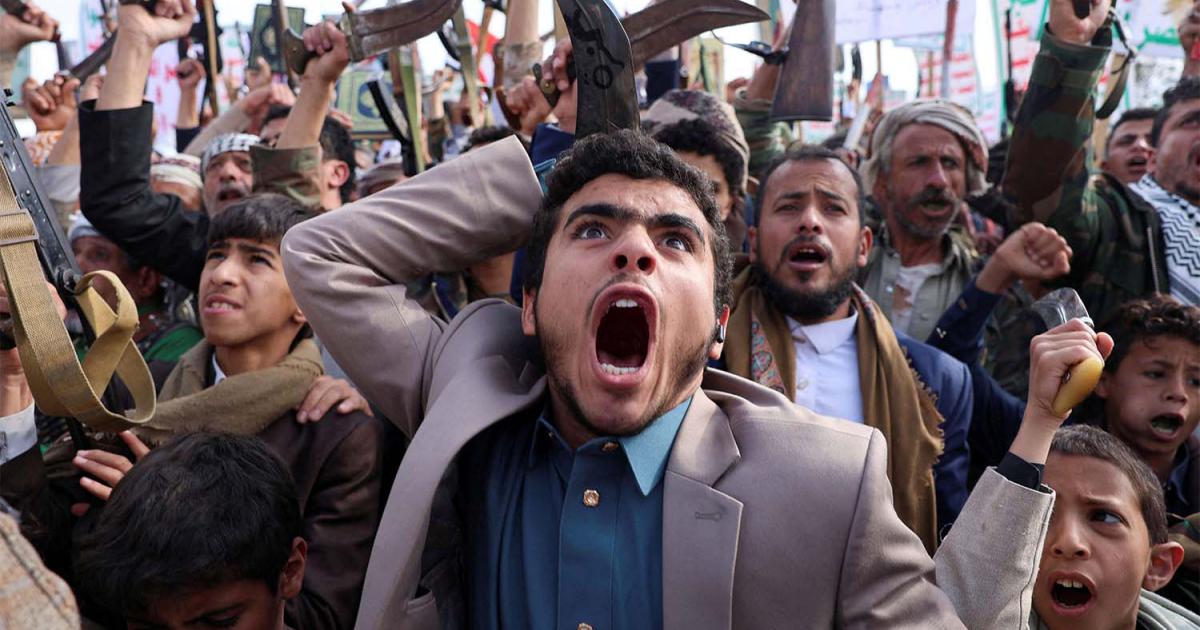
Iran is facing a rare moment of acknowledgment: the group it created and nurtured since the 1990s—the Yemeni Houthi movement—no longer moves according to Tehran’s calculations. Indicators coming from within Iranian decision-making circles reflect a growing realization that the Yemeni arm has slipped out of control, and that the bet on turning it into “a Yemeni Hezbollah in the flank of Saudi Arabia and regional states” has faltered at the first real test.
This shift raises a broader question about the future of the network of proxies Iran has built over the past two decades; the fracture that has struck the relationship between Tehran and the Houthis comes after similar signs in Lebanon and Iraq, suggesting that the “Axis of Resistance” is facing internal and external pressures beyond Iran’s ability to manage, especially amid the economic and political challenges shaking the Islamic Republic from within.
In Yemen, it has become clear that the group is no longer an attractive card for any regional or international actor that might adopt it as a tool of influence or bargaining; the accumulated crises within the areas under its control have made the Houthi project less appealing even to forces that once viewed it as capable of filling the vacuum of the state. Conviction is growing inside Yemen and beyond that the group is entering a phase of structural decline, and that the question is no longer whether it will collapse, but: who will fill the vacuum after it?
And the available indicators suggest that the most capable alternative to manage the next phase is represented by the National Resistance Forces, as they are the force that enjoys popular acceptance in northern Yemen and maintains close relations with the south. The political council led by the Presidential Leadership Council member, Lieutenant General Tariq Saleh, is increasingly seen as the realistic option to run the state after the Houthis, and a potential lever for rebuilding the political system away from the models of armed political Islam.
The British newspaper The Telegraph described what is happening as “the biggest strategic setback” for the Iranian regime in years, reporting that senior officials in Tehran have acknowledged losing control over the Houthi group in Yemen, the last pillar of its main network of regional proxies. Officials admitted that the group, which has launched repeated attacks on global shipping lanes, no longer takes its orders from Tehran as it once did, revealing a deep strategic fracture in the “Axis of Resistance” that the regime has built over decades, amid a gradual collapse of its pillars in Lebanon, Iraq, and Gaza.
A senior Iranian official told the newspaper that the Houthis “have gone down the path of rebellion,” and that “they no longer listen to Tehran the way they used to.” The official did not hide—according to the report—the presence of similar patterns in Iraq, where some armed groups behave “as if Tehran had never been connected to them at all.” These acknowledgments represent a dramatic shift, especially after Israel’s targeting of senior Hezbollah leaders and its encirclement of Hamas following the siege of Gaza, which has made the Houthis Tehran’s last and most important pillar— a lifeline it cannot afford to lose.
In the face of this growing fracture, the Iranian regime sent a senior commander in the Quds Force of the Islamic Revolutionary Guard Corps, Abdul Reza Shahlai, to Yemen in a desperate attempt to regain influence. His mission consists of pressuring the Houthis to restore a level of cooperation, as they are viewed in Tehran as “the only remaining active group” within the proxy network.
The Houthis have been suffering from an acute leadership crisis since late August, after the unrecognized government was hit by an Israeli strike that killed its prime minister and a large number of ministers, as well as local, security, and military officials. This strike not only revealed a “leadership crisis,” but also pushed figures close to Abdulmalik al-Houthi—the group’s leader—to suspect other officials and consider them potential sources of leaks. Close surveillance was imposed on them, some were prevented from moving, and guards were stationed at their homes to block entry and exit, under the pretext of fearing further targeting, while the leadership believes that certain figures outside the Houthi group are providing the United States and Israel with information about weapons stockpiles and the movements of leaders close to Abdulmalik al-Houthi.
This crisis could not be resolved by the Iranian regime’s delegations in Sanaa, and the Revolutionary Guard elements sent to the Yemeni capital failed to fill the strategic vacuum, reflecting internal confusion within Tehran itself.
The state of confusion and suspicion within the ranks of the Houthis is a natural extension of the confusion inside Iran, and Shahlai’s mission appears to have failed before it even began. The man, who is pursued by the United States with a reward of 15 million dollars, was supposed to push the Houthis to “cooperate more than before,” considering that they are the only group that still raises Tehran’s banner with relative clarity.
The collapse of Houthi loyalty is not merely an operational problem; it is a blow that strikes at the core of the Iranian regime’s identity, which has portrayed itself for decades as the guardian of the Palestinian cause and the architect of a unified regional resistance front. Yet it did not participate in the ceasefire talks on Gaza in Sharm el-Sheikh, recognizing that its influence has sharply diminished, while even the Houthis—who claim to defend the Palestinians—show far less confidence in Tehran.
The roots of the fracture go back to last April, when Iran refused to assist the Houthis during the intense American attacks on Yemen, fearing being dragged into a direct confrontation. This hesitation weakened Tehran’s credibility and accelerated the group’s independence. Today, the group controls Sanaa, prints its own currency, collects taxes, diverts international aid, trades in narcotics, sells weapons to extremist groups in Africa, and disrupts shipping in the Red Sea. Their geographical advantage—using Yemen’s mountains to hide missiles and drones—reduces their need for Iranian oversight. They do not need anyone to motivate them to carry out terrorist attacks; they have succeeded over the past three years in building alliances with al-Qaeda in the Arabian Peninsula, which for the first time acquired drones and “Iranian-made” explosives.
The loss of control over the Houthis comes after a long series of blows to Iran’s influence network. Hezbollah’s leadership was severely damaged after Israel assassinated key leaders, including Hassan Nasrallah, who had been a principal adviser to Abdulmalik al-Houthi. Tehran’s channels with Hamas were also cut off after the group was isolated in Gaza, while several militias in Iraq now act independently and ignore Tehran’s orders to suspend military activities to reduce tensions.
These developments reveal the shrinking regional presence of a regime that has long relied on proxy warfare. Tehran now depends on a few remaining groups that show nominal loyalty, but even these are falling apart.
The regime’s attempts to de-escalate tensions with the Gulf states, especially Saudi Arabia, conflict with the Houthis’ desire to display military strength, leaving Tehran trapped between the necessities of geopolitics and the ambitions of a proxy it no longer fully controls. The assassination of Nasrallah also removed a key adviser to the Houthis, and Iran’s and Hezbollah’s networks have failed to fill the vacuum, further weakening the cohesion of the network.
Today’s crisis within the proxy network represents more than a tactical challenge; it is a sign of a fundamental weakness in the structure of the Iranian regime, which relied on militias operating in coordination under its guidance to expand its regional influence without entering direct confrontation. But the increasing independence of the Houthis—and their ability to withstand militarily—reveals the collapse of a strategy long considered the cornerstone of Tehran’s regional project.
The Houthis are seeking to escape their internal crises by creating new tensions and supporting armed groups in the southeastern governorates, such as Al-Mahrah and Hadramout. This behavior serves as a warning bell that Iran is losing important regional understandings, including the agreement it signed with Saudi Arabia in China in March 2023.
And if the Houthis continue supporting extremist armed groups in southern Yemen, this will mean the return of violence—and possibly their defeat—and Iran’s exit from Yemen with no significant gains. For Yemenis today, the choice has become clear: to remove the Houthis permanently from the political and military scene. Tehran understands that the group’s rebellion means their imminent end or their forced return to obedience, and although it may try to preserve them through understandings or agreements, that does not necessarily mean their survival in the long term, especially amid the rising Yemeni desire to remove the group and restore the republican system.
Saleh Abuaudal is a Yemeni researcher
The views expressed are solely those of the author and may or may not reflect those of Middle East Online