In summary
A 19th Century law called the Posse Comitatus Act defines what the military can do on U.S. soil. President Trump broke that law by sending the National Guard to L.A., a federal judge rules.
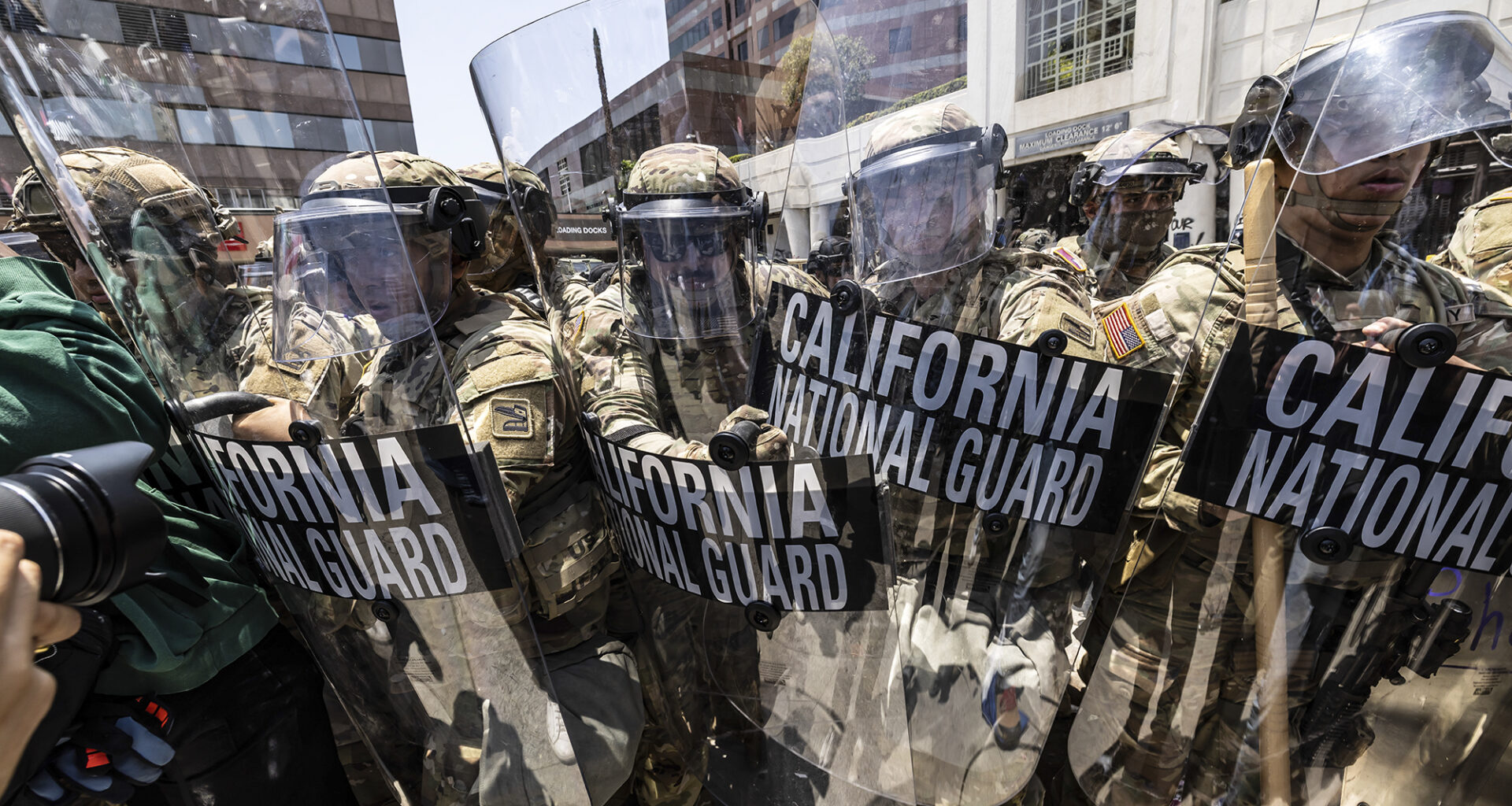
President Donald Trump’s deployment of the military to Los Angeles violated federal laws and his use of the armed forces must be heavily curtailed in California, a federal judge ruled today in a 52-page opinion that inveighed against the president’s belief that he has unchecked powers to send the military into U.S. cities.
“There were indeed protests in Los Angeles, and some individuals engaged in violence,” wrote Charles Breyer, the judge overseeing the trial. “Yet there was no rebellion, nor was civilian law enforcement unable to respond to the protests and enforce the law.”
The judge blocked the Trump administration from using the military to engage in “arrests, apprehensions, searches, seizures, security patrols, traffic control, crowd control, riot control, evidence collection, interrogation, or acting as informants, unless and until” the administration presents valid constitutional or legal exceptions, Breyer wrote. But his own order won’t go into effect until Sept. 12.
Breyer’s ruling caps one phase of the legal saga over Trump’s use of the military in Los Angeles, and it colors an increasingly tense legal environment nationally after Trump deployed the National Guard to Washington, D.C. — aided by several Republican governors — and threatened to send troops to Oakland as well as Chicago and New York.
The threats to send armed forces to other U.S. cities prompted Breyer to write that Trump is “creating a national police force with the president as its chief.”
Breyer’s decision follows closely the arguments California Attorney General Rob Bonta’s legal team made. They contended that the 700 U.S. Marines and 4,000 National Guard soldiers that the Trump administration deployed to Southern California after protests in Los Angeles broke out against federal immigration sweeps violated a 19th century law called the Posse Comitatus Act. It prohibits the military from engaging in law enforcement activity.
Hours after the Breyer’s ruling became public, Bonta wrote that it “affirms that President Trump is not king, and the power of the executive is not boundless.” He added that Trump’s use of the military defied a core principal, that the armed forces be “apolitical and the activities of troops on U.S. soil be extremely limited to ensure civil liberties and protect against military overreach.”
Gov. Gavin Newsom, the first plaintiff in the trial, wrote in a statement that “Trump is breaking the law by trying to create a national police force with himself as its chief.”
In response to Breyer’s ruling, Bill Essayli, a prosecutor for the Department of Justice wrote on social media that “the military will remain in Los Angeles. This is a false narrative and a misleading injunction.”
Bonta said at a press conference that he expects the Trump administration to appeal Breyer’s decision, noting that the judge paused his own injunction until next Friday to give the federal government time to appeal. A panel of judges in the 9th Circuit Court of Appeals in June blocked an earlier Breyer decision that favored California.
Fewer than 300 National Guard troops remain in Los Angeles, though the Department of Defense issued a new activation order to deploy troops in California for another 90 days on Aug. 5. Hours after Breyer’s ruling, Bonta filed new paperwork asking the judge to return the remaining National Guard troops to California’s command under Newsom.
California’s lawyers argued that by assisting federal immigration agents, the National Guard performed the law enforcement duties that federal statute — and Department of Defense guidance — prohibit. That guidance said armed forces cannot do the following: “Evidence collection; security functions; crowd and traffic control; and operating, manning, or staffing checkpoints.” California lawyers pointed to that language in their legal briefs.
Federal Department of Justice attorneys contended that those actions don’t count as law enforcement. They also said California was wrong to sue over the Posse Comitatus Act in a civil court because that act is a criminal statute, not civil.

Military as a ‘national police force’
California lawyers also said in their briefs that the use of the National Guard in Los Angeles meant that soldiers could accompany any number of federal agencies enforcing the nation’s laws, such as food inspectors, medical fraud investigators or federal voting rights officials to “monitor” election polling places.
Breyer seemed persuaded by that argument. He wrote in his ruling that if the government’s rationale is that the military can assist law enforcement whenever there’s danger to officers, there’s no logical end to the military’s involvement, since law enforcement is inherently dangerous.
In his ruling, Breyer said that federal lawyers were presenting a “perpetual, atextual right to defy Congress.” By their logic, the president’s power is limitless, allowing the executive in chief to “ to deploy troops to accompany any federal employee whose job puts them at some risk — as do the jobs of many federal employees, from OSHA inspectors to IRS agents to U.S. marshals.”
How often National Guard joined immigration agents
California lawyers showed during the trial that National Guard soldiers took part in over 60 operations with federal immigration law enforcement forces. The National Guard accompanied immigration law enforcement agents on roughly 75% of the agents’ missions between June and early July, an Immigration and Customs Enforcement field director for Los Angeles testified. Guard members set up armed perimeters that blocked traffic and people, the lawyers said, and apprehended at least one protester.
The troops also took part in a mission at MacArthur Park, a Los Angeles public park, that a government memo presented during the trial described as “demonstrating federal reach and presence” — not to protect other federal officers from serious danger.
National Guard soldiers arrived with Humvees and tactical vehicles. Other evidence from federal documents that California attorneys displayed showed that “current intelligence does not indicate a high value target or threat to federal functions at this location” and that there was “no indication that failure to act would result in a loss of life or significant property damage.”
Breyer agreed. “The record is replete with evidence that Task Force 51” — the U.S. military division in Los Angeles — “executed domestic law in these prohibited ways,” the judge wrote.
The Trump administration “instigated a months-long deployment of the National Guard and Marines to Los Angeles for the purpose of establishing a military presence there and enforcing federal law,” Breyer wrote.
“Such conduct is a serious violation of the Posse Comitatus Act,” he added.
The judge also observed that at times the uniforms of the military were indistinguishable from those worn by other federal immigration law enforcement personnel during operations in Southern California.
Breyer wrote that these violations were willful. “Defendants knowingly contradicted their own training materials, which listed twelve functions that the Posse Comitatus Act bars the military from performing.”
Is the National Guard subject to Posse Comitatus?
Another major question in the trial was whether the National Guard is covered by the Posse Comitatus Act even when the president uses an obscure law federalizing the troops.
It is, Breyer wrote. “The court will not take defendants’ invitation to create a brand-new exception to the Posse Comitatus Act that nullifies the act itself.”
The federal government has argued that the National Guard isn’t bound by Posse Comitatus and can in fact execute the nation’s laws due to the other law, which permits the president to call up the National Guard in emergencies. That was a claim Breyer responded to skeptically during the trial.
“Why did I spend a day looking at slide after slide and regulation after regulation and reports after reports on conduct of the soldiers to ensure that they were in compliance with the Posse Comitatus Act. If that Posse Comitatus Act is irrelevant, why did that happen?” Breyer asked the federal government attorney during the trial.
Meghan Strong, an attorney representing California, pointed to a June 16 Department of Defense memo that she described as showing that using the National Guard to enforce laws “would be inconsistent with the Posse Comitatus Act.” That view was reaffirmed during the trial by William Harrington, the deputy chief of staff of Task Force 51, which is the military unit deployed to Los Angeles.
“You said that if any National Guard troops were federalized as part of the deployment, they would lose the ability to conduct law enforcement activities, because of the Posse Comitatus Act,” Strong said to Harrington at the trial.
“Correct,” Harrington replied.
Lawyers for California said during the trial that the National Guard can still play a role in emergencies as long as it’s not law-enforcement in nature. Those include guarding federal buildings or even delivering the mail, as the National Guard did during the Nixon administration in 1970 while postal workers were on strike.
If Trump wants to send the National Guard to, say, San Francisco, he can, Bonta said at a press conference, but the troops couldn’t do anything Breyer proscribed. They could sit “at the federal building and protect it from no threats,” Bonta said.
“But it would be a complete misuse of the military, using them as political pawns to add no value and actually take them away from highly valuable roles, again, like tackling wildfires,” he added.