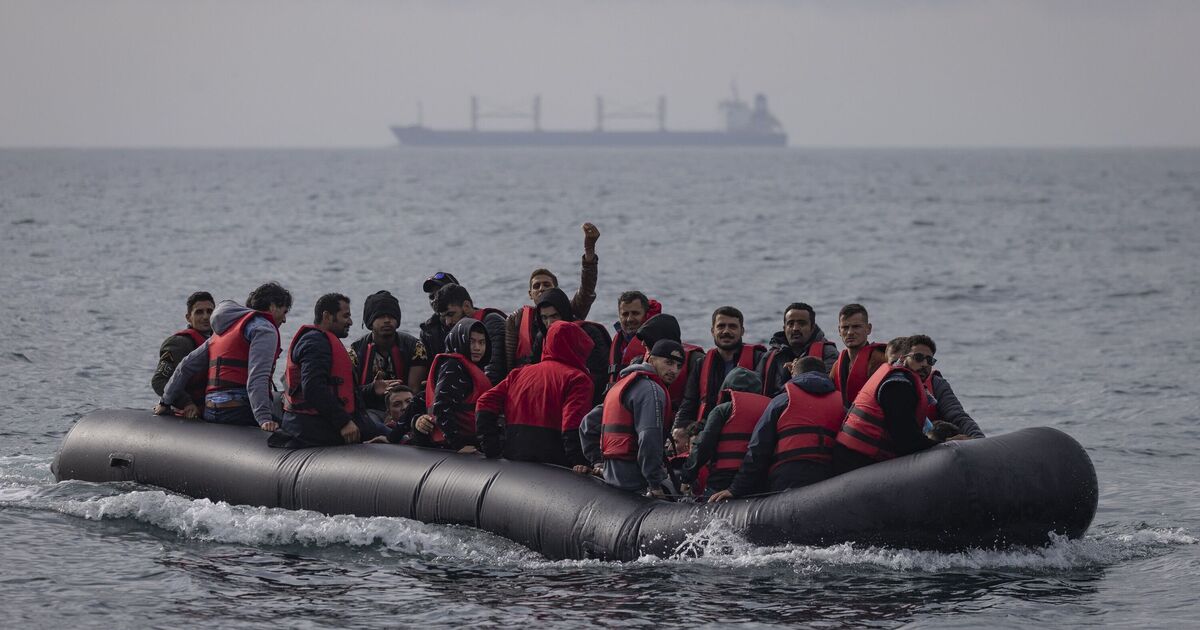
Migrants claiming asylum after piloting dinghies across the Channel are not being protected from prosecution, border chiefs have insisted. Some 54 migrants who guided a dinghy to UK waters last Summer went on to seek sanctuary.
This is because Labour began processing asylum claims again and repealed a law blocking illegal migrants from obtaining refuge, critics said. A Home Office spokesperson said: “Claiming asylum will not prevent us from prosecuting those who pilot these dangerous small boat crossings. We will do whatever it takes to secure our borders. And thanks to our deal with France, people crossing in small boats can be detained and removed to France.”
Shadow Home Secretary Chris Philp told the Express: “Every decision here carries a political fingerprint.
“The reflex to process instead of deter, the reluctance to test claims, the fear of offending the activist groups that dictate the Government’s posture on borders.
“Starmer’s leadership, or lack thereof, encourages an aversion to conflict. A Government that has chosen the path of least resistance.
“A leader who will not confront the problem because confrontation requires conviction. Starmer has none.”
Home Office records, obtained through a Freedom of Information request, also revealed 17 of these claimed to be victims of modern slavery.
The Modern Slavery Act has become a key obstacle to attempts to deport failed asylum seekers and foreign criminals.
Home Office figures show 101 people were arrested and identified as a small boat pilot in 2024. But research by the University of Oxford said only 27 were charged, with just 5 being convicted.
The number of arrests is up marginally from 94 in 2023.
The highest number of arrests under the Immigration Act 1971 came in 2022 – when a record number of migrants crossed the Channel in small boats.
Just 38 small boat pilots were convicted in the first six months of this year.
Of the convicted pilots, 11 were from Sudan; four were from Iran and three were Palestinian. And of the 38 passengers, the greatest number were from Albania (seven), followed by Iraq (five) and Afghanistan and Vietnam (both four). The figures do not take account of the work of the National Crime Agency.
Under changes introduced by the Illegal Migration Act 2023, small boats arrivals were barred from claiming asylum.
But Labour has legislated to scrap the IMA after winning power in July 2024.
Labour’s replacement – the Border, Security, Asylum and Immigration Bill – is expected to gain Royal Assent on Tuesday.
Part of this, the Home Office says, will give “Immigration Enforcement officers unprecedented powers to gather intelligence from mobile phones to go after and arrest people smugglers”.
Officers will also be given powers to make illegal migrants remove an outer coat, jacket or gloves at UK ports to search for hidden devices.
Investigators will be allowed to download mobile phone data from migrants’ phones. This, the Home Office claims, will help the National Crime Agency build cases against people smugglers.
Minister for Border Security and Asylum, Alex Norris, said: “Organised criminal networks rely on phone contacts and social media to recruit migrants for Channel crossings.
“These new powers will allow law enforcement to seize illegal migrants’ phones before an arrest so we can gather intelligence and shut down these vile smuggling gangs before they attempt to risk more lives in these dangerous journeys.
“We are restoring order and control at our borders.”
Almost 40,000 migrants have crossed the Channel this year, the second highest annual total since the crisis began.
Smugglers often give migrants free passage if they agree to pilot a dinghy across the Channel.
And fears are intensifying over organised crime gangs bolstering their networks across Northern France
Researchers from the Global Initiative Against Transnational Organised Crime revealed how smuggling gangs are recruiting ‘brokers’ in migrant camps to help fill their boats.
They said: “One of the recent trends has been the rise of ‘small hands’ – migrants who recruit others for the smuggling gangs, helping them fill the boats in exchange for free passage at a later date.
“Hired for their language skills, they recruit migrants of their own nationality or ethnicity.
“The ‘small hands’ also know the crossing points from the French beaches, and work in groups to prepare and launch the boats.
“These middlemen in the supply chain have started to charge for their service – a fee of between €1,000 and €1,500 for each boat that leaves the French shore.
“With up to four hands working on a boat, this is an additional cost for the smuggler of up to €6 000 (on condition that if the boat is intercepted no payment is made).
“The hands sometimes recruit a third person to act as ‘security’, for which they are paid €200 to €500, or a free passage on a boat crossing after they have worked some shifts.”