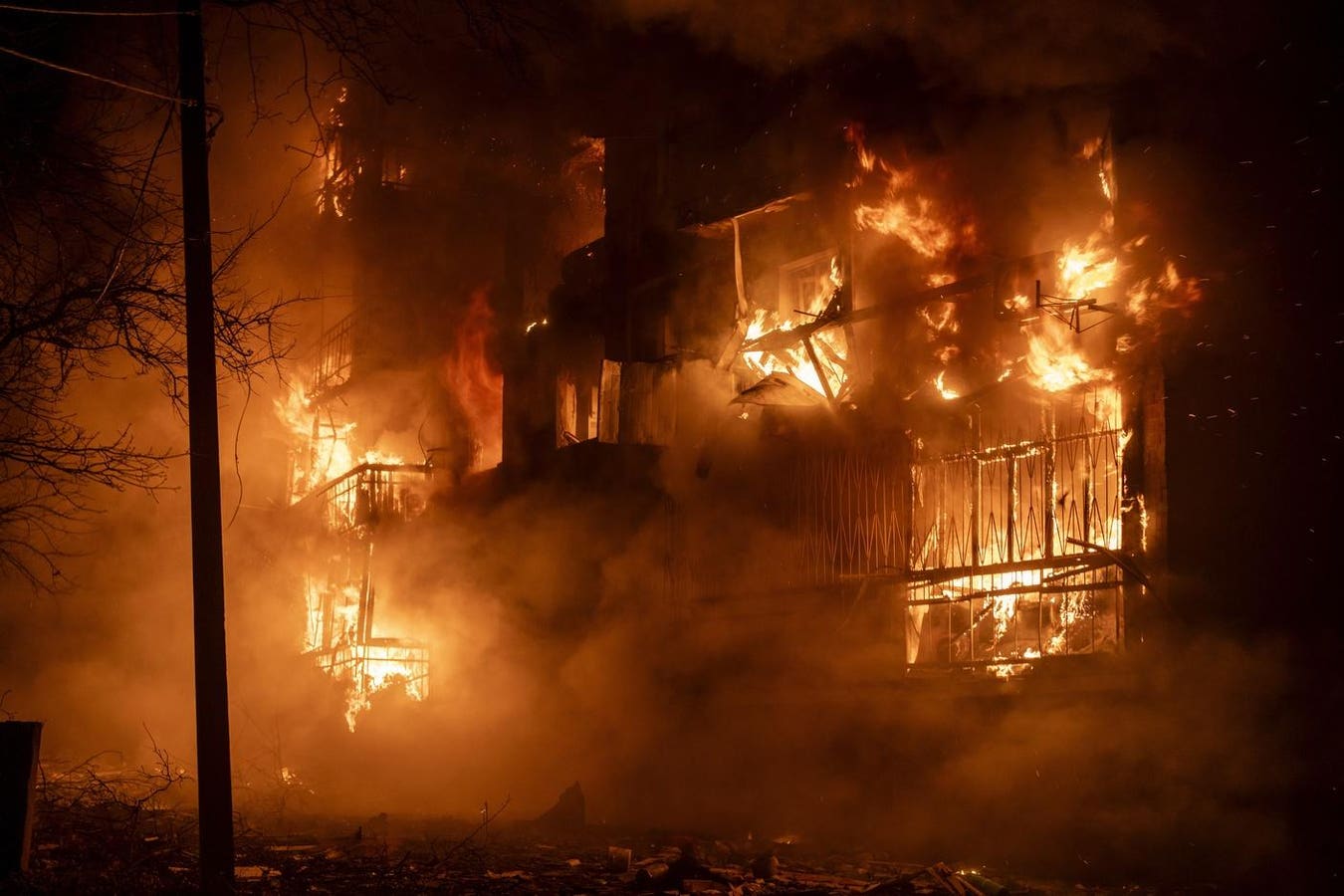
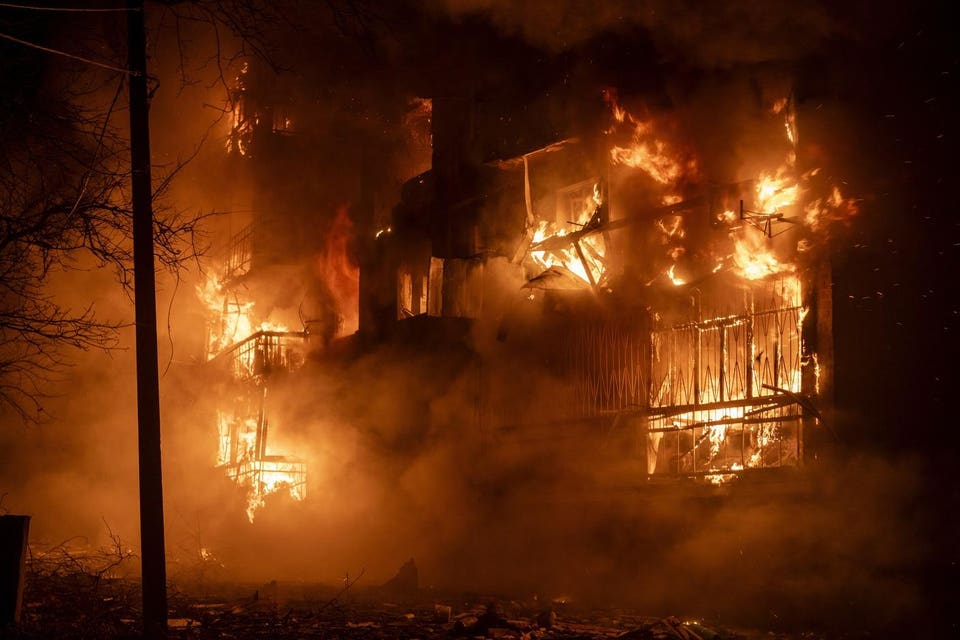
KRAMATORSK, UKRAINE – DECEMBER 01: Firefighters work to extinguish the blaze after a Russian strike hit the building, injuring one woman in Kramatorsk, Donetsk region, Ukraine on December 01, 2025. (Photo by Jose Colon/Anadolu via Getty Images)
Anadolu via Getty Images
Dispatches from Ukraine. Day 1,377.
Russian Attacks on Ukraine
In Kramatorsk, Donetsk region, two women and two men were injured as a result of Russian shelling of a residential area on December 1st.
On Nov. 29, Russia unleashed its largest aerial attack on Ukraine in a month, firing 36 missiles and circa 600 drones. Ukraine’s Air Force intercepted 577 airborne projectiles, including 19 missiles. This latest, sweeping attack struck residential areas and critical energy infrastructure across the country, with the worst of the barrage concentrated on Ukraine’s capital, Kyiv. At least three people were killed in Kyiv and its surrounding, eponymous province.
In addition, between Nov. 27 and Dec. 1, at least 15 people were killed and some 110 others injured in Russian strikes, Ukrainian officials reported. The central province of Dnipropetrovsk was hardest hit, with seven residents killed. In southern Kherson province, four people lost their lives, while eastern Donetsk and northeastern Kharkiv provinces each recorded two civilian deaths.
Ukrainian Counterstrikes
In an attempt to curtail Russia’s ability to finance its war, Ukraine carried out a record number of retaliatory drone strikes on Russia’s oil infrastructure in November. Kyiv hit refineries at least 14 times over the month, as well as targeting Black Sea oil terminals, and multiple tankers. Ukraine’s attacks, albeit smaller, have made a dent in Russia’s refining capabilities, which are running at roughly 5 million barrels per day, down from the 5.3-5.5 million normally processed in late autumn.
Peace Talks in Florida
Senior U.S. and Ukrainian diplomats held what the Ukrainian delegation described as “difficult” talks in Florida on Nov. 30, capping another week of Washington’s efforts to end Russia’s invasion. The meeting brought together U.S. Secretary of State Marco Rubio, Donald Trump’s special envoy Steve Witkoff, and Trump’s son-in-law Jared Kushner, following earlier bilateral talks in Geneva.
Rubio characterized the discussions as an incremental step forward. “Much work remains. But today was again a very productive and useful session, where I think additional progress was made,” he said after the talks. In addition, Rubio said the discussions touched on conditions that would support “long-term prosperity” for Ukraine. Rustem Umerov, who led the Ukrainian delegation, meanwhile, called the session “difficult but productive.” He also noted “significant progress” had been made toward a “just peace.”
The recent diplomatic push took place at a turbulent moment for high-level politics in Kyiv. President Volodymyr Zelenskyy dismissed his long-time chief of staff, Andriy Yermak, on Nov. 27 after he became embroiled in a widening corruption probe. The smoldering scandal has affected several senior members of Zelenskyy’s administration, including two ministers from the current government.
During his time in office, Yermak amassed enormous political influence, including over President Zelenskyy, his close friend. Just a few months ago, his resignation would have been hard to imagine, as he had remained in the post through almost four years of war. However, many opposed the concentration of so much power in the hands of an unelected official and see his resignation as its own triumph. Yermak himself said that he will join Ukraine’s military and that he is not afraid of “reprisals.”
Security council secretary Umerov, who has been linked to the investigation but is not considered a suspect as of now, has replaced Yermak as Ukraine’s lead negotiator. He was joined by first deputy foreign minister Sergiy Kyslytsya, who served as Ukraine’s representative to the United Nations from 2020 to 2024.
Trump, who has been attempting to reinvigorate negotiations, said on Sunday that “Ukraine’s got some difficult little problems … the corruption situation going on, which is not helpful.” He has signaled that Witkoff will likely travel to Moscow this week to meet Russian President Vladimir Putin.
Talks in Geneva last week scaled back a deleterious 28-point peace plan drafted by the U.S. in close cooperation with Moscow. Ukrainian as well as European officials had sharply criticized the proposal as overly accommodating to Russia. After hours of negotiations in Switzerland, the delegations reportedly reduced the list to roughly 19 points and set aside the most contentious issues — questions of territory, security guarantees, and Ukraine’s NATO aspirations — for direct decision-making between Trump and Zelenskyy.
The key uncertainty now is whether Russia will accept any revised proposal. Moscow has maintained its maximalist demands and insists it holds the advantage on the battlefield. Kremlin spokesperson Dmitry Peskov accused Kyiv and European governments of undermining the original proposal, while foreign minister Sergei Lavrov warned that if the revised terms “erased … key understandings” reached earlier between presidents Putin and Trump, the situation would be “fundamentally different.”
By Danylo Nosov, Karina L. Tahiliani