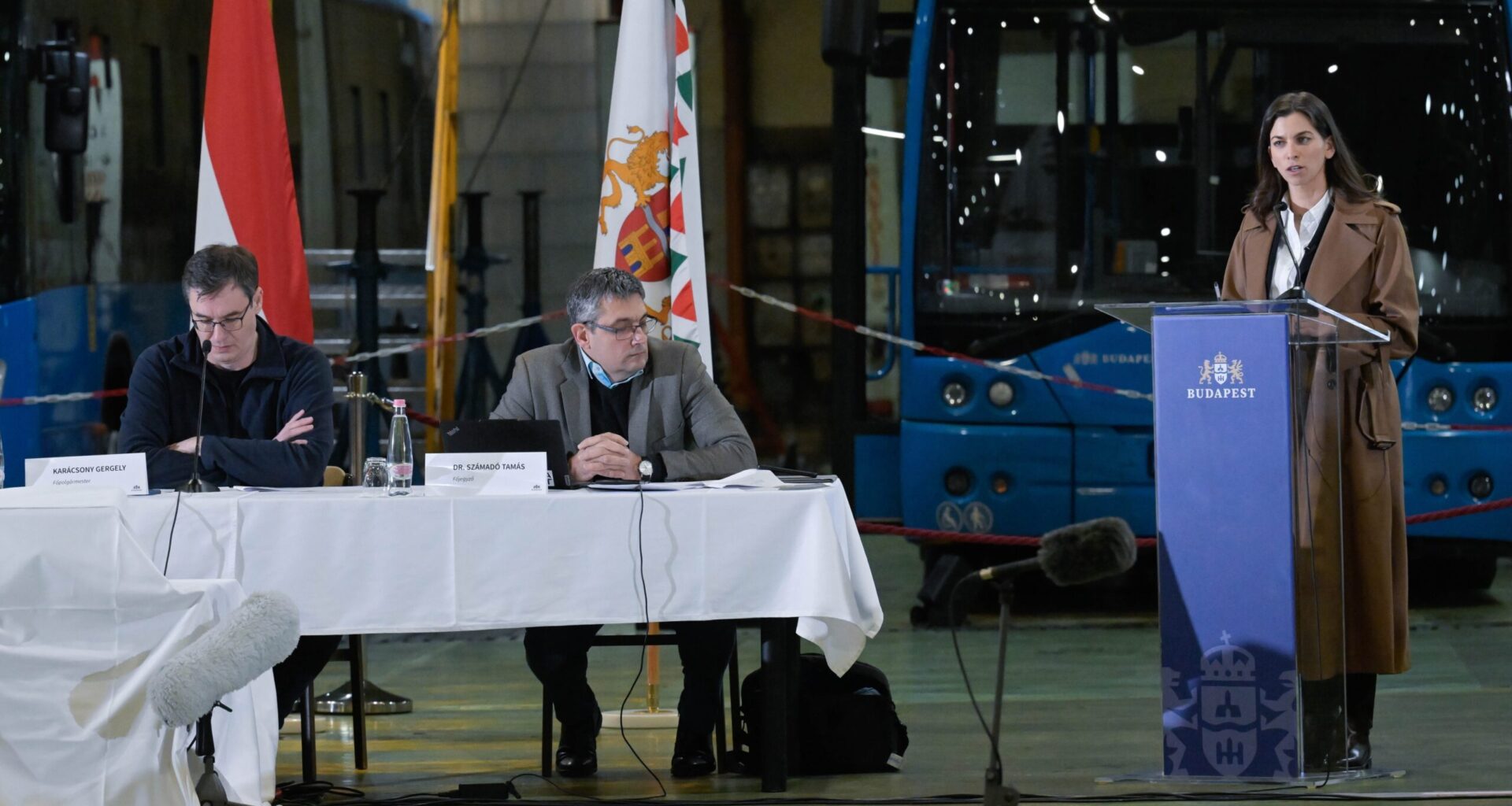
The Budapest General Assembly has formally urged the government to reopen negotiations with the mayor to ensure that the principle of sustainable fiscal management, set out in Hungary’s constitution, can be upheld in the city’s budget. The resolution was adopted at an extraordinary session on Monday, held at the Kelenföld bus depot of the Budapest Transport Corporation.
12 assembly members voted in favour of the final proposal, while the ten representatives of Fidesz abstained. MPs from the Tisza Party boycotted the meeting, arguing they did not wish to participate in what they called a political spectacle.
The session was prompted by a recent statement from Gergely Gulyás, Minister heading the Prime Minister’s Office, who said the government was ready to help the capital maintain basic operations, but expected the General Assembly to declare insolvency first. Fidesz submitted an amendment calling for such a declaration, but the majority rejected it. Assembly members instead approved an amendment from the Podmaniczky Movement affirming that the city rejects any possible nationalization of its municipal companies.
Mayor Gergely Karácsony reminded the chamber that court rulings had deemed the current method of collecting the solidarity contribution unlawful, and that state-mandated withdrawals from the city’s budget contradict the constitution. The State Audit Office, he added, similarly warned that Budapest cannot meet its mandatory service obligations if it complies with the state’s financial demands.
Karácsony warned that without resumed talks, the city could soon face a situation where it is unable to pay the wages of the 27,000 employees working in essential public services. He rejected the government’s demand for a declaration of insolvency, calling it unacceptable and insisting that Budapest is not insolvent. ‘Our task now is to take the government at its word,’ he said, referring to its claim that it will not allow Budapest to become unworkable.
Fidesz faction leader of the General Assembly of Budapest Alexandra Szentkirályi accused the mayor of turning the city’s finances into a political stage and shifting blame for six years of mismanagement. She noted that former mayor István Tarlós left the city with 214 billion forints in savings in 2019, while the city now holds 170 billion forints in debt, despite doubled revenue from the local business tax.
She listed a series of expenditures, 51 billion spent on the Rákosrendező project, more than 1 billion in public procurement fines, 900 million on bonuses and benefits, and tens of millions on Budapest Brand, arguing that mismanagement is to blame for the crisis. Meanwhile, she said, the government has invested more than 770 billion in the capital on rail upgrades, new trams and health infrastructure. Szentkirályi also criticized the Tisza Party for skipping the vote while previously supporting the city’s acquisition of Rákosrendező and the ‘unlawful bankruptcy budget’.
Tibor Déri of the Democratic Coalition likewise condemned the Tisza Party’s absence as irresponsible toward the city’s residents and workers.
Municipal chief executive Ambrus Kiss countered Fidesz’s claims, noting that the current city leadership has not taken on any new debt because the government has not permitted it. He warned that without changes to financing rules, Budapest will begin 2026 with a deficit of 33 billion, insufficient to repay its 40 billion overdraft. This, he said, would violate the economic stability law and leave the city unable to fund public services until business tax revenues arrive in March.
Leader of the Podmaniczky Movement Dávid Vitézy called the extraordinary session unnecessary theatre. He recalled that his group had already proposed during the summer that the city stop paying utility bills to MOL and MVM, an action he argued would create real pressure, as the government would then have to decide whether to halt Budapest’s public transport.
Related articles: