Consumption data shows that approximately 60% of Latvia’s population uses dietary supplements during the course of a year. The range of these products is also impressive – an average of 1,000 new dietary supplements are registered in Latvia every year. Latvian Radio paid attention to a slimming product that might contain a banned substance.
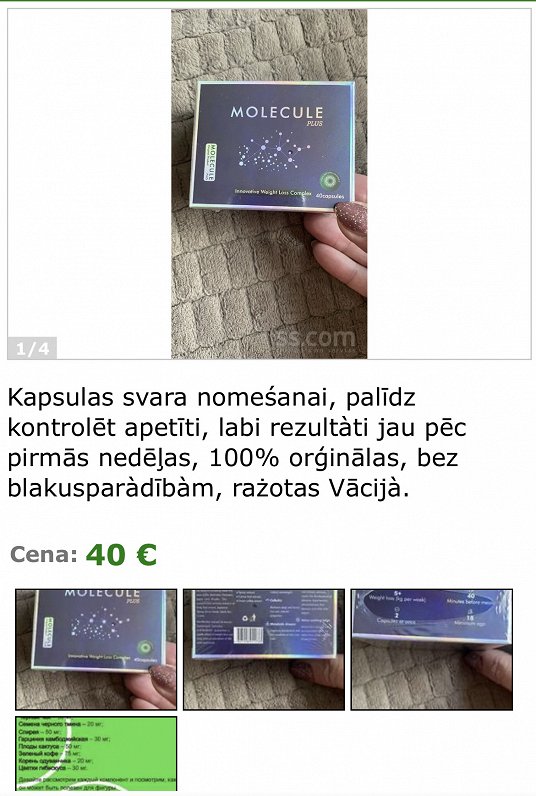
Molecule Plus are slimming capsules that promise to help you lose up to five kilograms a week. They were recently reported on by the British broadcaster BBC, which revealed that the product is becoming popular among young people in Russia, but that it contains sibutramine, a dangerous substance that is banned in many parts of the world.
It has been previously used in prescription drugs to treat obesity, but in 2010, the European Medicines Agency (EMA) concluded that it significantly increases the risk of heart attack and stroke. Since the ban, this substance has occasionally appeared in illegal weight loss products advertised on the internet as “natural” or “dietary supplements.”
Latvian Radio has confirmed that this weight loss product is also being sold on the popular classifieds portal in Latvia, ss.com.
Saleswoman: I have them regularly, yes.
Journalist: Does someone bring them to you?
Seller: Well, I buy them, yes.
The advertisement also includes photos showing that the product is supposedly manufactured in Germany, but the description of the ingredients is in Russian, while the basic information is in English. The seller contacted by Latvian Radio said that the capsules come from China. “Everyone has their own sources, so to speak, for obtaining them,” she said.
In addition, the woman also sells “LiDa” capsules, which are not legally available in Latvia and many other countries because laboratories have repeatedly found the banned substance sibutramine in them. Latvian health authorities have also warned about the dangers of this particular product.
In order to distribute weight loss products in Latvia, they must be registered with the Food and Veterinary Service (PVD). In this case, they could appear in either of two different registers – dietary supplements and food products belonging to certain groups, as it is not entirely clear which of them such a product should be included in.
Molecule Plus and LiDa are not registered in either register, which means that they cannot be distributed in Latvia.
After the PVD was informed about the advertisement, the service contacted the portal, and the advertisement has already been removed. “That is why we urge people to carefully evaluate what they buy online. If it has not been recommended by a specialist, then you should not buy anything just because you want to lose weight,” said Vineta Grīnberga, head of the Food Distribution Supervision Division of the PVD.
However, even if a dietary supplement is registered with the PVD, this does not mean that every product has been laboratory tested – tests are only carried out on a random basis. Grīnberga explained: “Accordingly, what the service checks – it takes minerals, microelements, most often in the case of dietary supplements, and compares them with the information on the label, plus either pesticide residues, if they are of plant origin, or heavy metals, which are specified in the regulations.”
For example, there are currently 12,411 dietary supplements registered in Latvia. Last year, 270 samples were tested at random – approximately 2% of the total range. Of these, 15 were found to be non-compliant. Sibutramine is not included in these tests because it is expensive. However, in response to complaints, the PVD also tests for the presence of this substance – last year, five samples were tested (two of which were slimming products), and no non-compliance was found. There is a unified warning system in Europe, and this year, sibutramine has been detected in nine cases, mainly in products manufactured in Turkiye.
Researchers from the scientific institute BIOR, in collaboration with colleagues from Lithuania and Estonia, conducted a survey this summer on the use of dietary supplements. The results are alarming – they are widely used in all Baltic countries, most people have not consulted a specialist beforehand, and more than 40% of survey participants consume three to five different ones at the same time.
BIOR nutritionist Inese Siksna explained: “And there is an additional risk that the active ingredients in dietary supplements may have adverse effects when combined.”
Combining dietary supplements with medication can also be dangerous. Other European countries, such as France, already have a system in place to monitor side effects.
“We see reports there that in some cases are very serious, such as liver and kidney damage, where a link to the use of dietary supplements has been proven,” said Siksna.
Select text and press Ctrl+Enter to send a suggested correction to the editor
Select text and press Report a mistake to send a suggested correction to the editor
Tell us about a mistake