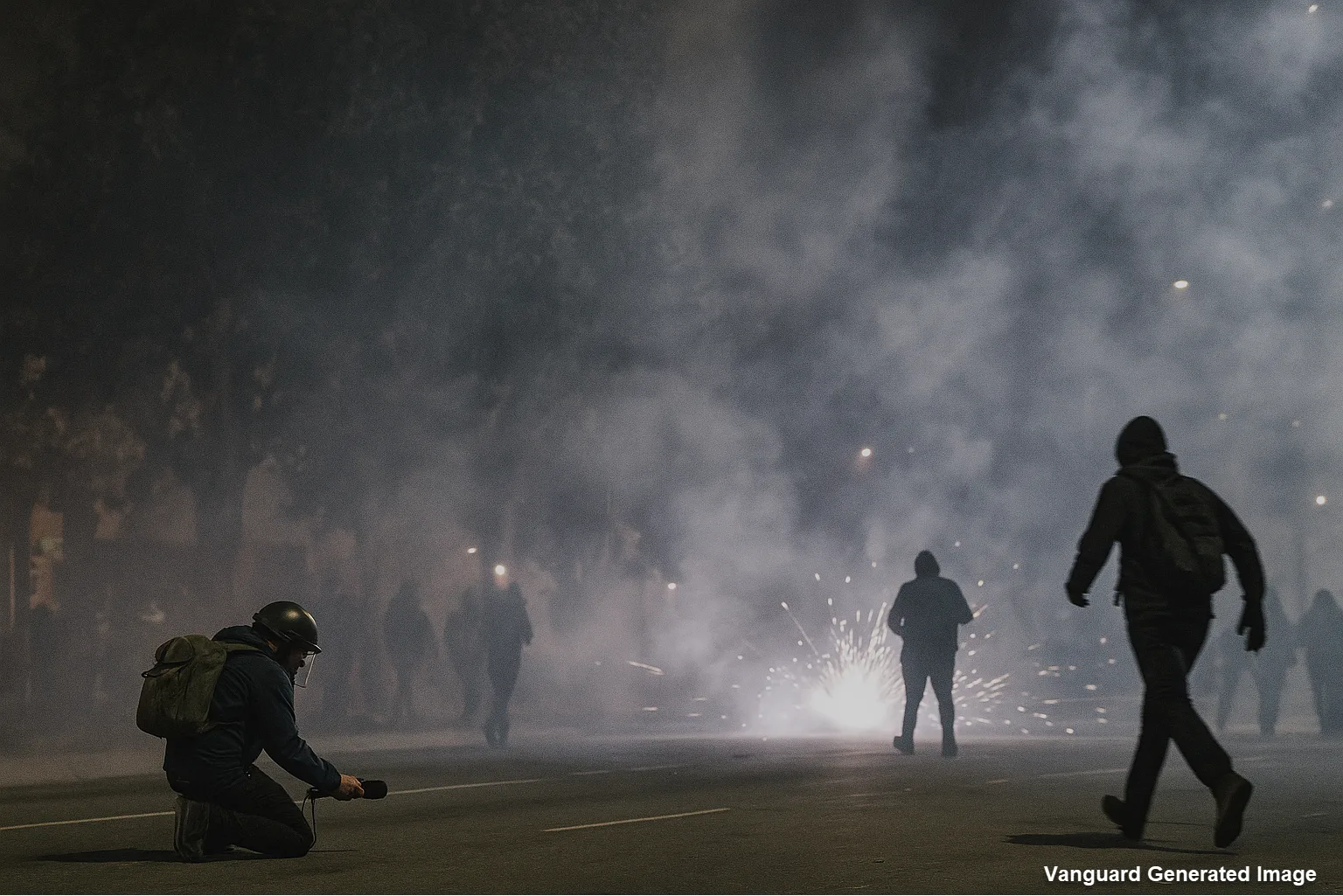
“The court record shows that federal law enforcement in Los Angeles targeted the heads and faces of journalists and protestors with rubber bullets. They fired even at the backs of journalists and protestors.” – Michele Heisler, MD, MPA
Physicians for Human Rights (PHR) argues in a new amicus brief that U.S. federal law enforcement repeatedly misused rubber bullets, pepper balls, tear gas canisters and flash-bang grenades against journalists, medics and peaceful demonstrators during protests in Los Angeles in the summer of 2025.
The brief was filed in L.A. Press Club v. Kristi Noem before the U.S. Court of Appeals for the Ninth Circuit.
PHR writes that its medical and legal experts reviewed court declarations and reporting documenting excessive force by federal immigration agents deployed during protests that followed aggressive immigration enforcement actions ordered by the Trump administration.
The organization states that evidence in the case record indicates federal agents used a range of crowd-control weapons in ways that violated international standards, including U.N. guidelines on the use of less-lethal force.
The brief draws on nearly four decades of PHR research regarding the health effects of kinetic impact projectiles and chemical irritants.
“Crowd control weapons like rubber bullets, pepper balls, and tear gas may be labeled ‘less lethal,’ but medical research shows they can cause serious injury or even death. The risk of grave harms is even greater when law enforcement misuses these weapons as the court record indicates was the case in Los Angeles this summer,” said Michele Heisler, MD, MPA, medical director at PHR and professor of internal medicine and public health at the University of Michigan.
The filing states that federal agents repeatedly fired rubber bullets at individuals’ heads, necks and upper bodies, despite long-established medical and international guidance warning that such use risks skull fractures, eye injuries, traumatic brain injury and permanent disability.
The brief states that these rounds were also fired at the backs of journalists and retreating demonstrators.
“The court record shows that federal law enforcement in Los Angeles targeted the heads and faces of journalists and protestors with rubber bullets. They fired even at the backs of journalists and protestors,” Heisler said.
Heisler added, “Federal agents also deployed vast quantities of tear gas and shot pepper balls and tear gas cannisters into groups of protestors when there was no evidence agents were being threatened. Officials fired dangerous disorientation devices like flashbangs into large crowds. The examples that the court highlighted show how federal law enforcement repeatedly misused crowd control weapons in a manner that risked serious injury to non-violent protestors, journalists, and bystanders.”
The brief recounts multiple incidents in which individuals were injured. Those include a concussion suffered by journalist Ryanne Mena after being struck in the head with a rubber bullet while covering protests, injuries to photographer Ted Soqui after being struck by projectiles, and a tear-gas deployment that triggered an asthma attack in demonstrator Diya Cruz.
Court filings also describe journalists and observers being struck at close range, including individuals who were hit while walking away or sheltering behind vehicles.
PHR states that chemical irritants such as pepper spray and tear gas were used in ways that endangered not only targeted individuals but also bystanders, medics and members of the press.
The brief notes that tear gas exposure can trigger breathing difficulties, temporary blindness and long-term respiratory complications, and that pepper balls deployed at close range function similarly to kinetic impact projectiles, increasing the likelihood of blunt-force injuries.
The organization also states that flash-bang grenades, which are designed for controlled tactical use, were reportedly thrown into large crowds in chaotic and indiscriminate ways. According to PHR, such devices are capable of causing burns, concussive injuries, hearing damage and psychological trauma when used improperly.
The lawsuit underlying the brief was filed by journalists, legal observers and press organizations who allege that federal agents violated the constitutional rights of demonstrators and the press during the Los Angeles protests.
The plaintiffs argue that force was used in response to protests over expanded immigration raids and arrest quotas imposed by Immigration and Customs Enforcement. The district court granted a preliminary injunction on Sept. 10, finding that force used by federal agents had interfered with peaceful protest and newsgathering.
PHR is urging the Ninth Circuit to uphold that order. The organization argues that the documented incidents demonstrate ongoing risk to constitutional rights and public safety if the injunction is lifted.
PHR writes that its position is grounded in years of forensic and public health research showing that improper use of less-lethal weapons can cause life-altering injuries, permanent disability and death. It maintains that restrictions imposed by the district court are necessary to prevent further misuse of weapons by federal officers during demonstrations.
PHR states that upholding the injunction would help protect protesters, working journalists and medical volunteers from future injury, and would reinforce legal limits on the use of force against people engaging in First Amendment activity.
Follow the Vanguard on Social Media – X, Instagram and Facebook. Subscribe the Vanguard News letters. To make a tax-deductible donation, please visit davisvanguard.org/donate or give directly through ActBlue. Your support will ensure that the vital work of the Vanguard continues.
Categories: Breaking News Immigration State of California Tags: Donald Trump Excessive Force Federal Law Enforcement First Amendment immigration enforcement Kristi Noem L.A. Press Club Los Angeles Physicians for Human Rights Police Accountability protest rights