Report on kids’ social media use, students protest closure of prayer room, rare earth mining on Greenland and more news from Denmark this Wednesday.
High social media usage among kids
Almost all children and young people in Denmark are now using social media, a new study from the consumer agency Konkurrence- og Forbrugerstyrelsen has found.
Children aged eight to 12 have profiles on an average of two social media platforms. For teenagers aged 13 to 17 that rises to profiles on six platforms, while young people aged 18 to 25 have profiles on an average of eight.
Over 98 percent of Danish children and young people in those age brackets are on social media.
The survey found that TikTok is the most heavily used social media platform for young people.
The survey points to a “relatively high level of use” concentrated on a small number of social media platforms, says Andreas Maaløe, a consumer behaviour expert at the Danish Competition and Consumer Authority.
“Habits are the hardest thing to change. And what we’re seeing here is usage that is heavily driven by habit. Social media are always in our pockets and always accessible,” Andreas Maaløe, a consumer behaviour expert at Konkurrence- og Forbrugerstyrelsen, told news wire Ritzau.
Students protest closure of prayer rooms at University of Copenhagen
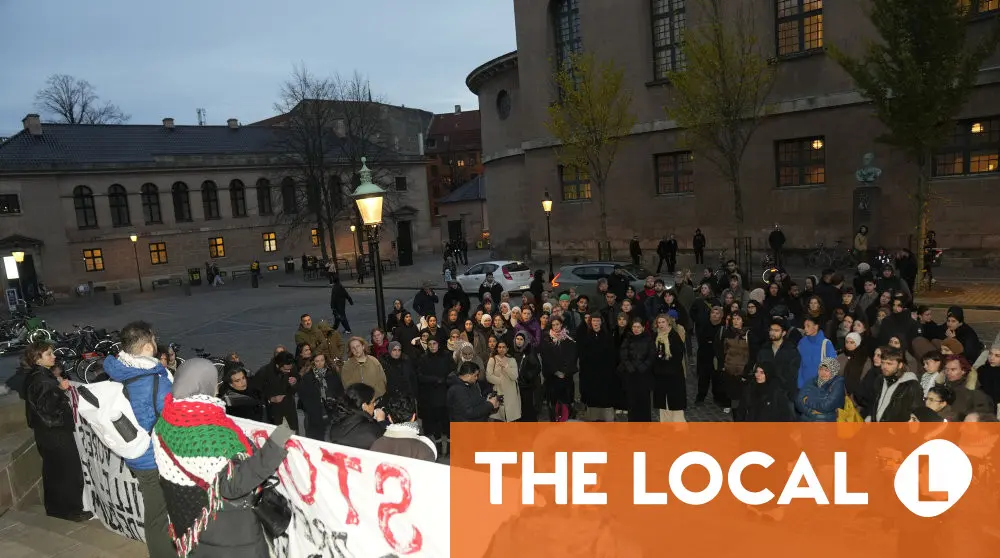
Around 100 students yesterday took part in a protest at the University of Copenhagen against a decision to close a prayer room, also known as a “quiet room”, at the university.
The protest was led by Jesper Gür, a medicine student who represents the Student Council (Studenterrrådet) in Copenhagen on the university’s board.
“We are demonstrating against the University of Copenhagen’s decision to close a quiet room, which is a facility that supports student wellbeing, and that it has done so without any prior dialogue or an inclusive process,” he told news wire Ritzau.
Prime Minister Mette Frederiksen has urged educational institutions to close the prayer rooms, arguing they could contribute to gender segregation and negative social control among students.
Gür said that this would be a problem if it occurred, but described it as “a hypothetical problem that has not been documented.”
“If we are to address problems with social control, it won’t be solved by closing physical facilities, but through a genuine dialogue about the issue,” he said.
Advertisement
Rare earths raise hopes for Greenland’s nascent mining industry
A Canadian firm operating in Greenland is looking at mining the key smartphone and electric-vehicle ingredients there, its chief executive told AFP.
Rare-earth elements have become strategically key to the 21st-century economy, with a wide range of uses in everyday products such as phones and medical equipment, as well as in magnets crucial to the auto, electronics and defence industries.
Canadian group Amaroq, which operates a gold mine in Greenland and is developing a critical-minerals deposit, is now considering mining rare earths on the vast Arctic island, chief executive Eldur Olafsson said in an interview.
In November, Amaroq said it had found rare earths in its licenced zone on Greenland.
“I can build your mine and I can deliver the material in Denmark,” Olafsson told AFP.
We’ll have a full report on this in an article on our website today.
Advertisement
New coins featuring King Frederik released into circulation
A new series of Danish coins featuring King Frederik and a brand new set of designs is now in circulation.
New coins have to be minted after a change of monarch, and the process began when King Frederik took over the throne last year.
The new 20-krone and 10-krone coins show King Frederik’s portrait in profile on the obverse side, with the shield and crown from the King’s coat of arms on the reverse.
The new 5, 2 and 1-krone coins feature the King’s monogram and a new design which is noticeably different from the previous series of coins issued during the reign of Queen Margrethe.