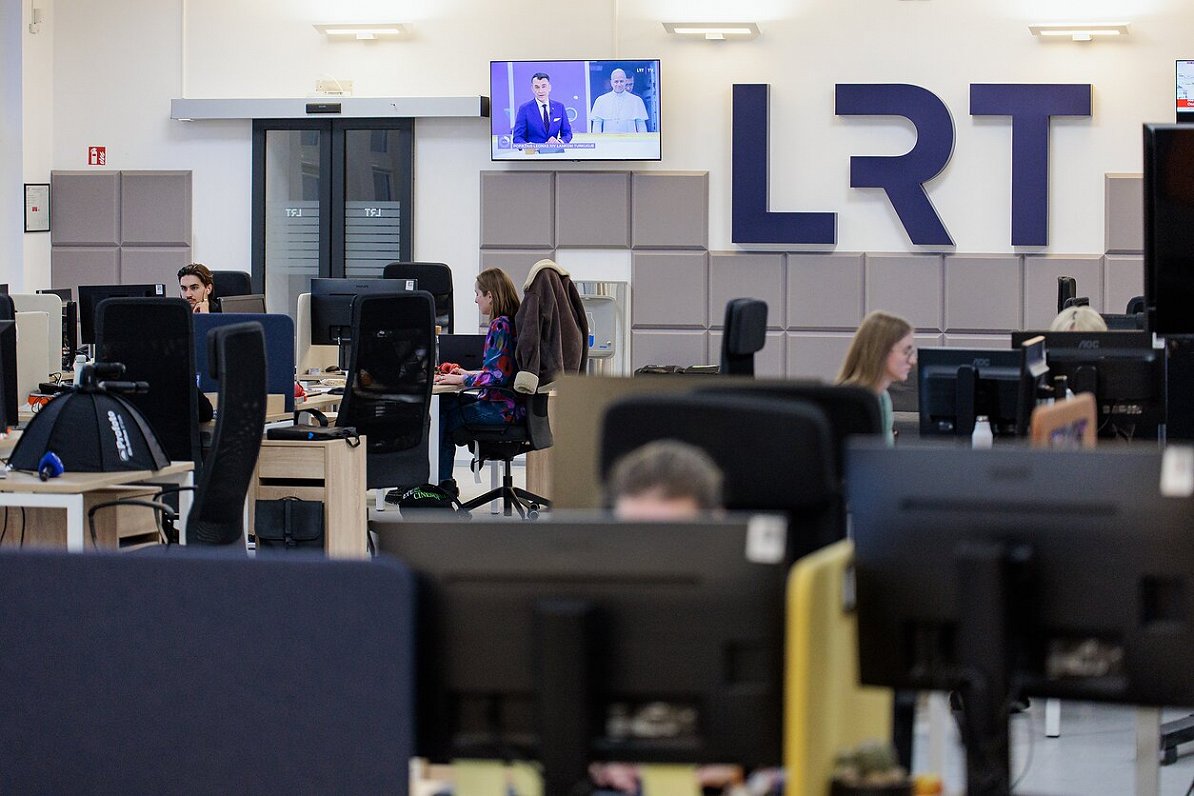
LRT is the Lithuanian equivalent of LSM in Latvia, and also operates an English-language service, with which LSM frequently exchanges stories and information (as is also the case with ERR in Estonia). We have always found LRT to have the highest journalistic standards and to be completely impartial, so we feel it is worth drawing attention to their concerns.
Journalists in Vilnius have now set up a committee comprising members of both commercial and public service media, as well as groups representing civil society. Journalists at LRT will protest by holding a moment of silence during broadcasts, while members of the public, as well as media workers and organisations representing them, will hold a rally outside the parliament in Vilnius on December 9.
”Make no mistake, this is not just about LRT. The suppression of free speech has begun – it will not stop unless we act now,” said Birutė Davidonytė, chair of the Association of Professional Journalists speaking on December 1st.
The protest was prompted when a group of lawmakers, led by Remigijus Žemaitaitis, leader of the populist Nemunas Dawn party, registered legal amendments on November 24th that simplified the procedure for dismissing the director general of LRT.
If the amendments are adopted, politicians will be able to easily replace the leadership of the public broadcaster, threatening its editorial independence, journalists and international media watchdogs say.
“This is a public broadcaster, not a party broadcaster,” Rolandas Barysas, editor-in-chief of the leading Verslo Žinios business daily, told reporters.
The proposal quickly gained approval in the parliament, which is now moving to pass the bill under an expedited procedure.
The parliament’s legal department previously said that the bill may also contradict the “Constitutional Court’s doctrine” on media independence and also run counter to the European Media Freedom Act. Members of the public have also spoken out against the changes – around 100,000 people in Lithuania signed a petition calling on the parliament to reconsider.
On November 27th, the parliament also approved another proposal led by Žemaitaitis, head of the Nemunas Dawn party, which froze the LRT budget for three years.
“LRT is not a perfect organisation – an audit by the State Audit Office outlined the needed changes,” said Barysas of Verslo Žinios. “There could also be a broader discussion about LRT’s funding model, but that does not mean we should completely suspend funding.”
Žemaitaitis previously outlined his wish to tackle the country’s public broadcaster. His party passed a resolution on November 8, saying that “the biggest threat to society” stemmed from the political opposition and the media – perhaps a surprising claim given the proximity of Russia and Belarus.
According to Liepa Želnienė, a journalist at LRT, Žemaitaitis previously told her that “LRT is finished”.
Politicians are now engaged in a campaign against media workers, which includes public slandering of journalists and calling for them “to be dealt with”, according to Edvardas Kubilius, a journalist at LRT.
“We see obvious attempts to pit LRT against the public,” he told reporters at the December 1st press conference.
“I have been working at LRT for 15 years and would never have thought that I would be signing a petition, that I would be one of those speaking out in support of journalists protesting against something, but we are in a situation where we cannot do our job,” Kubilius said.
Select text and press Ctrl+Enter to send a suggested correction to the editor
Select text and press Report a mistake to send a suggested correction to the editor
Tell us about a mistake