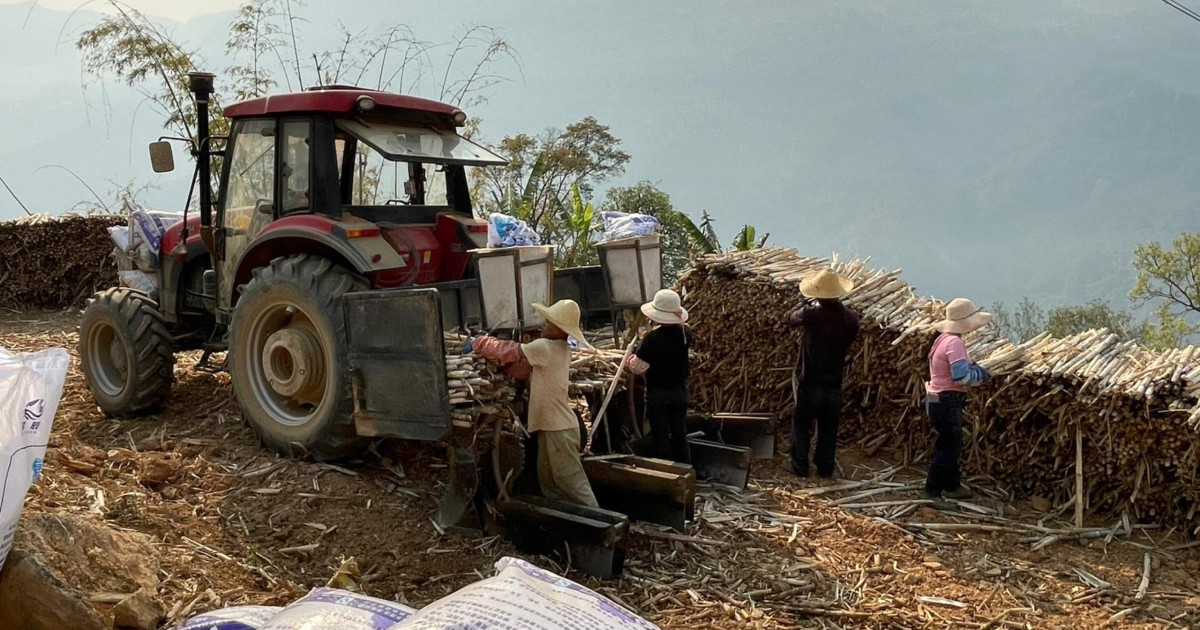
It seems regardless of how they arrived there or where they come from, the work of Myanmar migrants in Yunnan revolves around sugarcane. But not all of them look to settle there.
In another village, we met a group of men who only come to work for a short time during the sugarcane cutting season. They were all from Magway Region, located in the central Dry Zone of Myanmar. There were four or five of them. We had the chance to talk to them on the side of the road next to the field where they were working. From the road, we could see the place where Mai Yai and his group were working to cover the fields with special plastic, not too far from a big sugar mill.
Yunnan is one of the key large-scale sugarcane production hubs in China, primarily through a household-based system. Due to a dramatic decline in sugarcane production since the early 2010s, both the Chinese state and Chinese companies have deployed several strategies to improve the scale of production. This has included taking control of suitable land across the border in Myanmar, where there is a readily accessible pool of labour. The harvested sugarcane is then transported back to the Chinese side of the border to be processed further in sugar mills.
This arrangement has been operationalized under the opium substitution programme between the Yunnan provincial government and ethnic armed organisations along the border. For example, in 2009, a Public Announcement of Chinese Import Quotas from Opium Substitution Projects in Shan State formalized this arrangement. At the same time, Yunnan’s household-based farming sector, impacted by the ‘hollowing out’ of its villages, began to depend heavily on migrant labour from Myanmar, thereby helping to sustain the sugarcane industry.
We met the Magway group in February 2024. Unlike others we had spoken with, they were not planning on staying in China. “We will go back in April,” Mai Yai from their group told me. Mai Yai is about 36 years old. He is of the Ta’ang ethnic group from northern Shan State. His family still owns a tea plantation in their hometown. His wife is from Magway Region. It seems that Mai Yai followed her to her home area, Magway, after they got married.
They had all left their homes in Magway and travelled together to a city on the Myanmar side near the border in March 2023. There, while still on the Myanmar side, they worked at cutting sugarcane in the fields in the surrounding area. “We first worked there. It’s only been about two months since we have been here in Yunnan. There, we cut sugarcane. The boss on the Myanmar side and the boss on the China side are the same person,” Mai Yai explained.
The original connection goes back to their home village. “Our group leader and our villagers have contact, so we came. We went by car from Magway to the border. The fare was 70,000 Kyats [about 23 euro] per person. To pass through checkpoints, we needed letters of recommendation from the ward and police station, our ID cards and Covid vaccination papers. When we left our homes, Magway was peaceful, but we don’t know about the current situation. We will go back in April.”
Mai Yai compared the wages he earned cutting sugarcane on the Myanmar side with the wages they earn on the China side.
“Here, we have to cover the ground with plastic, spray insecticide and add fertilizer. The daily wage is only 100 Yuan [about 12 euro]. When we worked on the Myanmar side, we had to pay the group leader 0.5 Yuan per bundle of sugarcane. One bundle has about 20 stalks of sugarcane. We could earn up to 210-250 Yuan [25-30 euro] per day.” But Mai Yai added that the group leaders get daily wages from the regular workers who can cut up to 50-70 bundles a day. This means that the group leader earns 25-35 Yuan [3-4 euro] a day just from Mai Yai alone.
While working, the migrant workers have daily contact with their family members through Viber or Facebook. They transfer money to their families through the hundi system. I continued listening to Mai Yai’s stories about their daily lives.
“We work from 7 a.m. to around 11:30 a.m. Then we take an hour-and-a-half break. We start working again at 1 p.m. and work until 5 p.m. Our boss buys food for us, and we pay him back later. There are many people who want to come here, but the border gate is still closed, right?”
He paused for a moment before continuing. “We have been coming to work like this for the past two years. But we only come during the sugarcane cutting season. When the season is over, we go back to our homes. We are used to coming to work like this. When the season comes, we contact the person who is a group leader.” Then those who want to cut sugarcane gather and prepare to go as a group, I imagined in my mind.
Those who come to work legally have to go through a series of paperwork. They have to get a border crossing permit, translate their ID card into Chinese, and get a health certificate. Finally, they get a temporary border pass (which they call a ‘red book’). These are all expenses that the workers themselves must pay for. Some bosses pay in advance, and the workers have to pay them back later.
The routineness of this life is remarkable. It has even become a normal practice for their boss to keep their red books and national ID cards, we learned. In some places, the companies that hire workers also keep the Myanmar-China border crossing permits (‘red books’) and national ID cards. They are worried that the migrant workers will not work well for the bosses. Another concern of the bosses is that the workers will run away. The bosses often keep the migrant workers’ red books and ID cards as another excuse, saying that the workers came legally and they can show their documents to the police.
Some migrant workers find a job in restaurants, car washes, noodle shops and shoe factories, but most of them work as sugarcane cutters. The fact that workers have to pay a daily 10 Yuan to the group leader has also become a fixed routine for them. Listening to them explain their situation to me, I can’t decide whether they consider it as exploitation or not. They come here to work hard to save money for their families. And for some of them, it’s not because they don’t have land to farm in their area in Myanmar. Some of them own a plot of land. But perhaps the land is not enough to make a good living or the quality of their land is not so good, or as one of them said, “We have our own land, but the weather is not good for growing plants.”
I am truly worried whether they can return home safely in April as they hoped because of the difficult political situation and the fighting in Myanmar. The conditions are very grave.